


Some error occured while loading the Quick View. Please close the Quick View and try reloading the page.
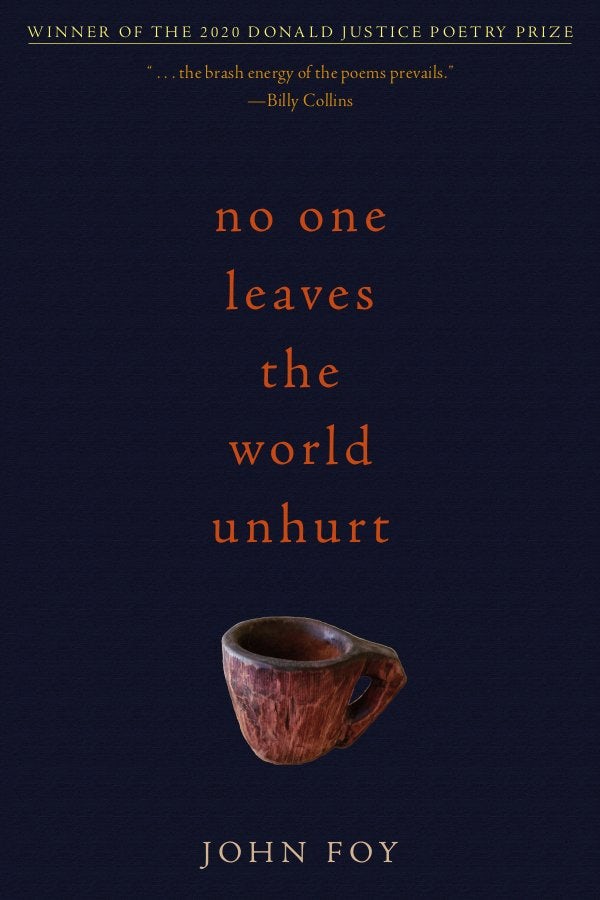


"No One Leaves the World Unhurt serves brilliantly as both apt title and sage reminder, it’s equally impossible to leave John Foy’s new book without also feeling amused, enlightened, and deeply moved." —Alabama Literary Review
"Foy’s subject is pain… cage the demons in rhyme and meter—rise above suffering to the formal speaking of suffering—and we can carry on." —The Hudson Review
"Taking aggressive advantage of the imaginative freedom that poetry offers, Foy breaks into some frightening places here, including the brutality of war, the terrors of the future, his own dead body, and the “cracked house of his mind.” This edginess is skillfully balanced by Foy’s formalist aptitudes, with inventive rhyming and sonnet skills on inconspicuous display. Still, the brash energy of the poems prevails. If some of them could drive themselves down Main Street, they would turn a lot of heads." —Billy Collins, author of The Rain in Portugal
"This accomplished and lively collection trains anthropological high-beams on contemporary America’s frequently absurd patterns of thought and behavior. Foy’s poems are by turns witty and affecting: gravity is leavened by playfulness; humorous forays ride on serious undercurrents. Like Robert Frost, Foy can compose traditionally formal poems without losing or even fraying natural thought threads. He also deftly incorporates the lexicon of economics into his meditations on grief, sex, Barbie dolls, and Atlas 'shouldering the heavens like a man / with a second mortgage and child support to pay.' At last, here is a voice that tells the truth in such a way that we want to keep on listening." —J. Allyn Rosser, author of Mimi’s Trapeze
"I find two things conspicuously missing in contemporary poetry. One is the quality that Keats called 'negative capability,' projecting the self into the minds and hearts of those who are different from the poet, perhaps even uncongenial to him. The other is the old-fashioned 'metaphysical' conceit, in which an everyday object becomes a controlling metaphor for the poem, and even the poet’s choice of form becomes the vehicle of meaning. Take it from me; John Foy possesses both." —R. S. Gwynn, author of No Word of Farewell