


Some error occured while loading the Quick View. Please close the Quick View and try reloading the page.
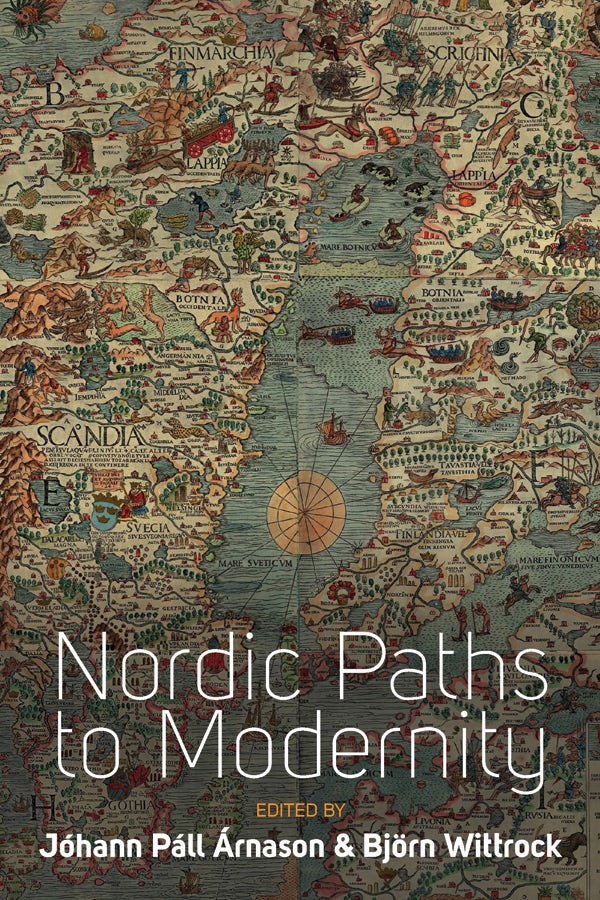
Within the growing attention to the diverse forms and trajectories of modern societies, the Nordic countries are now widely seen as a distinctive and instructive case. While discussions have centred on the ‘Nordic model’ of the welfare state and its record of adaptation to the changing global environment of the late twentieth century, this volume’s focus goes beyond these themes. The guiding principle here is that a long-term historical-sociological perspective is needed to make sense of the Nordic paths to modernity; of their significant but not complete convergence in patterns, which for some time were perceived as aspects of a model to be emulated in other settings; and of the specific features that still set the five countries in question (Denmark, Sweden, Norway, Finland and Iceland) apart from one another. The contributors explore transformative processes, above all the change from an absolutistmilitary state to a democratic one with its welfarist phase, as well as the crucial experiences that will have significant implications on future developments.


“…the articles, taken together, provide an exciting picture of the diversity that is unified in the Nordic region… [and] a significant contribution to the discussion of multiple modernities.” · Scandinavian-Canadian Studies/Études scandinaves au Canada
“The contributors to this volume are supremely well-qualified to explore these themes; most of them have spent long and distinguished careers researching these or similar questions…As one might expect, the book impresses above all with the weight of scholarship displayed here.” · H-Soz-u-Kult
“…the chapters are lucidly composed, and consequently pleasant to read…The introduction by the editors is very fine indeed…I find something compellingly interesting everywhere in the text. The combination of theory, conception and fact is quite gracefully handled. No heavy-footed jargon here.” · Sheldon Rothblatt, University of California, Berkeley
Jóhann Páll Árnason is Emeritus Professor of Sociology at La Trobe University, Melbourne, and Visiting Professor at Charles University, Prague. His research interests focus on comparative historical sociology, with particular emphasis on the comparative sociology of civilizations. Recent publications include: Civilizations in Dispute: Historical Questions and Theoretical Traditions (Brill 2003); Axial Civilizations and World History (co-editor, Brill 2005); and The Roman Empire in Context: Historical and Comparative Perspectives (co-editor, Blackwell 2010).
Acknowledgements
Introduction
Jóhann Páll ÁrnasonandBjörn Wittrock
Chapter 1. Nordic Modernity: Origins, Trajectories, Perspective
Bo Stråth
Chapter 2. The Danish Path to Modernity
Uffe Østergård
Chapter 3. Denmark 1740-1940: A Centralised Cultural Community
Niels Kayser Nielsen
Chapter 4. The Making of Sweden
Björn Wittrock
Chapter 5. History, Ethics and the Path to Modernity in Pre-Revolutionary Sweden
Peter Hallberg
Chapter 6. Shifting Knowledge Regimes: The Metamorphoses of Norwegian Reformism
Rune Slagstad
Chapter 7. Alternative Processes of Modernization?
Gunnar Skirbekk
Chapter 8. Nordic Modernity and Finnish Modernity: Similarities and Differences
Risto Alapuro
Chapter 9. The Finnish Grand Duchy and the Paradoxes of the Finnish Political Culture
Henrik Stenius
Chapter 10. Icelandic Anomalies
Jóhann Páll Árnason
Chapter 11. ‘The Time Will Come’: Icelandic Modernity and the Role of Nationalism
Guðmundur Hálfdanarson
Notes on Contributors