


Some error occured while loading the Quick View. Please close the Quick View and try reloading the page.
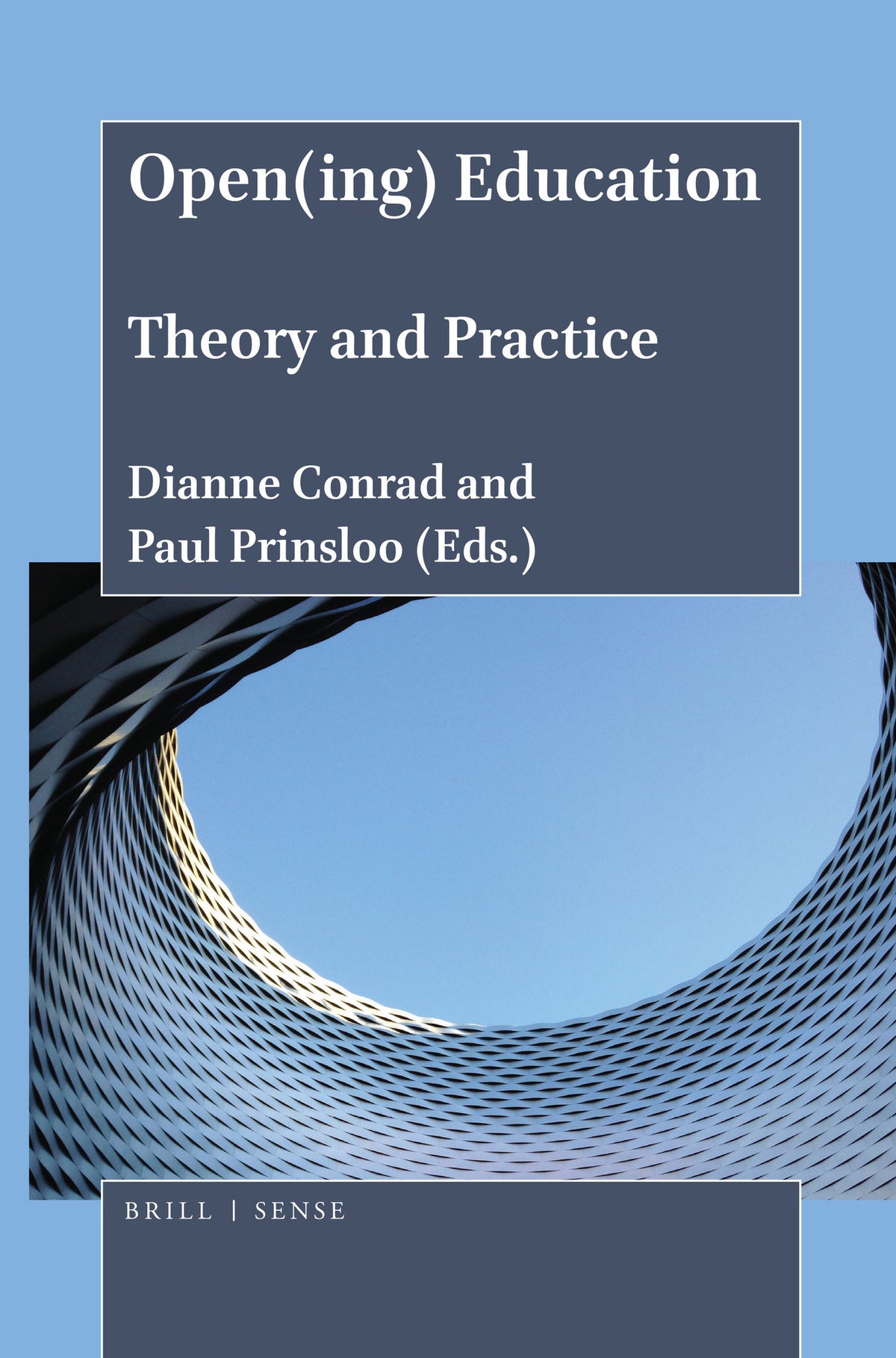
There is no shortage of scholarly research that reflects the growing importance of open education, whether referring to issues surrounding access to education (formal, informal or postformal); different copyright licencing regimes (e.g. Creative Commons); alternative forms of educational delivery such as Massive Open Online Courses (MOOCs), or alternative pathways to learning, curriculum development and delivery and/or assessing and accrediting learning. So what can another publication add to our understanding of open education?
It has become clear that thinking in terms of the binaries of ‘open’ versus ‘closed’ can no longer account and do justice to the wide range of possibilities and the varying factors that destabilise some definitions and practices. In Open(ing) Education: Theory and Practice, the authors therefore map ‘open’ as emerging from a dynamic network or ecology of often mutually constitutive factors resulting in a range of possibilities. The chapters in this book provide us with glimpses of open, opening, and opened, with none of these being permanent states of affairs, but rather contingent, serendipitous, often uncertain, and fluid.
This book is unique not only with regard to its variety of approaches to mapping the various possibilities between open and closed but also with regard to the global spread of its many contributing authors.
It has become clear that thinking in terms of the binaries of ‘open’ versus ‘closed’ can no longer account and do justice to the wide range of possibilities and the varying factors that destabilise some definitions and practices. In Open(ing) Education: Theory and Practice, the authors therefore map ‘open’ as emerging from a dynamic network or ecology of often mutually constitutive factors resulting in a range of possibilities. The chapters in this book provide us with glimpses of open, opening, and opened, with none of these being permanent states of affairs, but rather contingent, serendipitous, often uncertain, and fluid.
This book is unique not only with regard to its variety of approaches to mapping the various possibilities between open and closed but also with regard to the global spread of its many contributing authors.

Price: $173.00
Pages: 400
Publisher: Brill
Imprint: Brill
Publication Date:
January 30, 2020
ISBN: 9789004422971
Format: Hardcover

"The book offers both foundational considerations for open education and practical applications through case studies on topics such as
networks, systems thinking, power, and access. It may be most appropriate for upper-level undergraduates and graduate students, as well as
educational practitioners and researchers interested in understanding complex educational systems".
E. M. Johns, im CHOICE, 58 (7), 2021.
E. M. Johns, im CHOICE, 58 (7), 2021.
Dianne Conrad, PhD, is an adult, online and distance educator who continues to write and teach in retirement. She has published extensively and serves on many editorial boards. She recently co-authored Assessment Strategies for Online Learning: Engagement and Authenticity.
Paul Prinsloo is a Research Professor in Open and Distance Learning at the University of South Africa. He holds a DLitt and Phil and has published widely in books and journals. He keynotes globally and researches in the areas of learning analytics, student success and retention and postgraduate identities and supervision.
Paul Prinsloo is a Research Professor in Open and Distance Learning at the University of South Africa. He holds a DLitt and Phil and has published widely in books and journals. He keynotes globally and researches in the areas of learning analytics, student success and retention and postgraduate identities and supervision.