


Some error occured while loading the Quick View. Please close the Quick View and try reloading the page.
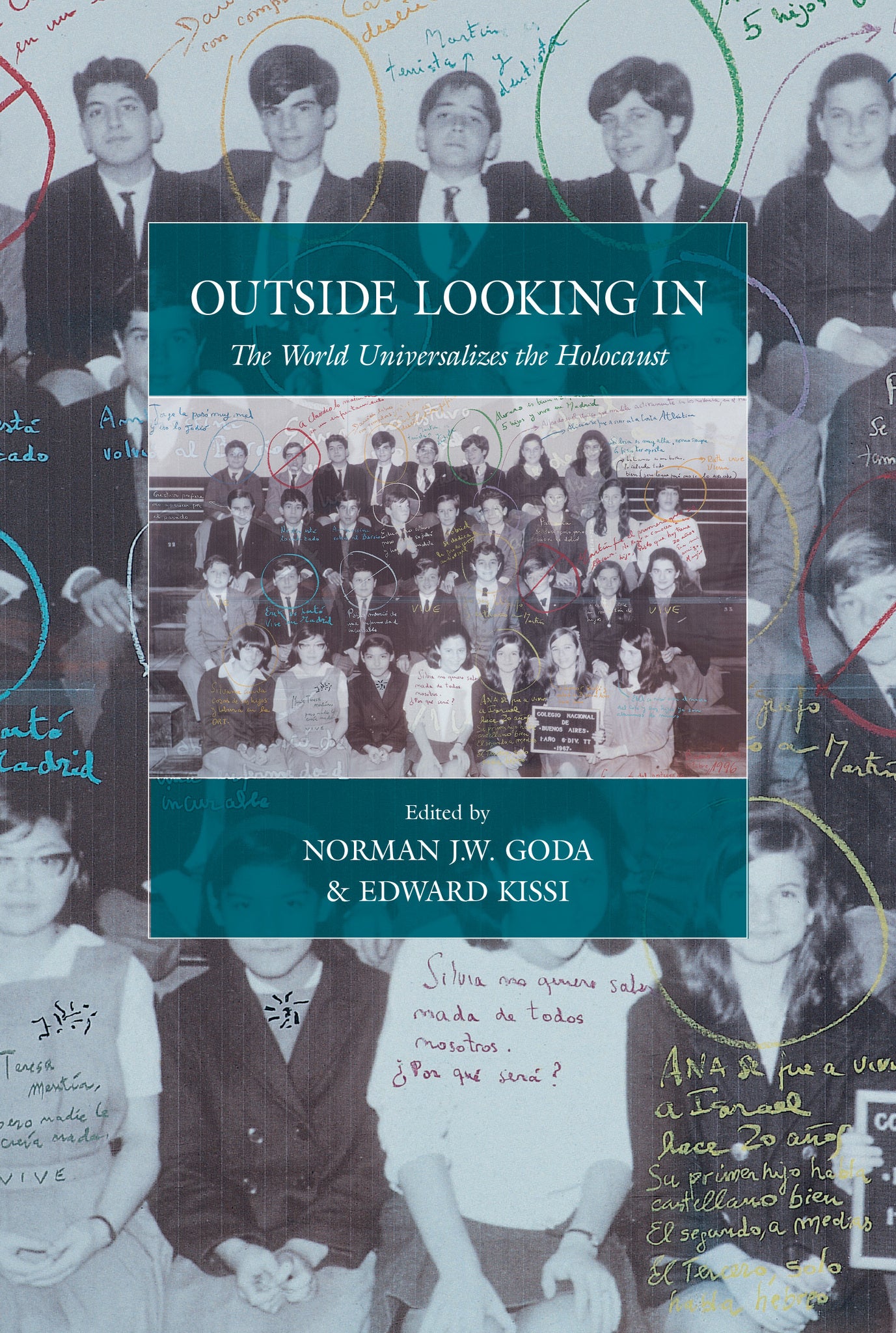
The question of how to conceive of the Holocaust within a wider, historical framework remains contentious. For some, it is a universal catastrophe that provides a blueprint for understanding comparable instances of targeted violence, while for others its particularity precludes any comparison with other genocides. Outside Looking In provides a fresh reassessment of the problem of Holocaust universalization, highlighting how the legacy of the Holocaust is transmitted across a variety of global cultural contexts. Ranging from the representation of the Holocaust in literature and film, to how its implications inform the work of politicians and legal theorists, this volume spotlights how foundational the Holocaust is to our global social and imaginative outlook.


"This is a fascinating and extremely timely edited volume from a diverse group of scholars who tackle intriguing topics, situated across the globe, with aplomb. I particularly appreciate that the editors have assembled pieces that both examine the global development of Holocaust universalization (Part I) as well as texts that focus on the limits of this universalization and its critics (Part II). This integrated and thoughtful approach is among the volume's great strengths." • Katrin Paehler, Illinois State University
“Taken together, most of the contributions to this volume offer a much-needed expansion of our knowledge of how the memory of the Holocaust has been universalized in particular settings. In addition to exploring Holocaust remembrance in places that have received little to no attention from scholars, overall the volume undermines simplistic characterizations of Holocaust memory as, at best, uncomplicated and, much worse, as a tool of past and ongoing oppression.” • Steven P. Remy, Brooklyn College
Norman J.W. Goda is the Norman and Irma Braman Professor of Holocaust Studies at the University of Florida. His books include The Holocaust: Europe, the World, and the Jews, 1918-1945 (Routledge 2022); Tales from Spandau: Nazi Criminals and the Cold War (Cambridge University Press 2006), and Tomorrow the World: Hitler, Northwest Africa, and the Path toward America (Texas A&M University Press 1998).
List of Figures
Introduction
Norman J.W. Goda and Edward Kissi
Part I. Holocaust Universalization in Real Time
Chapter 1. Universalizing the Holocaust in West and East Africa
Edward Kissi
Chapter 2. Biafra: State-Building, the Holocaust, and International Diplomacy
Charlotte Kiechel
Chapter 3. Mauritania and the “Events” of 1989: Why Victims Referenced the Holocaust
Sidi N’Diaye
Chapter 4. Local, Transnational, Universal: Changing Uses of Holocaust Memory Through the Visits of Jaika Grossman to Argentina, 1963-1985
Emmanuel Kahan
Chapter 5. Universalizing the Holocaust in Argentine Jewish Art
Tamara Kohn
Part II. The Limits of Holocaust Universalization
Chapter 6. The Perils of Framing the Indian Partition through the Holocaust
Anjali Gera Roy
Chapter 7. The Rise and Fall of Jews as Christ Figures in Postwar Christian Theology: A Case of Universalizing the Holocaust?
Jonathan Elukin
Chapter 8. Crimes against Humanity in French Law and Culture from Nuremberg to Barbie: The Law, the Holocaust, and the Limits of Universalization
Norman J.W. Goda
Chapter 9. “Jerusalem or Babylon?”: Israel and the Universalization of Holocaust Memory during the 1980s
Tom Eshed
Chapter 10. “Holocaust it Down”: Universalizing the Holocaust in American Film Comedies
Nathan Abrams and Michael Lipiner
Conclusion: It’s Been Universal All Along: The Holocaust’s Global Contexts
Doris L. Bergen
Index