


Some error occured while loading the Quick View. Please close the Quick View and try reloading the page.
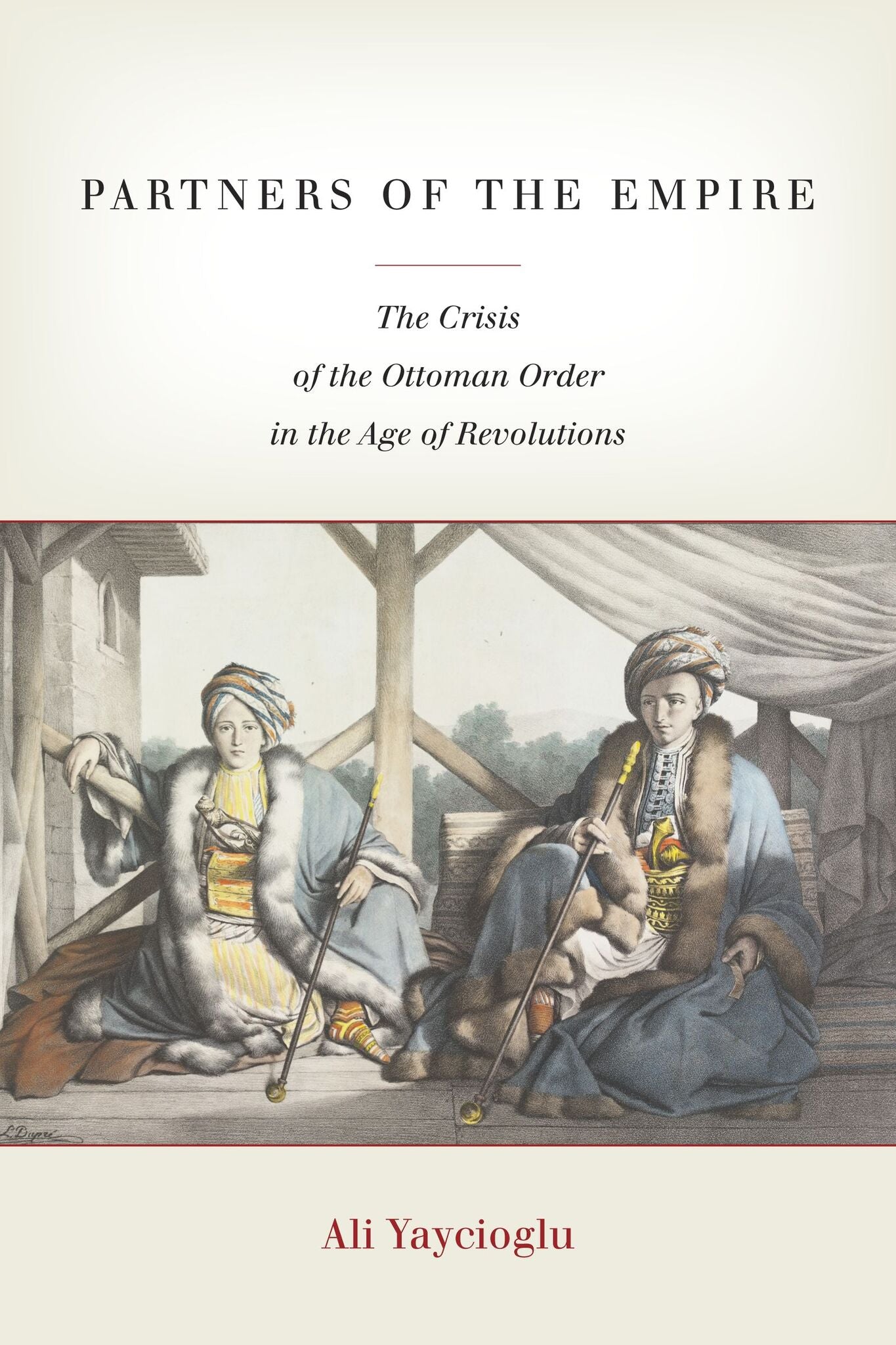
Partners of the Empire offers a radical rethinking of the Ottoman Empire in the eighteenth and early nineteenth centuries. Over this unstable period, the Ottoman Empire faced political crises, institutional shakeups, and popular insurrections. It responded through various reform options and settlements. New institutional configurations emerged; constitutional texts were codified—and annulled. The empire became a political theater where different actors struggled, collaborated, and competed on conflicting agendas and opposing interests.
This book takes a holistic look at the era, interested not simply in central reforms or in regional developments, but in their interactions. Drawing on original archival sources, Ali Yaycioglu uncovers the patterns of political action—the making and unmaking of coalitions, forms of building and losing power, and expressions of public opinion. Countering common assumptions, he shows that the Ottoman transformation in the Age of Revolutions was not a linear transition from the old order to the new, from decentralized state to centralized, from Eastern to Western institutions, or from pre-modern to modern. Rather, it was a condensed period of transformation that counted many crossing paths, as well as dead-ends, all of which offered a rich repertoire of governing possibilities to be followed, reinterpreted, or ultimately forgotten.


— Molly Greene
"Ali Yaycioglu skillfully weaves a complex narrative of the 18th-century Ottoman political landscape, illuminating the struggles as well as the coalitions between various social groups. His compelling account should be required reading not only for those interested in the history of the Ottoman Empire, the Balkans, and the Middle East, but in global history as well."
— Şevket Pamuk, Boğaziçi University
"This book not only fills the arguably single most important gap in early modern Middle Eastern history by providing a cohesive narrative for the eighteenth century in the Ottoman Empire, but it also teaches a lesson about how to write world history by centering the focus of analysis outside the West. Ali Yaycioglu's work offers the most conclusive corrective to the still often-heard argument that representative institutions are a foreign import to the Middle East."
— Baki Tezcan, University of California
"In its use of archival sources and its conceptual framework, Partners of the Empire embodies superb scholarship. It speaks to fundamental questions—popular sovereignty and the commensurability of European political developments. The emphasis on the Ottoman figure—the provincial ayan—and his imagined "partnership" in the empire is a significant contribution to our knowledge. At last, we now have a detailed exploration of their world."
— Adam Mestyan
"Partners of the Empire is a superb piece of scholarship and its author, Ali Yaycıolu, makes compelling arguments. Not only does he incorporate large amounts of secondary-source literature—including Turkish- language scholarship that is sometimes overlooked by Ottoman historians in the Anglophone world—but also seamlessly integrates his own (massive amount of) primary-source research into the rather vast and disparate literature that deals with the late eighteenth and early nineteenth centuries."
— Harun Kk
"[A]s Yaycioglu has shown, the Ottoman Empire grappled with the very same problems that its European counterparts did and attempted to reform itself accordingly. And like those in the empires of those counterparts, some reforms worked and others did not. If, then, we are to understand the Age of Revolutions as a global phenomenon, which it most certainly was, Yaycioglu's study is an important intervention that compels us to reconsider revolution and reform in the Ottoman Empire as evidence that its crises of empire occurred in lockstep with similar crises that arose contemporaneously in the empires of its rivals and allies."
— Robert John Clines
The introduction of the book engages in a discussion on the growing historiography of the global age of revolutions and recent debates about the transformation of the Ottoman Empire in the eighteenth and early nineteenth centuries. It argues that the global context helps us to understand the transformation of the Ottoman Empire in a more comparative and connected fashion and at the same time the Ottoman experience helps us to see the global context in a more synchronic and less linear way.
This chapter offers a brief sketch of the Ottoman world in the eighteenth century and examines the New Order, a set of reform agendas proposed by the Ottoman imperial elite to bring military and fiscal crisis to an end. Some of these reform agendas threatened segments of society, particularly those who endorsed the political claims of the Janissaries. It argues that neither the New Order nor the opposition were monolithic groups, but large coalitions with branches in the provinces, diverse positions, and various interests.
This chapter discusses the nature of the relationship between the provincial elite and the empire in the late eighteenth/early nineteenth centuries. It argues that throughout the eighteenth century provincial notables came to act as fiscal, administrative, and military entrepreneurs who engaged in formal or informal contractual relations with the empire. These contractual relations were based on offers, acceptances, rejections, and counteroffers in a volatile arena, without the formal security of contract, status, property, and life. The process gradually produced a new order of notables: the empire was run by partnerships between central and provincial elites. Some provincial notables joined the coalition of the New Order, while others acted with the opposition
Chapter Three analyzes the ways in which provincial communities responded to changes in the eighteenth century. It argues that while the central administration was disconnected from the provinces and outsourced authority to provincial notables, provincial communities developed bottom-up mechanisms to manage fiscal and administrative matters under the supervision of elected or communally nominated notables. Instead of reversing this participatory and electoral process and launching a centralizing policy, the central administration institutionalized bottom-up collective actions. In the new provincial order, collective action became a source of legitimacy. Provincial communities were becoming political actors—sometimes with and sometimes at expense of notables—in governance.
This chapter shifts to a narrative history of the events that took place between August 1806 and November 1808. Stories from previous chapters converge in Chapter Four, highlighting popular opposition to the New Order led by the Janissaries, shifting coalitions between provincial and imperial elites, growing politicization of the communities, and the trans-imperial story of the Napoleonic wars and wartime diplomacy. A series of contingencies, shifting alliances, and dead-ends led to the eventual collapse of The New Order due to a Janissary led popular revolt in 1807, after which government was restored.
This chapter presents a textual analysis of the Deed of Alliance. Close reading of the text, combined with commentary, is followed by a discussion of the document's reception in modern history and its place among other constitutional texts from the Age of Revolutions. A political coalition formed between the elites of the New Order and a group of provincial notables for a coup d'état to restore the New Order. This coalition manifested itself in the Deed of Alliance, which envisioned a new imperial order based on partnership, security, stability (instead of volatility), and trust among elites. The Deed was a constitutional synthesis of the New Order and order of notables.
The conclusion provides a perspective on the nineteenth- and early twentieth-century transformation of the Ottoman order. It argues that the structural developments that appeared in the late eighteenth and early nineteenth centuries, namely fiscal-military and administrative reform, the development of negotiational relations between the central government and the provincial notables, and the increasing participation of the communities in governance shaped the transformation in modern times until the collapse of the Ottoman Empire and the formation of modern nation-states in the Balkans and the Middle East.