


Some error occured while loading the Quick View. Please close the Quick View and try reloading the page.
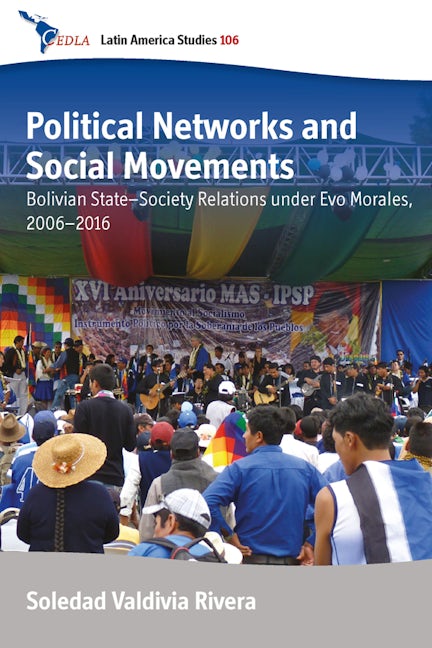
After a landslide electoral victory in 2006, Evo Morales became the first indigenous President of Bolivia. Morales’s stunning ascent was mirrored by the rising fortunes of his political party, the leftist Movimiento al Socialismo, which today continues to challenge the status quo in Bolivian politics and implement ambitious social reforms. This study examines how the state and social movements have impacted democratization in Bolivia, along with other sectors such as NGOs and the media. Soledad Valdivia Rivera’s analysis helps us to understand how the movement's relationships have come to transform the Bolivian political process as we know it.


“A sound piece of scholarship that is well-situated within the current literature on social movements. The book’s concept of network governance and its analysis of the Bolivian situation are informed and sound.” • Andrew Canessa, University of Essex
“Soledad Valdivia Rivera has written a rich and insightful study on a highly relevant topic for Bolivian politics (and beyond). In particular, the book demonstrates both extensive empirical work and a great passion for the subject and the case of Bolivia.” • Bettina Schorr, Freie Universität Berlin
Soledad Valdivia Rivera is a lecturer in modern history at the Latin American Studies Department at Leiden University. She also lectures in the university’s International Studies programme, based in The Hague. In 2009, she was awarded a grant by the Netherlands Organisation for Scientific Research (NWO) for her research.
List of Figures
Chapter 1. Social Movements, the State and Political Networks in the Construction of Democracy in Latin America
Chapter 2. Social Movements in the Neo-Liberal State: Evolution of the Social Movement into a Political Actor
Chapter 3. The ‘State-Society Interface’ and ‘Political Networks’: Social Movements and the Bolivian Constituent Process, 2006-2009
Chapter 4. ‘Political Networks’ in the Post-Constituent Period from 2010-2016
Chapter 5. Political Leadership and ‘Political Networks’
Conclusion
Reference List