


Some error occured while loading the Quick View. Please close the Quick View and try reloading the page.
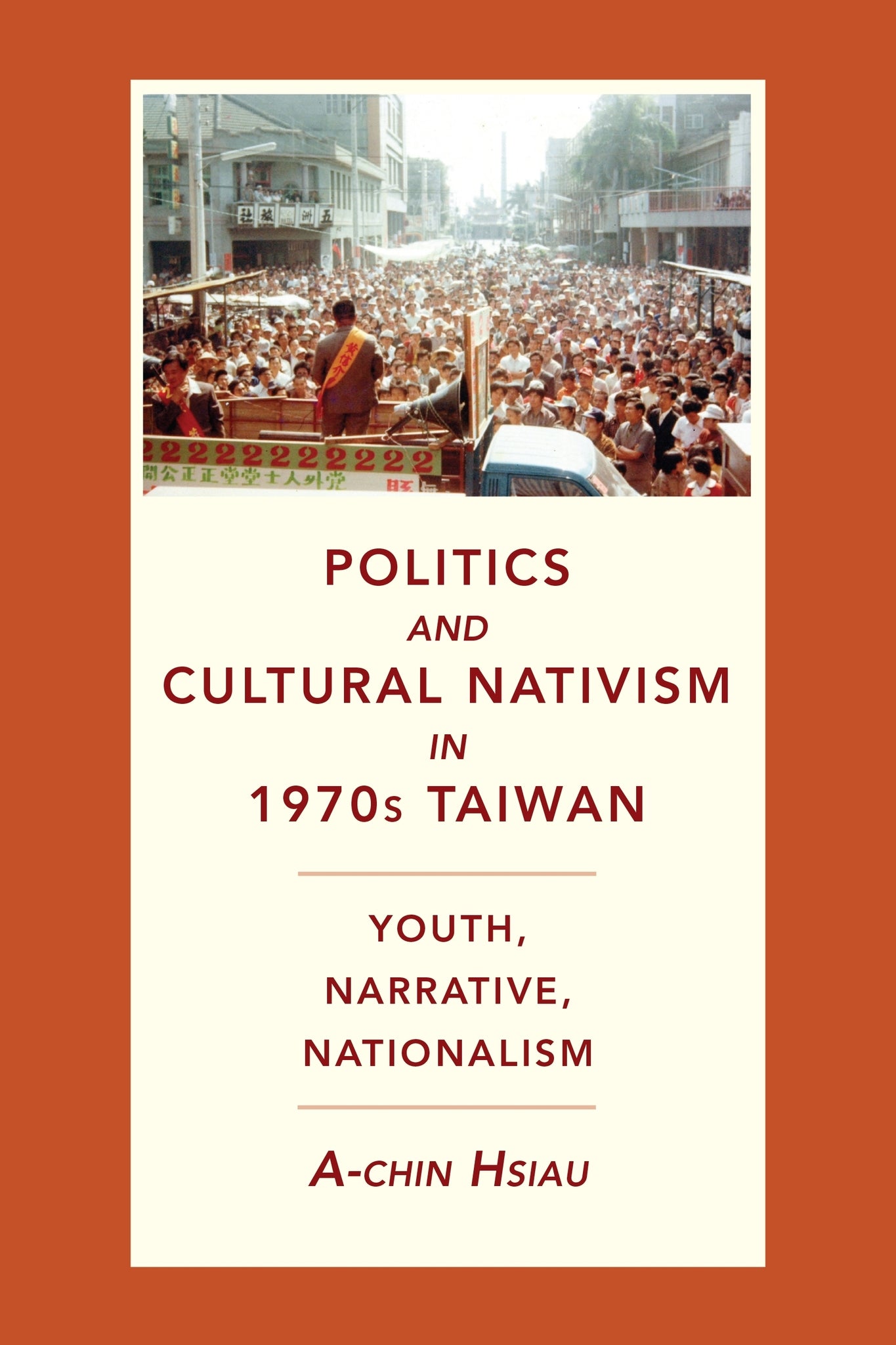
In the aftermath of 1949, Taiwan’s elites saw themselves as embodying China in exile both politically and culturally. The island—officially known as the Republic of China—was a temporary home to await the reconquest of the mainland. Taiwan, not the People’s Republic, represented China internationally until the early 1970s. Yet in recent decades Taiwan has increasingly come to see itself as a modern nation-state.
A-chin Hsiau traces the origins of Taiwanese national identity to the 1970s, when a surge of domestic dissent and youth activism transformed society, politics, and culture in ways that continue to be felt. After major diplomatic setbacks at the beginning of the 1970s posed a serious challenge to Kuomintang authoritarian rule, a younger generation without firsthand experience of life on the mainland began openly challenging the status quo. Hsiau examines how student activists, writers, and dissident researchers of Taiwanese anticolonial movements, despite accepting Chinese nationalist narratives, began to foreground Taiwan’s political and social past and present. Their activism, creative work, and historical explorations played pivotal roles in bringing to light and reshaping indigenous and national identities. In so doing, Hsiau contends, they laid the basis for Taiwanese nationalism and the eventual democratization of Taiwan.
Offering bracing new perspectives on nationalism, democratization, and identity in Taiwan, this book has significant implications spanning sociology, history, political science, and East Asian studies.


— Sung-sheng Yvonne Chang, author of Literary Culture in Taiwan: Martial Law to Market Law
Politics and Cultural Nativism in 1970s Taiwan explores an understudied period and adds nuance to the scholarly conversation about Taiwanese identity. Through detailed analysis, this book exposes how history has been rewritten to serve various identity construction efforts in Taiwan. It sheds new light on just how complicated and changeable identity can be.
— J. Megan Greene, author of The Origins of the Developmental State in Taiwan: Science Policy and the Quest for Modernization
In Politics and Cultural Nativism in 1970s Taiwan, A-chin Hsiau’s striking achievement is to demonstrate how committed activists who came of age during the era of martial law used indirect politics to pave the way for Taiwan’s later democratization. Hsiau shows compellingly how youth and its passions have the power to remake the world even amid political repression.
— Margaret Hillenbrand, author of Negative Exposures: Knowing What Not to Know in Contemporary China
Hsiau provides a sensible and nuanced interpretive account of how nativist discourse, cultural nationalism, and youth activism in 1970s Taiwan shaped its path toward democracy and thereby transformed global post–Cold War politics. This book is required reading for students and scholars of Asian and transregional studies.
— Ping-hui Liao, coeditor of Taiwan Under Japanese Colonial Rule, 1895-1945: History, Culture, Memory
A milestone of international Taiwan studies . . .With a solid scholarship, Hsiau has woven a convincing narrative of the power of ideas, and the moving saga of how Taiwanese youth's difficult search for their true selves should find wider resonance in present-day Taiwan, China, and beyond.
Good introductory reading for students of Taiwanese literature, culture, politics, and contemporary history.
A landmark piece of scholarship.
Relevant to sociology, history and Taiwan studies, but most of all to Chinese studies writ large . . . an important contribution to understanding China's rise in the international system, local societal reactions to Taiwan's global marginalization, and the apparently sudden emergence of Taiwanese nationalism in the 1970s.
Beyond the richness of the corpus and the finesse of the analyses, it is above all the theoretical approach adopted by the author that makes this publication essential in the field of Taiwan studies.
The focus on narrative makes this a valuable study of the creation of a usable past by continually altering memories of historical events and figures, and it allows Hsiau to take declarations of Chinese national identity by the return-to-reality generation at face value. He should be applauded for challenging essentialist and instrumentalist explanations and for highlighting the continued salience of Chinese identity.
Rich, detailed, and thoughtful.
Acknowledgments
Preface
Notes on Romanization and Translation
Introduction: Get Real
1. Generation and National Narration
2. Education, Exile, and Existentialism in the 1960s
3. The Rise of the Return-to-Reality Generation in the Early 1970s
4. The Rediscovery of Taiwan New Literature
5. The Reception of Nativist Literature
6. Dangwai Historiography
Conclusion: The Renarration of Identity
Glossary
Notes
Bibliography
Index