


Some error occured while loading the Quick View. Please close the Quick View and try reloading the page.
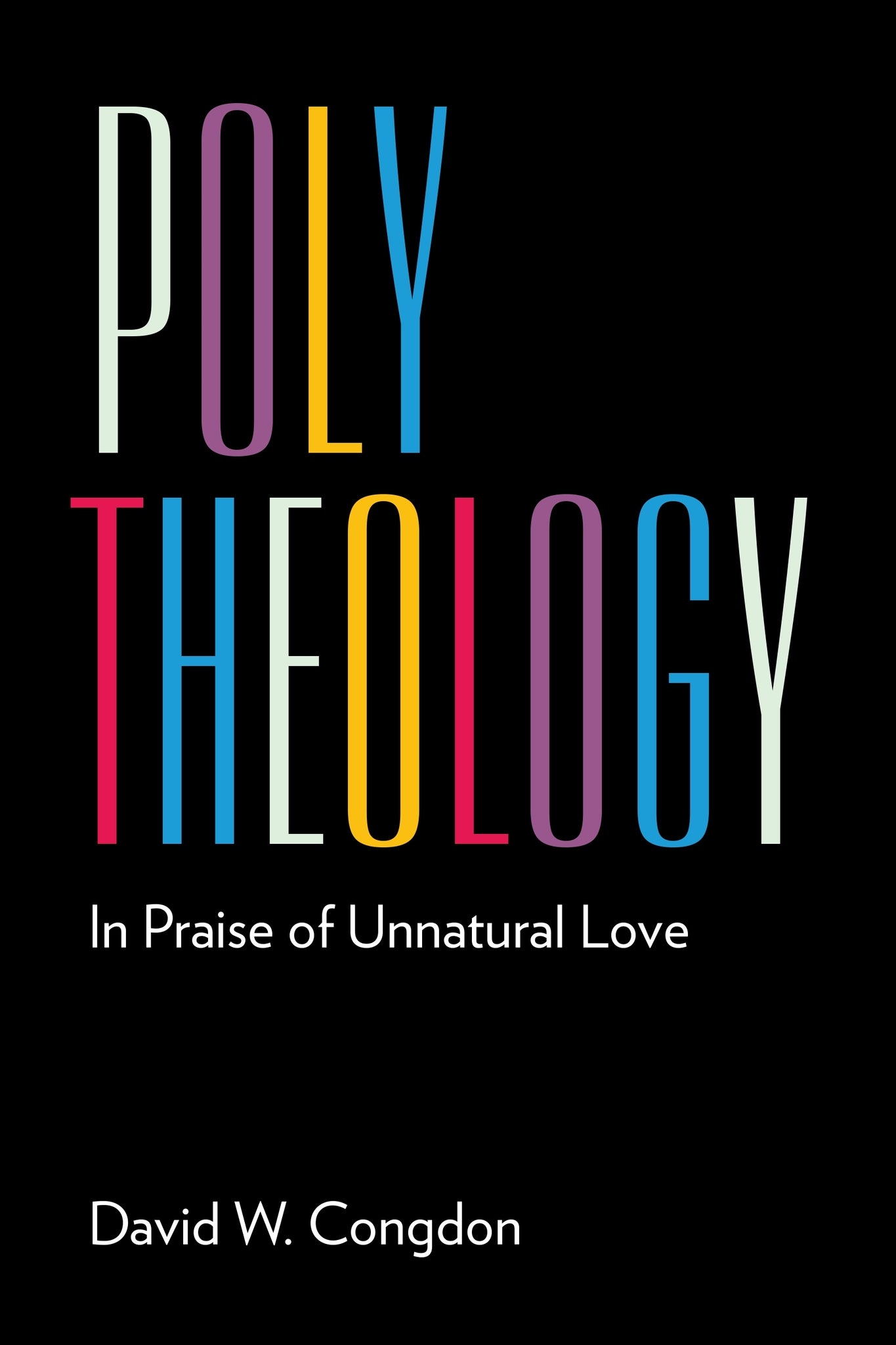
The first constructive theology of polyamory—and an invitation to embrace an unnatural, unrepressed Christianity.
Christianity and monogamy have been a match made in heaven, at least according to official church leaders. Theologians like Tertullian and Augustine argued for the normativity of monogamous marriage—a tradition that has remained firmly in place for centuries.
But monogamy is not just a religious idea. Many have even argued that monogamy is hardwired into human nature itself. More recently, some proponents of polyamory and ethical nonmonogamy have gone the opposite direction by arguing that monogamy is a myth and humans are naturally nonmonogamous. Both defenders of monogamy and advocates of nonmonogamy have sought to lay claim to the authority of nature to support their positions.
In Poly Theology, David W. Congdon points out how ironic it is that Christians—who claim to follow a man resurrected from the dead—have invested so much energy in conforming to what people regard as “natural.” Christianity is a deeply unnatural faith. Why should Christian ethics be any less unnatural? According to Congdon, the competitiveness and exclusivity associated with monogamy stand in uneasy tension with Christianity’s message of universally abundant grace, God’s noncompetitive transcendence, Christ’s two natures, and his ubiquitous sacramental presence.
Without excluding monogamy or making nonmonogamy normative, Congdon argues for a capacious and inclusive account of polyamory that makes space for all kinds of loves. Congdon challenges Christianity’s elevation of suffering and self-denial, arguing for a theology of pleasure and compersion in which another’s happiness does not compete with one’s own—but rather both flow from an original abundance.
Poly Theology is an invitation to a sex-positive, pleasure-positive vision of the Christian life.


David Congdon has written a courageous and intellectually rigorous invitation to rethink one of Christianity’s most unquestioned assumptions. Rather than asking whether monogamy or polyamory is morally superior, Poly Theology exposes the deeper theological problem of normativity itself. As someone whose work argues that faithfulness is discovered not in conformity to inherited relationship structures but in the daily practices of truth-telling, repair, mutual care, and presence, I found this book to be an important conversation partner. If contemporary monogamy has too often been shaped by settler colonial logics of possession, Protestant purity culture, and the politics of respectability, then Congdon reminds us that another theological imagination is possible. Faithfulness, after all, is not measured by the size of one’s relational network but by the countless small acts through which we become trustworthy to one another. This is not merely a book about polyamory. It is a book about refusing theological assimilation, making room for difference, and recovering love as an ethical practice of freedom rather than conformity. It is an important contribution to contemporary theology and to anyone seeking to imagine relationships beyond the confines of inherited normativity.---Rev. Roberto Che Espinoza, PhD, author of Activist Theology, and founder of Our Collective Becoming
David Congdon has written one of the most theologically consequential books on love to appear in decades. With exceptional scholarly rigor and remarkable courage, he challenges centuries of Christian orthodoxy rooted in “natural” law, compulsory monogamy, and patriarchal understandings of marriage—not by abandoning the Christian tradition, but by uncovering within it a more liberating, profoundly humane, and deeply coherent theological vision of love. Congdon demonstrates that many of Christianity's inherited assumptions about intimacy are historical constructions rather than theological necessities. This is a landmark contribution to contemporary theology and culture—one that deserves to be read far beyond the fields of Christian ethics and sexuality.---Jorge N. Ferrer, author of Love and Freedom: Transcending Monogamy and Polyamory
As someone who lost my vocation in the church for refusing to deny the truth of my own way of loving, I have been looking for a book like this for a long time. Poly Theology is not a book that asks the church to make room for polyamorous people out of tolerance or accommodation. It is a book that invites us to imagine that love itself may be more abundant, more expansive, and less possessive than we have been taught. It's an invitation to do the really necessary and overdue work of asking what theology is underpinning our relational ethics. Whether you are polyamorous, monogamous, questioning, or simply curious, this book opens a conversation that Christianity has avoided for far too long. I am grateful that Congdon has finally written it.---Kerlin Richter, poet, artist, spiritual director, sex educator, and former Episcopal priest
Congdon effectively interrogates the category of nature and shows why natural law is such a shaky basis for any sexual ethic. Less an apologia for polyamory per se and more a relativization of the dynamics that have rendered polyamory unthinkable for many Christians, his book seeks to make space for serious theological consideration of multiple models of love, in conversation with theologians including Augustine, Barth (who of course had his own unusual domestic situation), and Bultmann. Congdon's 'pleasure theology' is a bold offering, and this book is a fresh, serious and significant intervention in an often tired conversation on theology and sexuality.---Susannah Cornwall, Professor of Constructive Theologies, University of Exeter