


Some error occured while loading the Quick View. Please close the Quick View and try reloading the page.
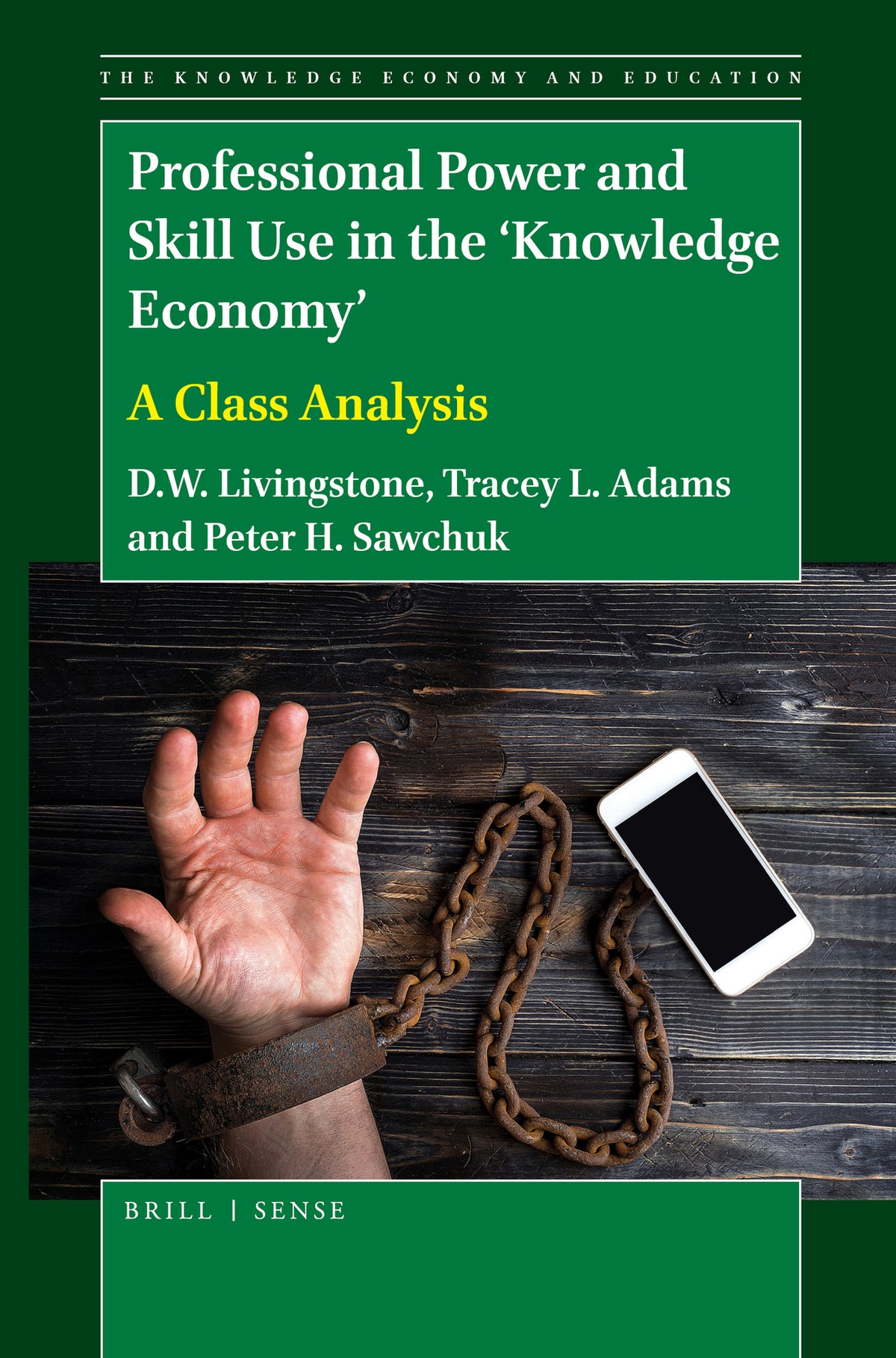
This is the first systematic analysis of the class structure of professionals. Their growing numbers, including mainly non-managerial professional employees as well as self-employed professionals, professional employers and professional managers, have been conflated in most prior studies. In this book, evidence comes from a unique series of large-scale surveys since the 1980s as well as recent comparative case studies of engineers and nurses. A primary focus is on issues of job control and skill utilization among these knowledge workers widely regarded as pivotal to the sustainability of knowledge economies. Professional employees in particular are found to face declining job control, diminishing use of their skills and increasing barriers to continuing learning. There are many original benchmarks here to serve as guides for further studies on professional classes, job design and training strategies in advanced capitalist economies.

Price: $179.00
Pages: 286
Publisher: Brill
Imprint: Brill
Publication Date:
30 April 2021
ISBN: 9789004463066
Format: Hardcover

"To call an occupation a 'profession' hides as much as it reveals. This landmark study of professions in general and two of the most important professions—engineering and nursing—shows that the vast majority of these knowledge-workers really are workers. Richly informed by statistics, surveys, and interviews, we see that while they need specialized knowledge and credentials, few of them work independently. Most are employees under management supervision. The resulting under-utilization of their expertise is fueling mounting class antagonism. Farewell to illusions of a 'professional-managerial class.'" – Paul S. Adler, Professor of Management and Organization, Sociology, and Environmental Studies at the University of Southern California and author of The 99 Percent Economy, and Technology and the Future of Work
"In this book, D.W. Livingstone's formidable research experience on work, education and economic change is brought to bear on the growth of professions. He and his colleagues, using both international statistics and close-focus studies of managers, engineers and nurses, give us a radical new perspective. They offer convincing proof of deep class divisions within professional worlds, and challenge the familiar rhetoric of the 'knowledge economy'. It's the kind of social science we need: carefully researched, deeply reasoned, and sharply relevant." – Raewyn Connell, Professor Emerita at the University of Sydney and author of The Good University and Southern Theory
"Essential reading for anyone interested in the future of work in the 'knowledge economy.' The book explodes common myths about the power and autonomy of professional employees, showing a loss of control long suffered by industrial workers. Bringing class analysis back, the authors’ documentation of professional proletarianization points to a new labor struggle protecting all workers and nourishing the collective intellect of 21st century societies." – Charles Derber, Professor of Sociology at Boston College and author of Professionals as Workers, Power in the Highest Degree, and Welcome to the Revolution
"This is a novel and important book. It reframes the study of professions, placing professional and expert workers across the unequal ranks of the highly skilled labor force on which the knowledge economy depends. This unprecedented empirical study confirms that the notion of a unified professional managerial class is as obsolete as the idyllic version of a community of professionals and it returns class analysis to its central theoretical place in the study of labor." – Magali Sarfatti Larson, Professor Emerita of Sociology,Temple University and author of The Rise of Professionalism
"In this book, D.W. Livingstone's formidable research experience on work, education and economic change is brought to bear on the growth of professions. He and his colleagues, using both international statistics and close-focus studies of managers, engineers and nurses, give us a radical new perspective. They offer convincing proof of deep class divisions within professional worlds, and challenge the familiar rhetoric of the 'knowledge economy'. It's the kind of social science we need: carefully researched, deeply reasoned, and sharply relevant." – Raewyn Connell, Professor Emerita at the University of Sydney and author of The Good University and Southern Theory
"Essential reading for anyone interested in the future of work in the 'knowledge economy.' The book explodes common myths about the power and autonomy of professional employees, showing a loss of control long suffered by industrial workers. Bringing class analysis back, the authors’ documentation of professional proletarianization points to a new labor struggle protecting all workers and nourishing the collective intellect of 21st century societies." – Charles Derber, Professor of Sociology at Boston College and author of Professionals as Workers, Power in the Highest Degree, and Welcome to the Revolution
"This is a novel and important book. It reframes the study of professions, placing professional and expert workers across the unequal ranks of the highly skilled labor force on which the knowledge economy depends. This unprecedented empirical study confirms that the notion of a unified professional managerial class is as obsolete as the idyllic version of a community of professionals and it returns class analysis to its central theoretical place in the study of labor." – Magali Sarfatti Larson, Professor Emerita of Sociology,Temple University and author of The Rise of Professionalism
D.W. Livingstone, Ph.D. (1971), Johns Hopkins University, is Past Canada Research Chair and Professor Emeritus at the University of Toronto. His books include The Education-Jobs Gap (1998), Education and Jobs (2009), and Lifelong Learning in Paid and Unpaid Work (2010).
Tracey L. Adams, Ph.D. (1997), University of Toronto, is Professor of Sociology at the University of Western Ontario. Her recent books include Regulating Professions (2018), and Gender, Age, and Inequality in the Professions (with M. Choroszewicz, 2019).
Peter H. Sawchuk, Ph.D. (2000), University of Toronto, is a Professor of Adult Education at the University of Toronto. His books include Contested Learning in Welfare Work (2014), and Emerging Approaches to Educational Research (2014).
Tracey L. Adams, Ph.D. (1997), University of Toronto, is Professor of Sociology at the University of Western Ontario. Her recent books include Regulating Professions (2018), and Gender, Age, and Inequality in the Professions (with M. Choroszewicz, 2019).
Peter H. Sawchuk, Ph.D. (2000), University of Toronto, is a Professor of Adult Education at the University of Toronto. His books include Contested Learning in Welfare Work (2014), and Emerging Approaches to Educational Research (2014).