


Some error occured while loading the Quick View. Please close the Quick View and try reloading the page.
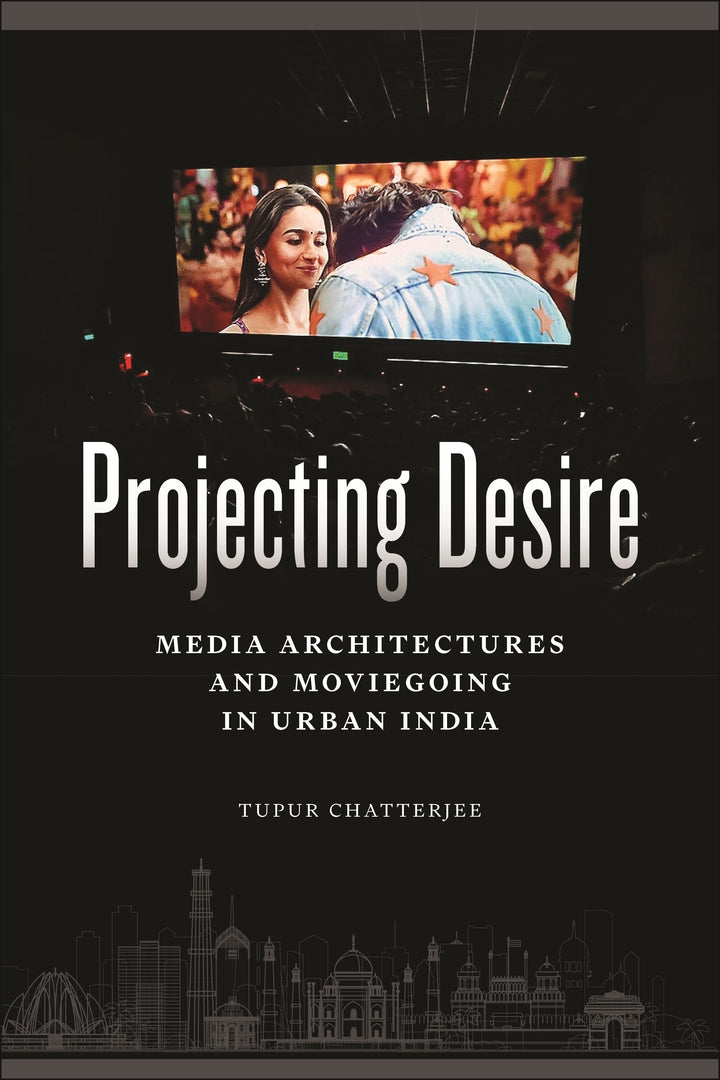
Winner, 2026 Best First Book Award, given by the Society of Cinema and Media Studies
How middle-class women transformed India’s screen and exhibition industries
Since the late 90s, multiplexes in India have almost always been located inside malls, rendering it impossible to inhabit one space without also inhabiting the other. Their prevalence coincides with a shift in the spectatorial imagination of India’s mass audience—spaces that, for several preceding decades, had been designed for the subaltern male, but are now built for the consuming, globalized middle-class woman. By catering to the mutable desires and anxieties of a rapidly expanding and heterogeneous middle class, the mall-multiplex has radically altered the politics of theatrical space and moviegoing.
Projecting Desire tells the story of this moment of historic transition as it played out across media industries, architecture and design, popular cinema, and public culture. Tupur Chatterjee highlights how the multiplex established a new link between media and architecture in the subcontinent, not only rewriting the relation between gender and urban space, but also changing the shapes of Indian cities.
Projecting Desire locates the post-globalization transformation of India’s screen and exhibition industries in a longer arc of ideas about urban planning and architecture, long mired in caste- and class-based gendered anxieties. It argues that the architectural mediations of India’s moviegoing cultures are key to imagining, planning, and policing the contemporary media city. Chatterjee integrates industrial and organizational ethnography, in-depth interviews, participant observation, discourse and textual analysis, and archival work with spatial and urban histories. Focusing on these new meccas of leisure and entertainment, Projecting Desire tracks the understudied nexus between new media architectures, cultures of public leisure, and popular cinema in the Global South.


"Among the finest books yet written on cinema and space. Combining historical and field research with political, social and urban theory, Tupur Chatterjee’s analysis is gripping from start to finish. A must-read for anyone interested in the cultural geographies of cinema."
"By situating the emergence of the multiplex theater in India in a broader history of previous media forms such as television and calling our attention to the material, aesthetic, and gendered dimensions of exhibition infrastructures, Tupur Chatterjee presents a compelling and insightful intermedial approach to understanding the contemporary transformations of India’s entertainment cultures."
"Intervenes in new cinema history and material cultural studies of film exhibition to assert gender as a critical framework for analyzing built environments and their influence on cinematic spectatorship. Taking New Delhi and the rise of the mall-multiplex as her case study, Tupur Chatterjee argues that the gender politics of cinema architecture and urban planning play a heretofore underappreciated role in viewer experience and the modern media city. Projecting Desire uses rigorous ethnographic and archival research as well as deft discourse and textual analysis to craft a forceful argument that will be of great interest to scholars working in media industry studies, global media studies, feminist media theory, and spectatorship studies."
"The book leaves readers with pivotal analyses of the fast-evolving economies of public leisure in India, conceiving the 'shopper-spectator' as a key discursive category. While evaluating the mulltiplex as its research object, it also provides a fresh take on spectatorial constitutions and tastes in India."