


Some error occured while loading the Quick View. Please close the Quick View and try reloading the page.
(sponsored by the Family School Community Partnership Issues SIG)
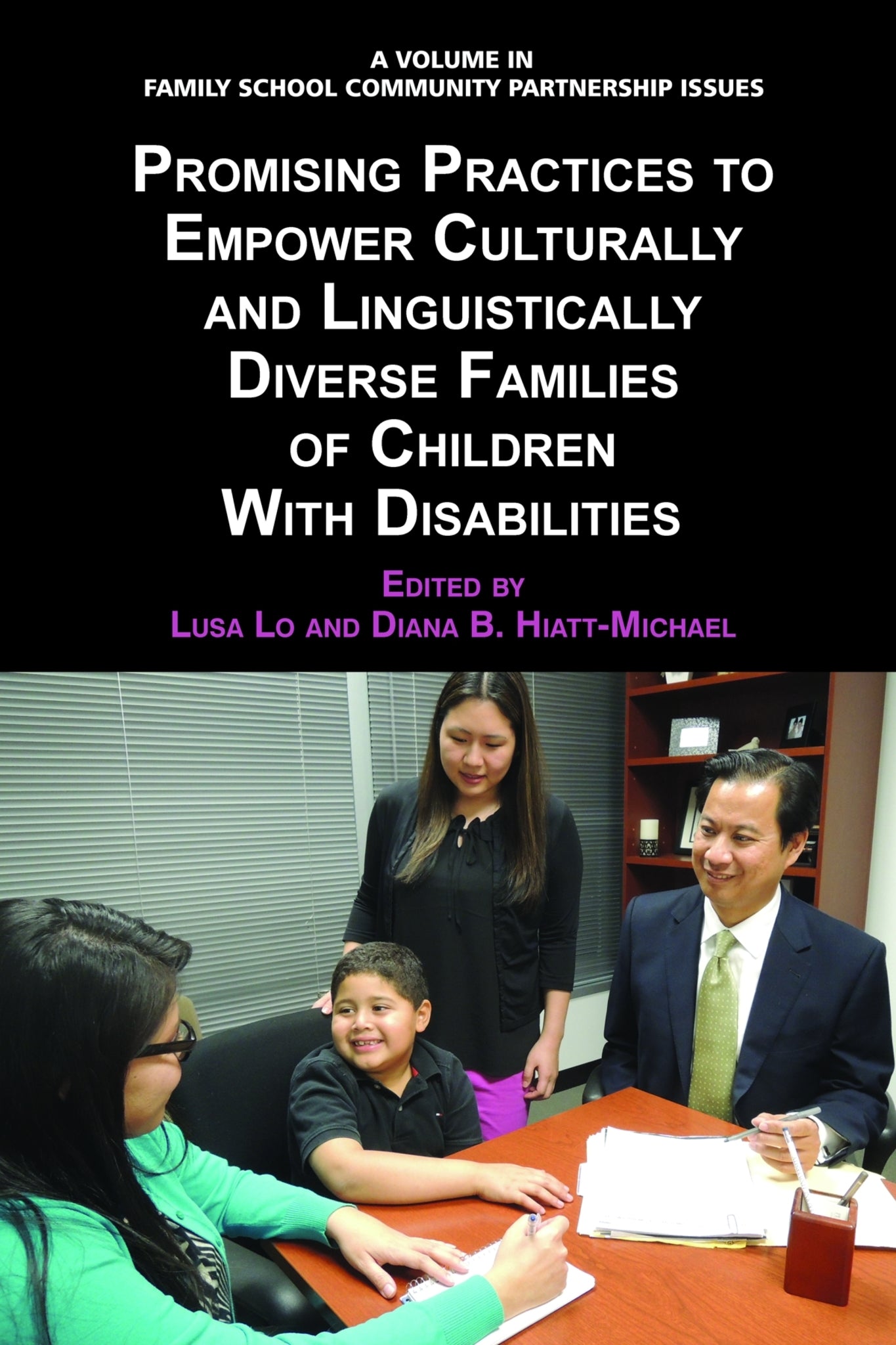
Promising Practices to Empower Culturally and Linguistically Diverse Families of Children with Disabilities offers research-supported school practices to empower families from diverse cultural backgrounds to make informed decisions regarding their children with diverse disabilities. In order to insure that every child is receiving the most appropriate educational program, these practices should be included in teacher and administrator preparation program throughout every county, state, and province.
Every site administrator, school counselor and special education teacher should have a copy of this book at one’s fingertips for ready reference. Suggested practices include activities for parent organizing, parent education, ways to provide co-mentoring of families, and formal support at Individualized Education Program meetings.


Foreword.
Part I. Practices in Schools.
Chapter 1. Learning to Navigate the Special Education Maze: A 3-Tiered Model for CLD Family Empowerment, Tracy Mueller.
Chapter 2. Family Involvement in Culturally Responsive Social-Skill Instruction for Latino Students With Disabilities, Ya-yu Lo, Vivian I. Correa, Adrienne L. Anderson, and Katherine Swart.
Chapter 3. Postsecondary Transition Planning for Families and Teachers With CLD Students With Disabilities, Rebekka J. Jez.
Part II. Practices in Communities.
Chapter 4. The Development of Grassroots Networks for Latino Families of Children With Disabilities, Michael P. Evans.
Chapter 5. Family School Partnering to Support New Immigrant and Refugee Families With Children With Disabilities, Gloria E. Miller and Vy Nguyen.
Chapter 6. Community Support for Parents of Young Children With Developmental Disabilities, Dana Kalek.
Chapter 7. Community Organizations Supporting Special Education Advocacy With Diverse Families, Terese C. Aceves and Ignacio Higareda.
Part III. Practices in Asian Countries.
Chapter 8. A School-Based Parent Support Group: Empowering Hong Kong Parents of Children With Disabilities to be Advocates, Lusa Lo, Tak-foo Cheng, and Kwok-ching Chan.
Chapter 9. Parent Advocacy Groups in Taiwan: Support for Families of Children With Disabilities, Hsiu-Zu Ho, Min Chia Tang, Whitney J. Detar, and Mian Wang.
About the Authors.