


Some error occured while loading the Quick View. Please close the Quick View and try reloading the page.
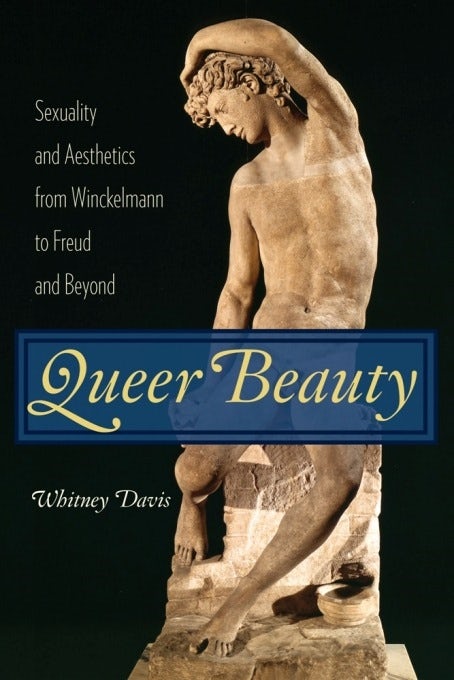
The pioneering work of Johann Winckelmann (1717-1768) identified a homoerotic appreciation of male beauty in classical Greek sculpture, a fascination that had endured in Western art since the Greeks. Yet after Winckelmann, the value (even the possibility) of art's queer beauty was often denied. Several theorists, notably the philosopher Immanuel Kant, broke sexual attraction and aesthetic appreciation into separate or dueling domains. In turn, sexual desire and aesthetic pleasure had to be profoundly rethought by later writers.
Whitney Davis follows how such innovative thinkers as John Addington Symonds, Michel Foucault, and Richard Wollheim rejoined these two domains, reclaiming earlier insights about the mutual implication of sexuality and aesthetics. Addressing texts by Arthur Schopenhauer, Charles Darwin, Oscar Wilde, Vernon Lee, and Sigmund Freud, among many others, Davis criticizes modern approaches, such as Kantian idealism, Darwinism, psychoanalysis, and analytic aesthetics, for either reducing aesthetics to a question of sexuality or for removing sexuality from the aesthetic field altogether. Despite these schematic reductions, sexuality always returns to aesthetics, and aesthetic considerations always recur in sexuality. Davis particularly emphasizes the way in which philosophies of art since the late eighteenth century have responded to nonstandard sexuality, especially homoeroticism, and how theories of nonstandard sexuality have drawn on aesthetics in significant ways.
Many imaginative and penetrating critics have wrestled productively, though often inconclusively and "against themselves," with the aesthetic making of sexual life and new forms of art made from reconstituted sexualities. Through a critique that confronts history, philosophy, science, psychology, and dominant theories of art and sexuality, Davis challenges privileged types of sexual and aesthetic creation imagined in modern culture-and assumed today.


Preface
Introduction: Sexuality and Aesthetics from Winckelmann to Freud and Beyond
1. Queer Beauty: Winckelmann and Kant on the Vicissitudes of the Ideal
2. The Universal Phallus: Hamilton, Knight, and the Wax Phalli of Isernia
3. Representative Representation: Schopenhauer's Ontology of Art
4. Double Mind: Hegel, Symonds, and Homoerotic Spirit in Renaissance Art
5. The Line of Death: Decadence and the Organic Metaphor
6. The Sense of Beauty: Homosexuality and Sexual Selection in Victorian Aesthetics
7. The Aesthetogenesis of Sex: "Narcissism" in Freudian Theory and Homosexualist Culture, I
8. Love All the Same: "Narcissism" in Freudian Theory and Homosexualist Culture, II
9. The Unbecoming: Michel Foucault and the Laboratories of Sexuality
10. Fantasmatic Iconicity: Freudianism, Formalism, and Richard Wollheim
Notes
Index