


Some error occured while loading the Quick View. Please close the Quick View and try reloading the page.
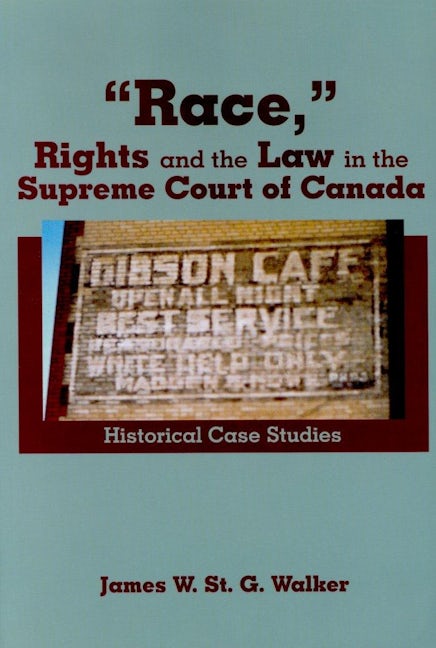
Four cases in which the legal issue was “race” — that of a Chinese restaurant owner who was fined for employing a white woman; a black man who was refused service in a bar; a Jew who wanted to buy a cottage but was prevented by the property owners’ association; and a Trinidadian of East Indian descent who was acceptable to the Canadian army but was rejected for immigration on grounds of “race” — drawn from the period between 1914 and 1955, are intimately examined to explore the role of the Supreme Court of Canada and the law in the racialization of Canadian society. With painstaking research into contemporary attitudes and practices, Walker demonstrates that Supreme Court Justices were expressing the prevailing “common sense” about “race” in their legal decisions. He shows that injustice on the grounds of “race” has been chronic in Canadian history, and that the law itself was once instrumental in creating these circumstances. The book concludes with a controversial discussion of current directions in Canadian law and their potential impact on Canada’s future as a multicultural society.


James W. St.G. Walker is a professor of history at the University of Waterloo, where he specializes in the history of human rights and race relations. His books include The Black Loyalists and “Race”, Rights and the Law in the Supreme Court of Canada (WLU Press, 1998), and he has published numerous articles and book chapters analyzing campaigns for human rights reform.
Table of Contents for “Race,” Rights and the Law in the Supreme Court of Canada: Historical Case Studies by James W.St.G. Walker
Foreword
Preface
Acknowledgments
Invitation
Chapter 1: Orientation
“Race” and the Law
Approaching the Bench
Approaching the Past
Chapter 2: Quong Wing v. The King
The Legislation
The Chinese Problem
Restriction and Regulation
Litigation
Defending the Family
The Moral Crusade
Chinese Response
Quong Wing and Quong Sing
Quong Wing v. the King
Explanations
Quong Wing as Precedent
Chapter 3: Christie v. York Corporation
The Incident
“Jim Crow” in Canada
The Montreal Community
Issues and Initiatives
La Question de la Liberté
In the Supreme Court of Canada
Aftermath
Christie as Precedent
Chapter 4: Noble and Wolf v. Alley
Exclusive Clientele
Counter Attack
Principles and Policies
The Public Interest
Preparing for the Supreme Court of Canada
Noble and Wolf v. Alley
Noble and Wolf as Precedent
Chapter 5: Narine-Singh v. Attorney General of Canada
“Race” and Immigration
Restrictive Tradition
South Asian Immigration
Rehearsal: Narain Singh and Munshi Singh
West Indian Immigration
Policy Shifts, 1945–52
The Immigration Act, 1952
Campaign for Immigration Reform
The Inevitable: Harry Singh in the Ontario Courts
Anticlimax: The Supreme Court of Canada
Confirmation
Chapter 6: Implications
“Race” and “Race Relations”
Legal Sensibility
Historical Study
Afterword
Directions in Public Policy
Apprehensions
Reflections
Index