


Some error occured while loading the Quick View. Please close the Quick View and try reloading the page.
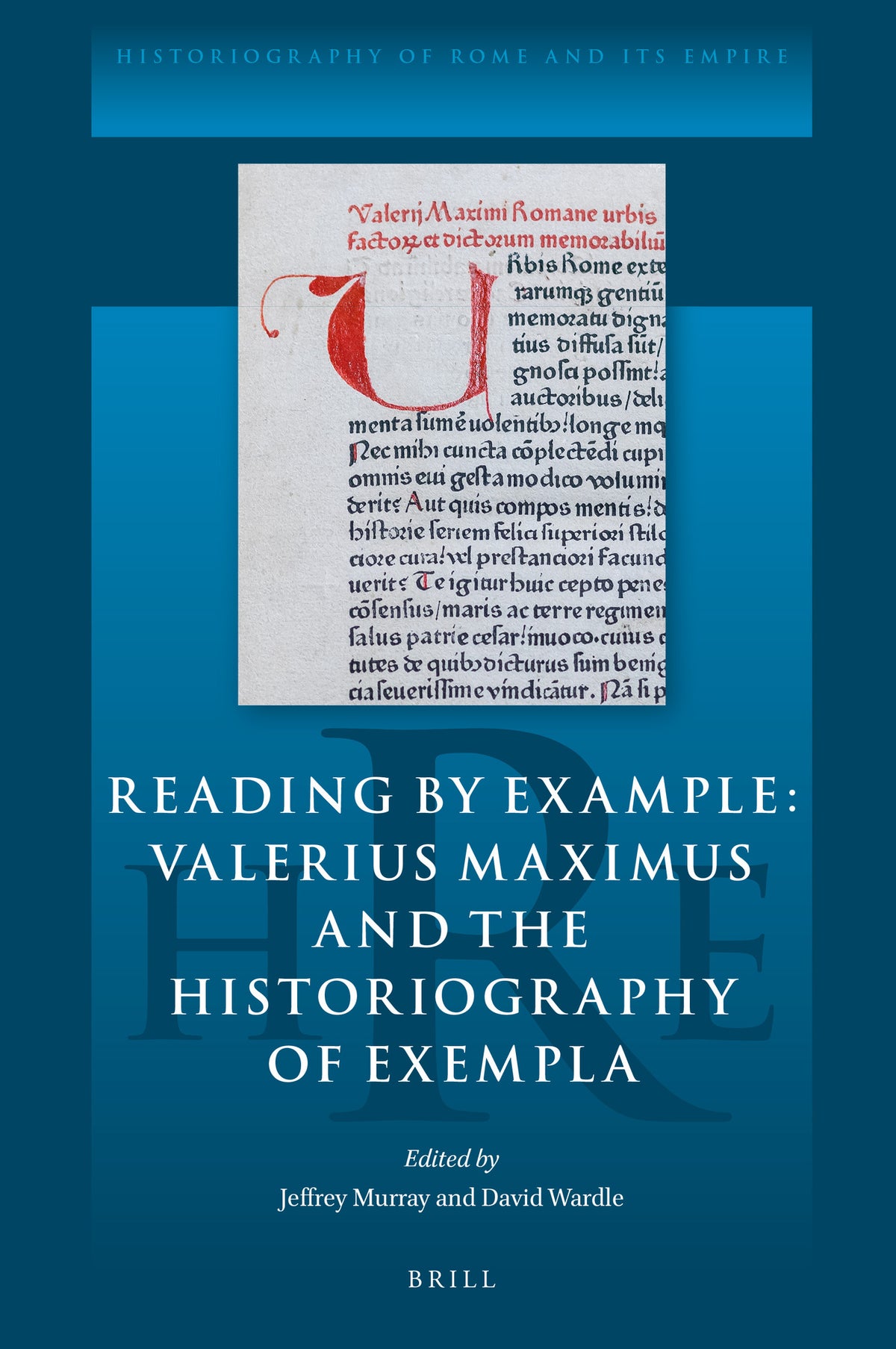
Long regarded as a sycophantic producer of overblown moral platitudes, Valerius Maximus emerges from a series of studies as an independent thinker capable of challenging his readers through the material he has collected: he makes them think about real moral dilemmas and grants to non-Roman societies a remarkable equivalence to Rome. Through his silences as much as his sermons he decodes the value- and political-system of his day. Valerius is talented as a reader of others and himself was read appreciatively in the Later Empire and even more so by Christians in Medieval Europe.
Contributors are John Atkinson, George Baroud, Emma Brobeck, Diederik Burgersdijk, Kyle Conrau-Lewis, Alain M. Gowing, Rebecca Langlands, Sarah Lawrence, Simon Lentzsch, Jeffrey Murray, Roman Roth, David Wardle.
Contributors are John Atkinson, George Baroud, Emma Brobeck, Diederik Burgersdijk, Kyle Conrau-Lewis, Alain M. Gowing, Rebecca Langlands, Sarah Lawrence, Simon Lentzsch, Jeffrey Murray, Roman Roth, David Wardle.

Price: $151.00
Pages: 352
Publisher: Brill
Imprint: Brill
Publication Date:
October 28, 2021
ISBN: 9789004499409
Format: Hardcover

"Interpreting Valerius Maximus’ Facta et dicta memorabilia as ‘a piece of literature in its own right’ (p. 1) was one of the aims of the 2017 conference in Cape Town, from which many papers in this volume emerged. Most of this thematically arranged volume goes beyond that and proves that there are well thought-out reasons for everything Valerius writes, for how he arranges his material as well as for every detail he avoids recording. Almost 30 years after M. Bloomer’s influential monograph Valerius Maximus and the Rhetoric of the New Nobility (1992), Reading by Example stands as a clear milestone in the scholarship, definitely demonstrating that Valerius has a project (or projects) and deserves to be investigated for his system of thought and defined authorial choices –and not primarily as ancillary to other authors." - Viola Periti, in: The Classical Review (2022), 1–4
"This strong collection of essays on Valerius Maximus contributes much to his rehabilitation as an author worth studying in his own right. (...) Hopefully this collection of fine essays can contribute much to dispelling the need in future to be defensive in studying this author and his work." - Alex A. Antoniou, in: BMCR 2022.11.38
"[D]rawing attention to hitherto neglected aspects of Valerius’ work, all chapters in this volume are successful not only in highlighting the enormous sophistication and nuance of the Facta et dicta memorabilia, but also in locating the work within the cultural, literary, and intellectual discourse of the early Principate. In demonstrating how, through the deliberate selection, organisation, and adaptation of his material, Valerius pursued his own literary agenda, the volume reviewed here is very much in the tradition of W. Martin Bloomer and will, undoubtedly, offer many important impulses for future research." - Heiko Westphal, in: Histos 17 (2023), cix–cxiii
"This strong collection of essays on Valerius Maximus contributes much to his rehabilitation as an author worth studying in his own right. (...) Hopefully this collection of fine essays can contribute much to dispelling the need in future to be defensive in studying this author and his work." - Alex A. Antoniou, in: BMCR 2022.11.38
"[D]rawing attention to hitherto neglected aspects of Valerius’ work, all chapters in this volume are successful not only in highlighting the enormous sophistication and nuance of the Facta et dicta memorabilia, but also in locating the work within the cultural, literary, and intellectual discourse of the early Principate. In demonstrating how, through the deliberate selection, organisation, and adaptation of his material, Valerius pursued his own literary agenda, the volume reviewed here is very much in the tradition of W. Martin Bloomer and will, undoubtedly, offer many important impulses for future research." - Heiko Westphal, in: Histos 17 (2023), cix–cxiii
Jeffrey Murray (PhD 2016 Cape Town) is Lecturer in Classics at the University of Cape Town. He has published several articles, book chapters, and reviews, and is currently preparing for publication a historical and historiographical commentary on Valerius Maximus, Facta et dicta memorabilia, Book 9.
David Wardle (DPhil. 1989 Oxford) is Professor of Classics in the University of Cape Town (South Africa). He published the first modern commentary on a book of Valerius Maximus (Oxford University Press, 1998), other monographs in the field of Latin Literature and Roman historiography and articles on these areas and Roman imperial history.
David Wardle (DPhil. 1989 Oxford) is Professor of Classics in the University of Cape Town (South Africa). He published the first modern commentary on a book of Valerius Maximus (Oxford University Press, 1998), other monographs in the field of Latin Literature and Roman historiography and articles on these areas and Roman imperial history.