


Some error occured while loading the Quick View. Please close the Quick View and try reloading the page.
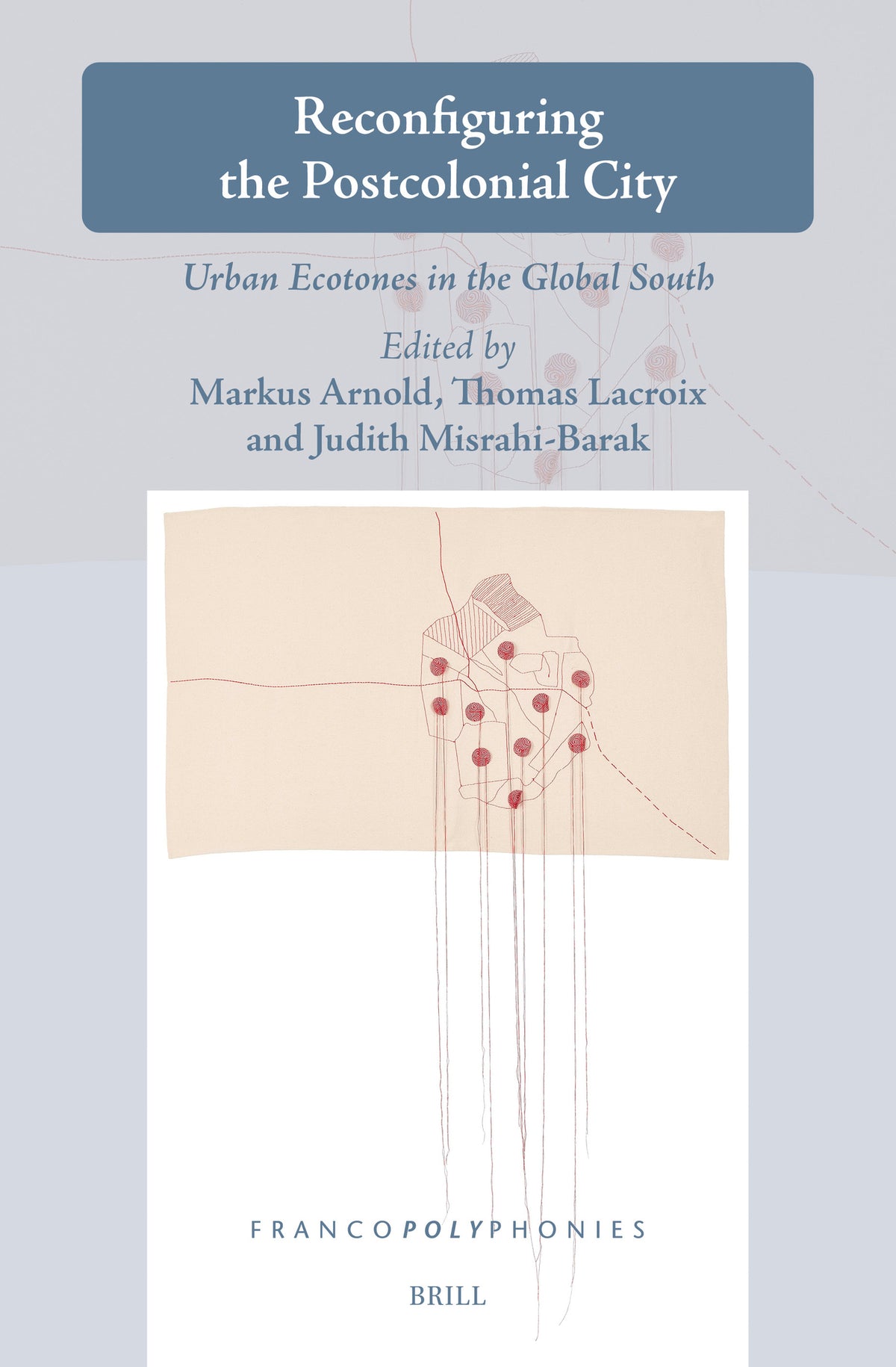
Global South cities are magnets of immigration flows. They are vivid crucibles of human diversity, cultural interactions, but also of political tensions and social violence. From Kolkata to Bogota, from Harare to Fort-de-France, from Bamako to Cape Town, this book offers a unique set of studies on cities where multifarious diaspora flows converge. Building on the concept of the ecotone, i.e. a contact zone between populations of different backgrounds, it elicits a multidisciplinary dialogue between social science and humanities scholars, exploring the articulation between the postcolonial and the neoliberal city. Following Ananya Roy’s proposition of a worlding the South (Roy 2014), this book contributes to forging a situated world view rooted in the experience and the imaginary of Southern cities.
With contributions by : Markus Arnold, Nataly Camacho-Mariño, Robin Cohen, Ute Fendler, Justine Feyereisen, Xavier Garnier, Marina Ortrud Hertrampf, Marianne Hillion, Mélanie Joseph-Vilain, Tania Katzschner, Thomas Lacroix, Christine Le Quellec Cottier, Sonja Loots, Emmanuel Mbégane Ndour, Ngetcham, Nicole Ollier, Parwine Patel, Molly Slavin.
"What if we rethink urban environments in the global South as ecotones? This is the question that this collection explores, across linguistic registers, and as an alternate way of approaching postcolonial cities in their intricate multi-dimensionalities. Specifically, the book proposes that we open conceptual repertoires of migratory ecotones, leaking and overlapping contact zones, volatile third spaces and heterotemporal matrices. By extension, the volume signals an exploration of what it might mean to think postcolonial cities in registers offered by water as much as land: estuaries, archipelagoes, intermediate zones of an intertidal fluidity in which the inequalities of their making reveal themselves in forms adapted to zones of transition. While there is yet more to explore at this watery conceptual interface, this book re-animates city form through a suggestive set of windows."
- Sarah Nuttall, Professor of Literary and Cultural Studies, WISER, University of the Witwatersrand and co-editor of Johannesburg: The Elusive Metropolis (Duke University Press).
'Reconfiguring the Postcolonial City décentre et corrige le concept de 'villes globales', en ancrant le regard au cœur des villes du Sud, offrant une autre compréhension du phénomène universel du « faire ville » et de son futur. Il met l’accent sur les mondes intermédiaires, les entre-deux incertains et les marges créatrices de sociabilité et de culture parfois même dans le dénuement et l’abandon institutionnel, faisant des « écotones » autant de « borderlands ». Enfin, il accède à la réalité sociale par la porte de la littérature. De Fort-de-France à Cape Town ou à Katiopa, des mondes chaotiques, cacophoniques et utopiques transmettent une énergie sociale vitale contre le fatalisme de l’effondrement."
- Michel Agier, auteur de Anthropologie de la ville, PUF, 2015
With contributions by : Markus Arnold, Nataly Camacho-Mariño, Robin Cohen, Ute Fendler, Justine Feyereisen, Xavier Garnier, Marina Ortrud Hertrampf, Marianne Hillion, Mélanie Joseph-Vilain, Tania Katzschner, Thomas Lacroix, Christine Le Quellec Cottier, Sonja Loots, Emmanuel Mbégane Ndour, Ngetcham, Nicole Ollier, Parwine Patel, Molly Slavin.
"What if we rethink urban environments in the global South as ecotones? This is the question that this collection explores, across linguistic registers, and as an alternate way of approaching postcolonial cities in their intricate multi-dimensionalities. Specifically, the book proposes that we open conceptual repertoires of migratory ecotones, leaking and overlapping contact zones, volatile third spaces and heterotemporal matrices. By extension, the volume signals an exploration of what it might mean to think postcolonial cities in registers offered by water as much as land: estuaries, archipelagoes, intermediate zones of an intertidal fluidity in which the inequalities of their making reveal themselves in forms adapted to zones of transition. While there is yet more to explore at this watery conceptual interface, this book re-animates city form through a suggestive set of windows."
- Sarah Nuttall, Professor of Literary and Cultural Studies, WISER, University of the Witwatersrand and co-editor of Johannesburg: The Elusive Metropolis (Duke University Press).
'Reconfiguring the Postcolonial City décentre et corrige le concept de 'villes globales', en ancrant le regard au cœur des villes du Sud, offrant une autre compréhension du phénomène universel du « faire ville » et de son futur. Il met l’accent sur les mondes intermédiaires, les entre-deux incertains et les marges créatrices de sociabilité et de culture parfois même dans le dénuement et l’abandon institutionnel, faisant des « écotones » autant de « borderlands ». Enfin, il accède à la réalité sociale par la porte de la littérature. De Fort-de-France à Cape Town ou à Katiopa, des mondes chaotiques, cacophoniques et utopiques transmettent une énergie sociale vitale contre le fatalisme de l’effondrement."
- Michel Agier, auteur de Anthropologie de la ville, PUF, 2015

Price: $114.00
Pages: 326
Publisher: Brill
Imprint: Brill
Publication Date:
06 December 2024
ISBN: 9789004713833
Format: Hardcover

"Reconfiguring the Postcolonial City. Urban Ecotones in the Global South contribue à structurer un champ en pleine évolution; l'ouvrage ouvre des perspectives stimulantes et trace de novelles orientations pour les études urbaines critiques consacrées aux Suds."
Laetitia Deleuze. French Studies in Southern Africa, 55.2 (2026).
Laetitia Deleuze. French Studies in Southern Africa, 55.2 (2026).
Markus Arnold is Associate Professor in Francophone studies at the University of Cape Town. His research covers postcolonial theory, Indian ocean & African literatures in French, text-image relations and graphic literature. His monograph is entitled La littérature mauricienne contemporaine (2017) and he is chief-editor of French Studies in Southern Africa.
Thomas Lacroix is CNRS director of research in geography at the Centre for International Research at Sciences Po Paris. His research focuses on immigrant transnationalism and its multilevel relations with the state and cities. He published The Transnational Society. A social theory of cross border linkages (2023).
Judith Misrahi-Barak is Professor in Postcolonial Studies at the English Department, University Paul Valéry Montpellier 3, France. Her prime areas of specialisation are Caribbean and Indo-Caribbean literatures in English. Her monograph is entitled Entre Atlantique et océan Indien: les voix de la Caraïbe anglophone (2021).
Thomas Lacroix is CNRS director of research in geography at the Centre for International Research at Sciences Po Paris. His research focuses on immigrant transnationalism and its multilevel relations with the state and cities. He published The Transnational Society. A social theory of cross border linkages (2023).
Judith Misrahi-Barak is Professor in Postcolonial Studies at the English Department, University Paul Valéry Montpellier 3, France. Her prime areas of specialisation are Caribbean and Indo-Caribbean literatures in English. Her monograph is entitled Entre Atlantique et océan Indien: les voix de la Caraïbe anglophone (2021).