


Some error occured while loading the Quick View. Please close the Quick View and try reloading the page.
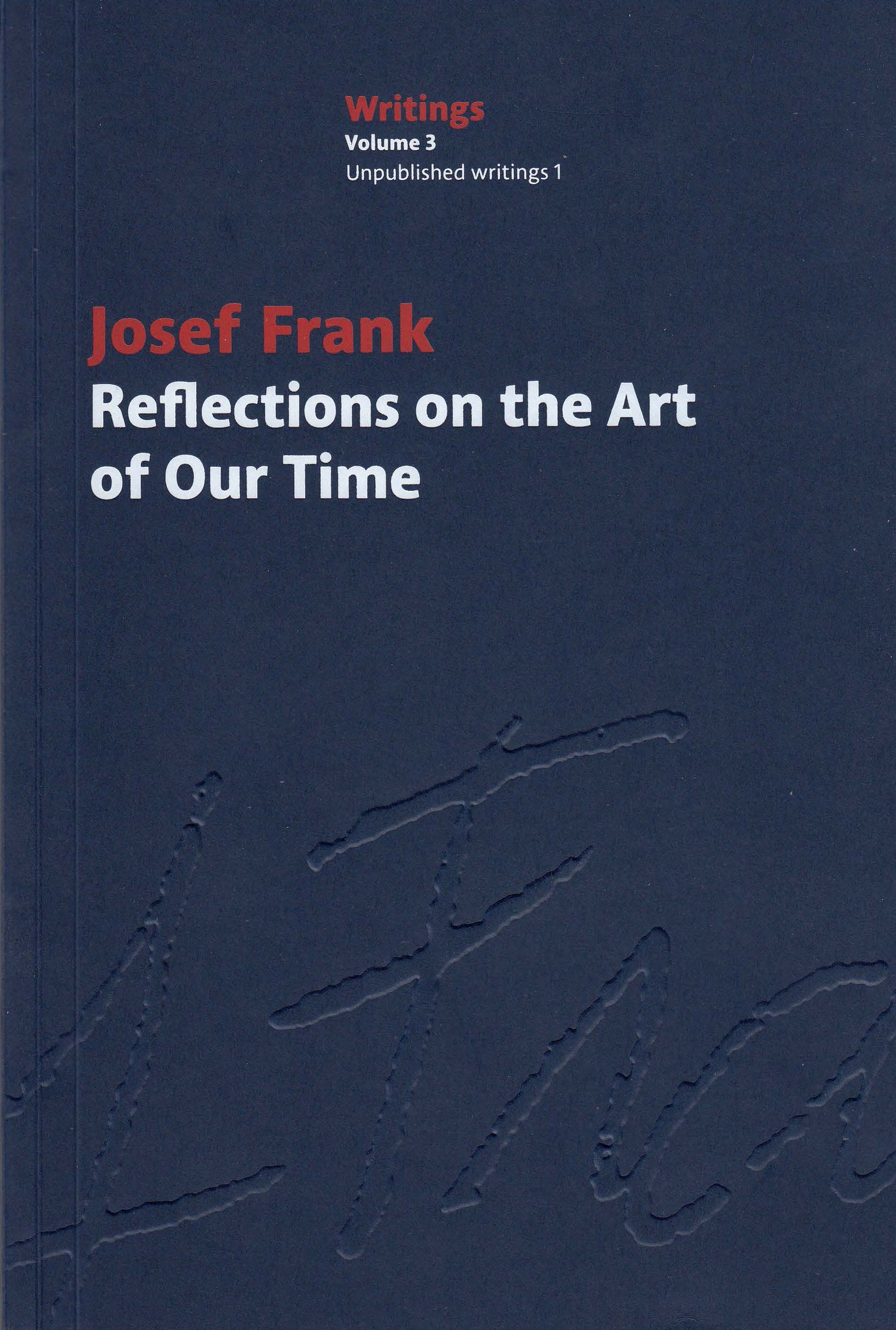
Previously unpublished, Josef Frank's searching essays on art and modernism find trends of totalitarianism in European aesthetics have crossed into the United States.
Reflections on the Art of Our Time is Josef Frank‘s (1885–1967) previously unpublished analysis of cultural developments since the fin de siècle. Frank believed that modern art and design had fallen prey to totalitarian and dictatorial currents in Europe, which culminated in the Second World War. He also observed that these same disturbing trends were spreading to the United States, where he was then living in exile, teaching and writing. Frank’s “Letter to the Editor” concerning Piet Mondrian, written on the occasion of the latter’s major retrospective at the Museum of Modern Art, which is also included in this work, exemplifies Frank’s concerns about the development of contemporary modernism. Edited and with contributions from Tano Bojankin, Caterina Cardamone, Hermann Czech, Christopher Long, Claudia Mazanek, along with an extended article by Otto Kapfinger.
Includes full-color reproductions of Frank's letters and notes, photographs, and maps.


"[Frank] wasn't really an architect ... [as much as] an intellectual, who built ideas." —Ernest Plischke
"The great humanist in modern architecture and design." —Christoph Thun-Hohenstein, director, Austrian Museum of Applied Arts/Contemporary Art (MAK), New York
"The importance of Frank’s architecture, not least ... elements of his work that were considered odd by his contemporaries, like nostalgia and improvisation, have been embraced by successive generations of architects, including Denise Scott Brown and Rem Koolhaas. His commitment to affordable housing is especially timely given its popularity among young design activists."
—The New York Times, "The Anti-Design Designer," January 19, 2016
Josef Frank Reflections on the art of our time
1 | Introduction
2 | Aesthetic World View
3 | Art and Science
4 | Art and Society
5 | Abstract Art
6 | Architecture as Art
7 | Arts and Crafts and Superstitions
Josef Frank On Mondrian
On Josef Frank's unpublished writings
Hermann Czech : Against Modernity | Motivations of a Rejection
Caterina Cardamone : A chronology of the archive material
Tano Bojankin : Josef Frank's Paths and Places | A Research
Otto Kapfinger : Living in the attic: space without intention, comfort in randomness
Claudia Mazanek : Editorial Notes
Short biographies
Selected bibliography Index
Thanks, illustration credits Imprint