


Some error occured while loading the Quick View. Please close the Quick View and try reloading the page.
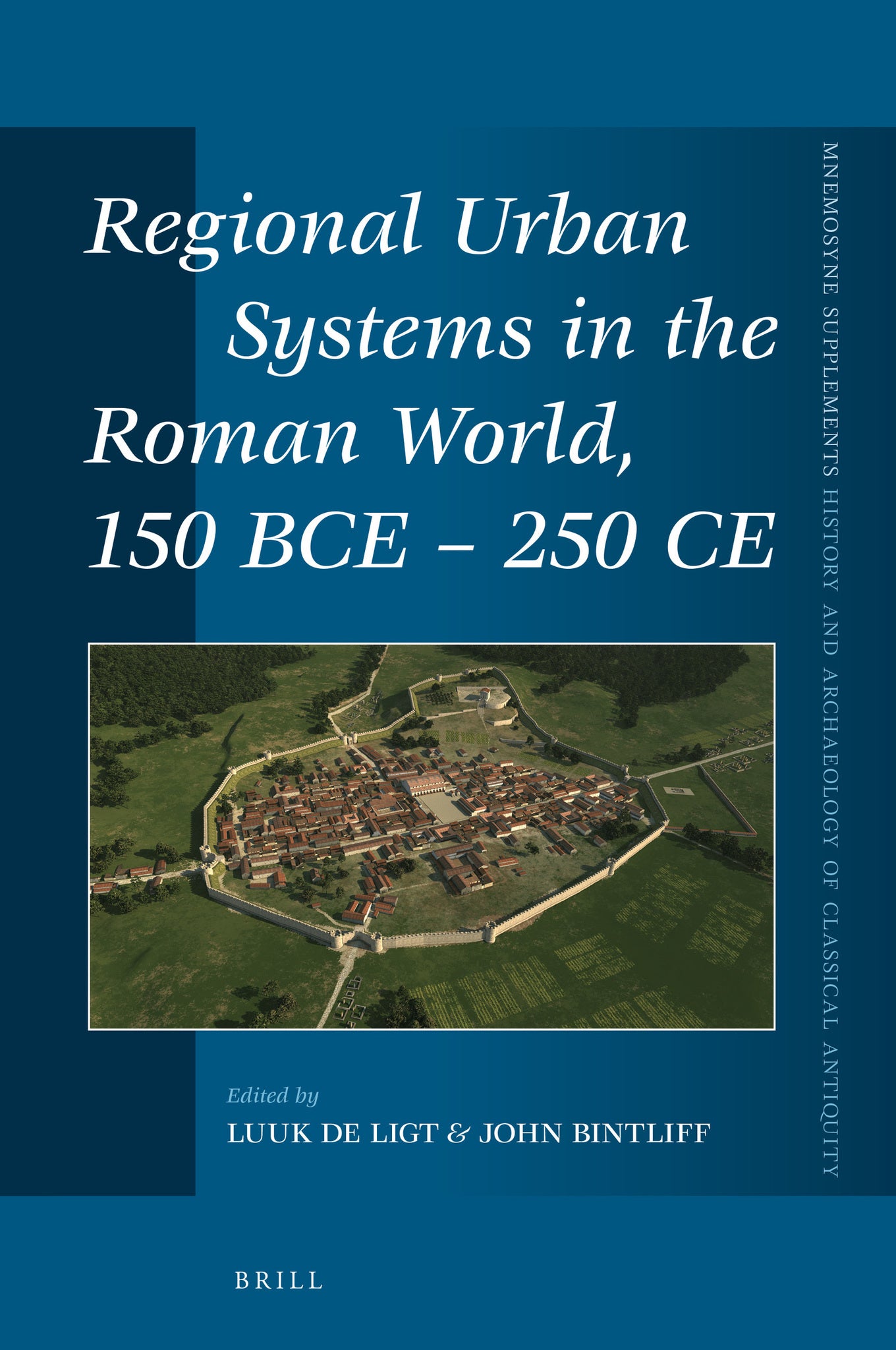
The focus of Regional Urban Systems in the Roman World is on urban hierarchies and interactions in large geographical areas rather than on individual cities. Based on a painstaking examination of archaeological and epigraphic evidence relating to more than 1,000 cities, the volume offers comprehensive reconstructions of the urban systems of Roman Gaul, North Africa, Sicily, Greece and Asia Minor. In addition it examines the transformation of the settlement systems of the Iberian Peninsula and the central and northern Balkan following the imposition of Roman rule. Throughout the volume regional urban configurations are examined from a rich variety of perspectives, ranging from climate and landscape, administration and politics, economic interactions and social relationships all the way to region-specific ways of shaping the townscapes of individual cities.

Price: $197.00
Pages: 582
Publisher: Brill
Imprint: Brill
Publication Date:
19 December 2019
ISBN: 9789004414334
Format: Hardcover

"The relevance of these contributions to the study of regional urban systems across the Roman world is demonstrated not only by the authors discussions, but also by the wealth of analytic data, tables, catalogues and appendices supplementing many of these texts. Undoubtedly, the volume provides new information that will be of use to anyone working on the urbanism, economic and socio-political history of the Roman Empire, striking a good balance between archaeological and ancient historical standpoints." - Niccol Mugnai, University of Oxford, in: Bryn Mawr Classical Review, 2021.01.29
''This volume successfully champions the regional perspective as a fruitful way to analyse the process of urbanisation in the Roman period. The adoption of multiple scales allows the publication to account for the diversity of urban developments, while paying due attention to both pan-imperial and region-specific factors. The publication makes it evident that a number of important insights would have been missed if urbanisation studies remained limited to research on single cities. The larger scale and the systemic context provided by the volume allow for more complex observations about economic integration and about the nature of contacts between individual cities. The volumes key conclusions about provincial urbanisation and the data it assembles will pave the way for further work on cities in the Roman world.'' - Pawel Borowski, in: The Classical Review 70.2 (2020)
''This volume successfully champions the regional perspective as a fruitful way to analyse the process of urbanisation in the Roman period. The adoption of multiple scales allows the publication to account for the diversity of urban developments, while paying due attention to both pan-imperial and region-specific factors. The publication makes it evident that a number of important insights would have been missed if urbanisation studies remained limited to research on single cities. The larger scale and the systemic context provided by the volume allow for more complex observations about economic integration and about the nature of contacts between individual cities. The volumes key conclusions about provincial urbanisation and the data it assembles will pave the way for further work on cities in the Roman world.'' - Pawel Borowski, in: The Classical Review 70.2 (2020)
Luuk de Ligt is Professor of Ancient History at Leiden University. He has published widely on economic history, social history, legal history and urban history. His monograph Peasants, Citizens and Soldiers (Cambridge University Press, 2012) has been greeted as a path-breaking contribution to the demographic history of Roman Italy. Between 2013 and 2018 he held a major research grant from the European Research Council (2013-2018) for the project An Empire of 2,000 Cities.
John Bintliff is Emeritus Professor of Classical and Mediterranean Archaeology at Leiden University and Emeritus Professor at the University of Edinburgh. Since 1978 he has been co-directing (with Cambridge University) the Boeotia Project. In 2012 he published The Complete Archaeology of Greece: From HunterGatherers to the 20th Century AD (Wiley-Blackwell). Between 2013 and 2018 he co-directed the ERC-funded project An Empire of 2,000 Cities.
List of contributors: Florian Baret, Damjan Donev Eseninova, Matthew S. Hobson, Michalis Karambinis, Frank Kolb Haselweg, Dragana Mladenovi, Oliva Rodrguez Gutirrez, Frida Pellegrino, Paul Scheding, David L. Stone, Manuel Fernndez-Götz, Frdric Trment, F. Vermeulen, Rinse Willet.
John Bintliff is Emeritus Professor of Classical and Mediterranean Archaeology at Leiden University and Emeritus Professor at the University of Edinburgh. Since 1978 he has been co-directing (with Cambridge University) the Boeotia Project. In 2012 he published The Complete Archaeology of Greece: From HunterGatherers to the 20th Century AD (Wiley-Blackwell). Between 2013 and 2018 he co-directed the ERC-funded project An Empire of 2,000 Cities.
List of contributors: Florian Baret, Damjan Donev Eseninova, Matthew S. Hobson, Michalis Karambinis, Frank Kolb Haselweg, Dragana Mladenovi, Oliva Rodrguez Gutirrez, Frida Pellegrino, Paul Scheding, David L. Stone, Manuel Fernndez-Götz, Frdric Trment, F. Vermeulen, Rinse Willet.