


Some error occured while loading the Quick View. Please close the Quick View and try reloading the page.
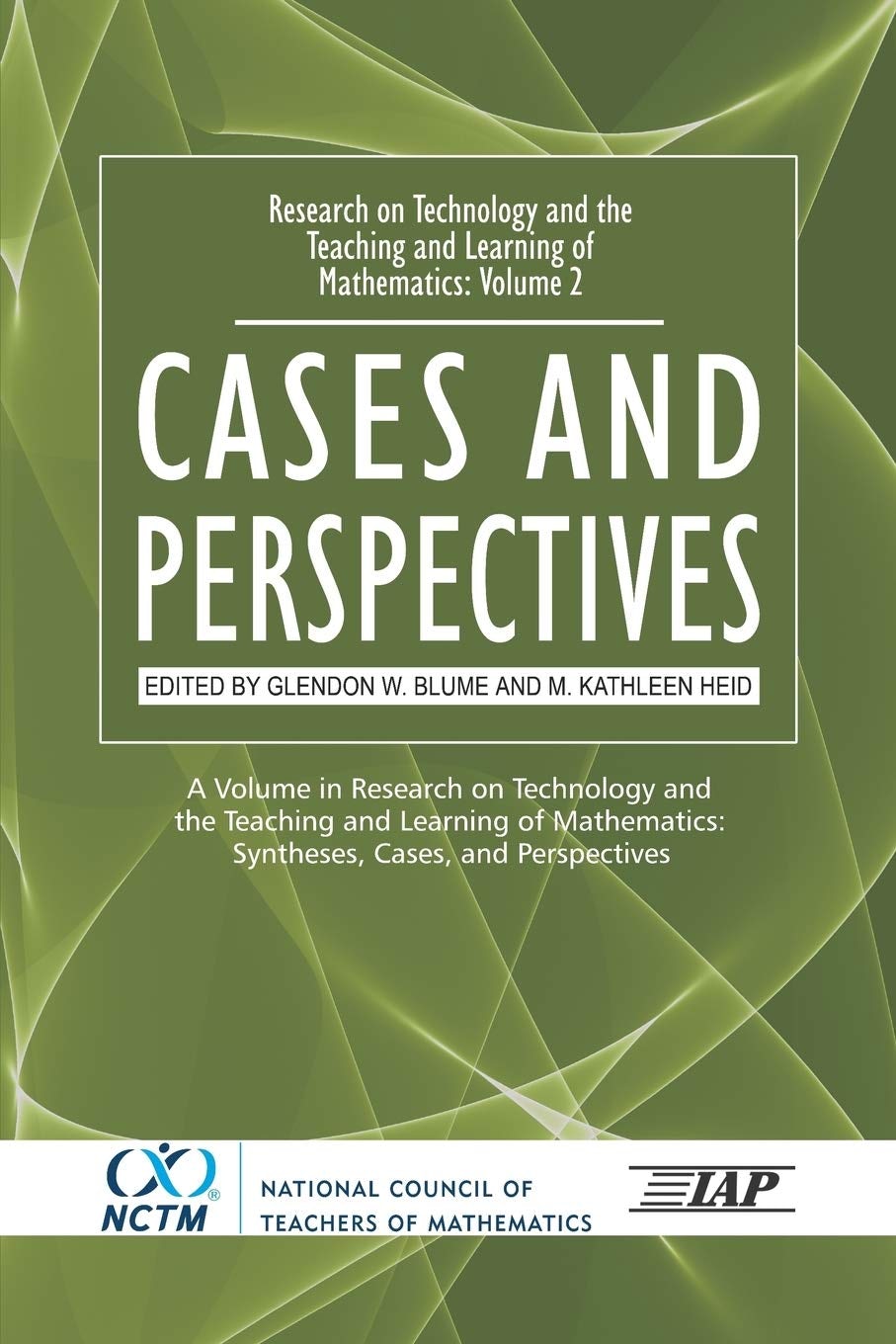
(Published in Co-operation with the National Council of Teacher of Mathematics)
According to NCTM's Principles and Standards for School Mathematics, "Technology is essential in teaching and learning of mathematics; it influences the mathematics that is taught and it enhances students' learning." How does research inform this clarion call for technology in mathematics teaching and learning? In response to the need to craft appropriate roles for technology in school mathematics new technological approaches have been applied to the teaching and learning of mathematics, and these approaches have been examined by researchers world-wide.
The second volume has a dual focus: cases and perspectives. It features descriptive cases that provide accounts of the development of technology-intensive curriculum and tools. In these cases the writers describe and analyze various roles that research played in their development work and ways in which research, curriculum development, and tool development can inform each other. These thoughtful descriptions and analyses provide documentation of how this process can and does occur. The remaining chapters in the second volume address research related issues and perspectives on the use of technology in the teaching and learning of mathematics. The lessons learned from the research presented in these volumes are lessons about teaching and learning that can be applied more broadly than solely in technological settings.


Preface.
Chapter 1. Research in a Pioneer Constructivist Network-Based Curriculum Project for Children's Learning of Fractions; Sharon Dugdale.
Chapter 2. The Development of a Dynamical Geometry Environment: Cabri-Géomètre; Colette Laborde and Jean-Marie Laborde.
Chapter 3. What Lies Behind Dynamic Interactive Geometry Software? E. Paul Goldenberg, Daniel Scher, and Nannette Feurzeig.
Chapter 4. From Network to Microcomputers and Fractions to Functions: Continuity in Software Research and Design; Sharon Dugdale.
Chapter 5. Linking Research and Software Development; Julie Sarama and Douglas H. Clements.
Chapter 6. Development of the Shape Makers Geometry Microworld: Design Principles and Research; Michael T. Battista.
Chapter 7. Integrating Intelligent Software Tutors with the Mathematics Classroom; Steven Ritter, Lisa Haverty, Kenneth R. Koedinger, William Hadley, and Albert T. Corbett.
Chapter 8. Research-Design Interactions in Building Function Probe Software; Jere Confrey and Alan Maloney.
Chapter 9. Changing Representational Infrastructures Changes Most Everything: The Case of SimCalc, Algebra, and Calculus; Jim Kaput and Roberta Schorr.
Chapter 10. Multiple Representations and Local Linearity: Research Influences on the Use of Technology in Calculus Curriculum Reform; Thomas P. Dick and Barbara S. Edwards.
Chapter 11. The Research Frontier: Where Technology Interacts with the Teaching and Learning of Data Analysis and Statistics; Susan N. Friel.
Chapter 12. Keeping the Faith: Fidelity in Technological Tools for Mathematics Education; Thomas P. Dick.
Chapter 13. Representations and Cognitive Objects in Modern School Geometry; Michael T. Battista.
Chapter 14. From Artifacts to Instruments: A Theoretical Framework Behind the Orchestra Metaphor; Paul Drijvers and Luc Trouche.
Chapter 15. Designing Tasks for the Co-Development of Conceptual and Technical Knowledge in CAS Activity: An Example from Factoring; Carolyn Kieran and Luis Saldanha.
Chapter 16. Teacher Education: Technology's Conduit to the Classroom; Patricia S. Wilson.
Chapter 17. Perspectives on Research, Policy, and the Use of Technology in Mathematics Teaching and Learning in the United States; Joan Ferrini-Mundy and Glenda A. Breaux.
Chapter 18. The Role of Research Theory in the Integration of Technology in Mathematics Teaching and Learning; Glendon W. Blume and M. Kathleen Heid.