


Some error occured while loading the Quick View. Please close the Quick View and try reloading the page.
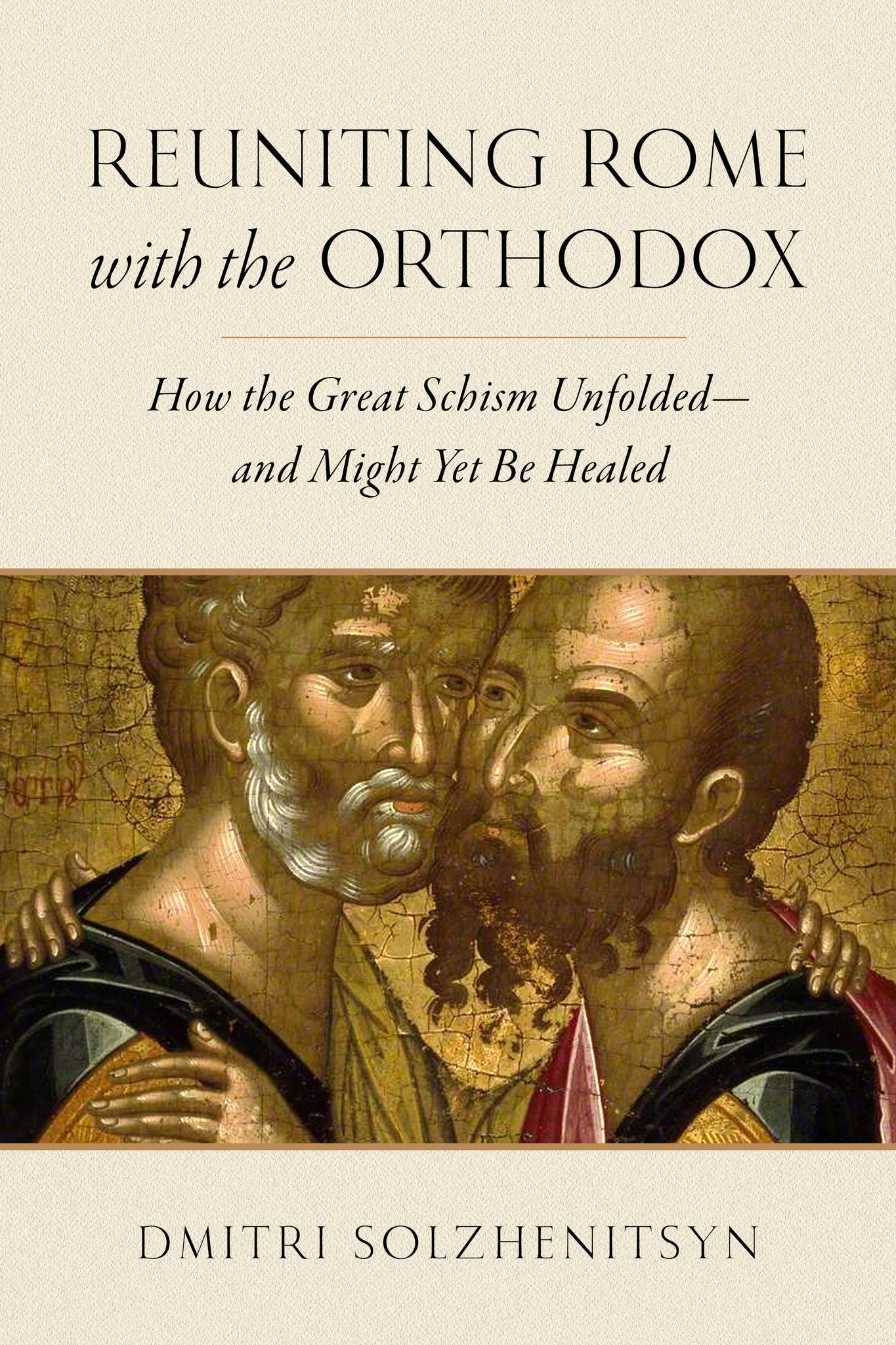
A scrupulously fair exploration of how the Catholic and Orthodox churches were split asunder—and what a path to union might look like.
In Reuniting Rome with the Orthodox Dmitri Solzhenitsyn provides a careful theological and historical reflection on the prospects for full communion between the Roman Catholic and Eastern Orthodox churches. He argues that Orthodox–Catholic reunification is not only a moral imperative but also a possibility, especially in light of recent ecumenical progress.
Solzhenitsyn traces the arc of Orthodox–Catholic relations from the churches’ shared apostolic heritage to their growing divergence to the Great Schism of 1054. He contends that the breakdown was ultimately fueled as much by a failure to practice love and charity as by doctrinal conflict. And he finds hope for unity in the gradually warming relations between the churches seen since the nineteenth century, as evidenced by symbolic reciprocal gestures and genuine theological breakthroughs.
Solzhenitsyn ends by offering a constructive vision for reunion, focusing on the core theological obstacles of papal authority and the filioque while also addressing broader Orthodox attitudes and the practical mechanics of reunion. In the end, he calls readers, Orthodox and Catholic alike, both to imagine what restored communion might look like in lived experience and to work—and pray—for unity.


Introduction - Fr. Laurent Cleenewerck
Chapter 1: Why Unite?
Chapter 2: Early Church History - Doctrine, Structure, and Primacy
The Beginning
Arianism and Other Early Heresies
Further disputes: Nestorianism, Monophysitism, and the Council of Chalcedon
Early Ecclesiastical Structure
Primacy through Chalcedon (451)
Chapter 3: The Emperor, de facto Roman primacy, and Continued East-West Divergence in the Early Medieval Period (452–800)
Introduction: General Developments from the Fifth to the Ninth Century
Post-Chalcedonian East-West Relations: the Acacian Schism
Justinian’s Reign: Imperial Dominance over Rome
A Gradual Recovery of Papal Independence: from Justin II until the Monothelitism Controversy
Deepening East-West Tensions: the Monothelitism and Iconoclasm Controversies
Competing Ecclesiologies in the Post-Chalcedonian Era
Diverging Liturgies and Practices Before the Schism
Chapter 4: The Great Schism (800–1204)
Introduction to the Great Schism
The Photian Schism
Between Photius and 1054
The Schism of 1054
From 1054 through the Sack of Constantinople (1204)
The Filioque from Inception through the Sack of Constantinople
Chapter 5: After the Schism: Efforts at Reconciliation (1204–1800)
The Second Council of Lyons (1272–1274)
The Council of Ferrara-Florence (1438–1445)
Uniatism and other Post-Florence Developments
Chapter 6: Modern Catholic-Orthodox relations and developments (1801–2025)
The 1848 Exchange Between Pope Pius IX and the Orthodox Patriarchs
Later Nineteenth Century: Major Vatican Developments and Continued Orthodox-Catholic Dialogue
The Twentieth Century: A Brief Overview
Vatican II
The Joint International Commission for Theological Dialogue, Munich and Uniatism
Et Unum Sint (1995) and other Developments under Pope John Paul II
Ravenna Document (2007)
Pope Francis, Warmed Vatican-Moscow Relations and Chieti (2016)
The Alexandria Document (2023) and The Bishop of Rome (2024)
Francis, Bartholomew, and the Synod on Synodality (2024)
Chapter 7: Reuniting the Churches
Do we Even Want to Reunite?
Finding Common Ground on Papal Primacy
Resolving the Filioque Barrier
Reuniting in Practice: What Will it Take?
Reflection
Afterword by Fr. Aidan Nichols O.P.