


Some error occured while loading the Quick View. Please close the Quick View and try reloading the page.
Winner, 2025 Lionel Trilling Book Award, Columbia College
Winner, 2024 Book Award, History Division, Association for Education in Journalism and Mass Communication
Honorable Mention, 2024 Aldo and Jeanne Scaglione Prize for East Asian Studies, Modern Language Association
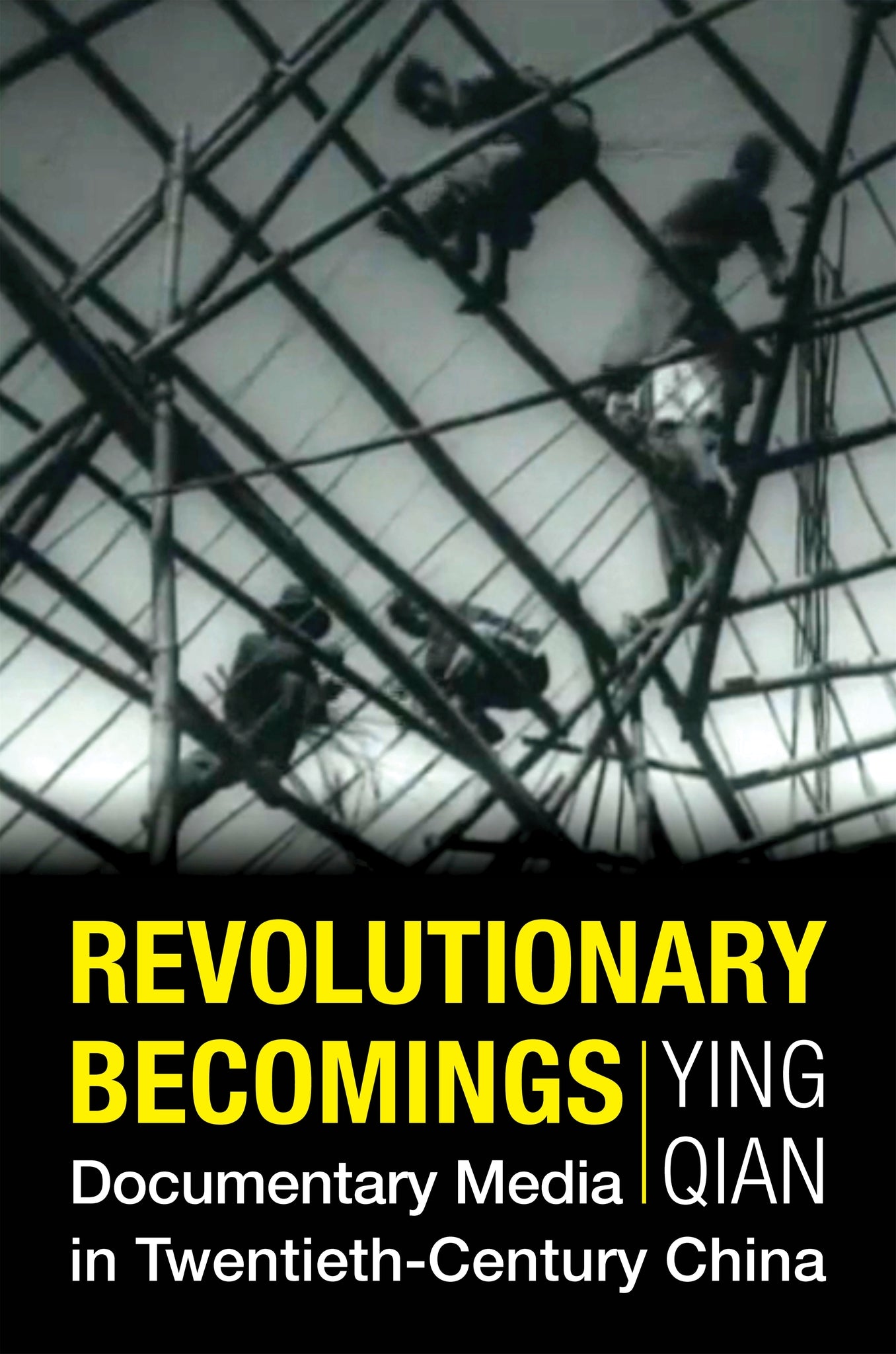
From the toppling of the Qing Empire in 1911 to the political campaigns and mass protests in the Mao and post-Mao eras, revolutionary upheavals characterized China’s twentieth century. In Revolutionary Becomings¸ Ying Qian studies documentary film as an “eventful medium” deeply embedded in these upheavals and as a prism to investigate the entwined histories of media and China’s revolutionary movements.
With meticulous historical excavation and attention to intermedial practices and transnational linkages, Qian discusses how early media practitioners at the turn of the twentieth century intermingled with rival politicians and warlords as well as civic and business organizations. She reveals the foundational role documentary media played in the Chinese Communist Revolution as a bridge between Marxist theories and Chinese historical conditions. In considering the years after the Communist Party came to power, Qian traces the dialectical relationships between media practice, political relationality, and revolutionary epistemology from production campaigns during the Great Leap Forward to the “class struggles” during the Cultural Revolution and the reorganization of society in the post-Mao decade. Exploring a wide range of previously uninvestigated works and intervening in key debates in documentary studies and film and media history, Revolutionary Becomings provides a groundbreaking assessment of the significance of media to the historical unfolding and actualization of revolutionary movements.


— Weihong Bao, author of Fiery Cinema: The Emergence of an Affective Medium in China, 1915-1945
In the age of generative AI and fake news, Qian offers a truly pathbreaking study of documentaries in a country famous for its political propaganda. The book soberly reminds us that what matters is not distinguishing between what is real and fictional, but rather how we can maintain reflexivity in a heavily mediated world, both then and now.
— Laikwan Pang, author of The Appearing Demos: Hong Kong During and After the Umbrella Movement
Revolutionary Becomings opens an exciting new window onto the unfairly neglected history of Chinese documentary by eschewing ideas of capturing reality and instead analyzing films as “eventful media” participating in the multiple reinventions of the country from the toppling of the Qing dynasty to the fall of the Gang of Four.
— Chris Berry, King’s College London
Interrogating common assumptions on what documentary is, Qian’s fascinating book excavates documentary as media artifact and production process and explicates its evolving theories and practices as integral to the upheavals of China’s tumultuous twentieth century. Revolutionary Becomings is invaluable for both scholars and practitioners of documentary media.
— Carma Hinton, filmmaker, director of Gate of Heavenly Peace and Morning Sun
Combining theoretical sophistication and interpretive skill with astonishing research and historical acuity, Ying Qian’s Revolutionary Becomings offers a remarkable history of twentieth century Chinese documentary focusing on its many entanglements with the constantly changing revolutionary politics of that era. This book sets a new standard for documentary studies.
— Charles Musser, Yale University
Sets the standard for writing in English on Chinese documentary film history...Essential reading for anyone interested in the relationship between non-fiction and political change, inside and outside China.
[This] book makes a substantial contribution to our understanding of institutionalization in the Chinese Communist revolution.
Expansive in scope, richly detailed, and expertly researched.
A master class in exploring diverse interactions between makers, subjects, and audiences implicated in modern Chinese media histories....Well researched and compellingly written, it is an invaluable source for scholars, students, and wider audiences interested in these topics.
Not only does the book do an excellent job showing the interconnectedness between film and other modes of artistic representation such as literature and photography, but it also smoothly and effectively integrates film analysis with production studies to provide an alternative model for studying historical turning points through media.
It promises to be rewarding reading, likely to stimulate scholars, documentary-makers and cinema lovers alike.
— Wanning Sun
Named a best book of 2024.
With its compelling historical narrative and engagement with the political and social roles of documentary film, Ying Qian’s study will help students and scholars alike navigate the complex and varied body of factual images made in twentieth-century China.
Makes a significant contribution to Chinese documentary studies and is valuable to scholars in the fields of film studies, documentary studies, media studies, Chinese studies, and studies of revolution.
A major work of depth and insight.
An unparalleled academic study...deserves to be read by people who are interested in learning about media, film, history, modern China, and international politics.
Acknowledgments
Introduction
1. Emergence: Colonial War, Nationalist Revolution, and Documentary’s Beginnings
2. Bombs and Seafarings: Documentaries Hard and Soft
3. Winning Realities: Wartime Propaganda and Solidarity
4. When Taylorism Met Revolutionary Romanticism: Great Leap Temporalities
5. The Uncertainty of Political Knowledge: Documentary in Crisis
6. Rehabilitation: Documentary in the Post-Mao Decade
Epilogue: Notes on Chinese Independent Documentary
Notes
Index