


Some error occured while loading the Quick View. Please close the Quick View and try reloading the page.
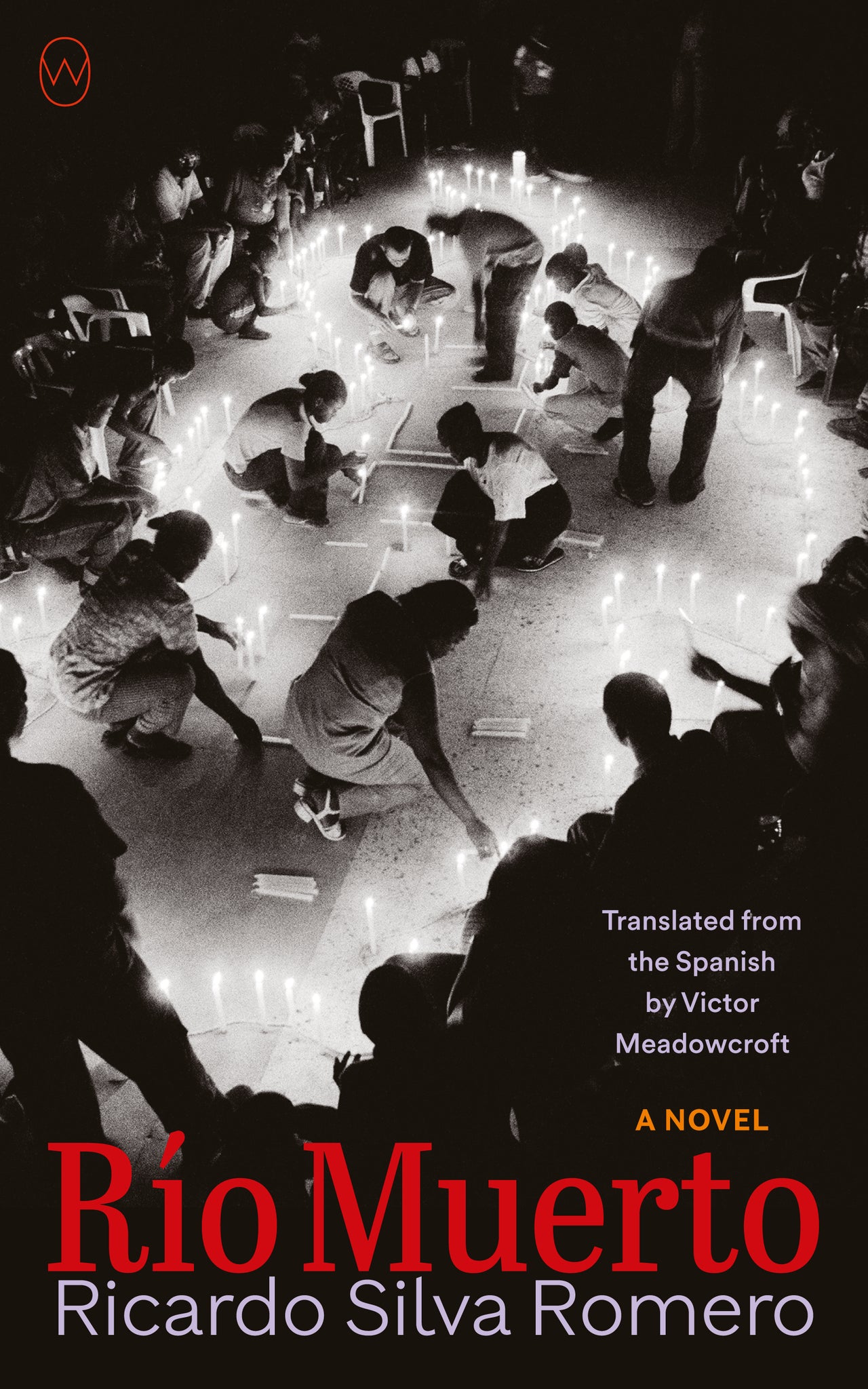
By one of Colombia's most renowned novelists and reminiscent of Chronicle of a Death Foretold by Gabriel Garcia Marquez, Río Muerto by Ricardo Silva Romero tackles the topic of paramilitarism and violence in Colombia when a father of two sons is killed a few steps from his home.
On the outskirts of Belén del Chamí, a town that has yet to appear on any map of Colombia, the mute Salomón Palacios is murdered a few steps away from his home. His widow, the courageous and foul-mouthed Hipólita Arenas, completely loses her sanity and confronts the paramilitaries and local politicians, challenging them to also kill her and her two fatherless sons. Yet as Hipólita faces her husband’s murderers on her desperate journey, she finds an unexpected calling to stay alive. This poetic and hypnotizing novel, told from the perspective of Salomón’s ghost, denounces the brutal killings of innocent citizens and at the same time celebrates the invisible: imagination, memories, hope, and the connection to afterlife.


2026 PEN TRANSLATION PRIZE FINALIST
Lithubs The Best International Fiction of February 2025
CrimeReads The Most Anticipated Crime Books of 2025
Electric Literature 10 Translated Novels You Should Read 2025
"Among this novel’s merits is its powerful celebration of the will to live, dovetailed with an evocation of the love members of a family have for one another, even under the most brutal and apparently hopeless circumstances."—The Arts Fuse
"Río Muertois a superb short novel that bridges the gap between horror and crime in very unique ways.Río Muertois a window into a violent world as well as a tale about a family suffering at the hands of paramilitarism and bad neighbors. Silva Romero is a star in Colombia and hopefully this, his first novel to be translated to English, will put him on the map and ensure we get more of his work soon."Gabino Iglesias, CrimeReads
"Río Muerto is engaging, almost cinematic. Beginning with the murder of Salomón Palacios, most of the book spans a single leap day in 1992, following Hipólita and her sons. Enraged by her husband’s murder and the whole town’s implicit collusion, Hipólita decides that the only dignified response is to get herself and her sons killed, to release them from the town’s living hell. Hipólita chooses, with a manic and sparkling clarity, to speak rather than remain silent, no matter the consequences. What follows is a crusade of righteous candor.Silva Romero uses Salomón’s continuous presence (as a ghost) in the novel to give voice to the murdered and disappeared victims of the armed conflict in Colombia, whose absence continues to take up a central role in efforts for peace and justice."—Full Stop
"Colombian writer Silva Romero makes his English-language debut with a wrenching tale of murder and survival. Near the remote Colombian town of Belen del Chami, a mute man named Salomon Palacios is gunned down by hooded assassins in 1992. His distraught widow, Hipolita, sets off on a rambling odyssey of retribution, accompanied by their sons Max, 12, and Segundo, eight. Salomon, meanwhile, has become a ghost, and he meets with the ghosts of other victims of political violence. Romero captures the intensity of the family’s grief, as they’re poorly consoled by a gravedigger and are ignored by the police, all while Salomon shadows them, unable to intervene. Silva Romero seamlessly weaves lyrical depictions of Salomon’s afterlife, a “dense, black, clammy, stinking jungle that looked to him like hell,” with pointed observations of the country’s decades-long guerrilla war, which “continues to break the extraordinary open hearts of thousands of Colombians.” Meadowcroft’s crystalline translation introduces readers to an important Latin American voice."—Publishers Weekly
"Set in the forgotten village of Belén del Chamí, somewhere in Colombia, and told from the perspective of the ghost of a mute man, Salomón Palacios, Río Muerto is the story of a forgotten village living at the mercy of Colombia’s dark underbelly. The novel begins after the murder of the mute man, as his wife, Hipólita, is driven to madness and decides to confront the paramilitaries and politicians she holds responsible for her husband’s death. Refusing to go in peace until he knows his family is safe, Salomón gives voice to the voiceless, telling a story of collective trauma and personal resilience. In less than 200 pages, Ricardo Silva Romero grapples with the ripple effects of societal upheaval and state violence, in what is described as both an intimate and politically charged portrayal of Colombian village life." —Electric Literature
“In this novel, Silva Romero explores with clarity and precision the way violence weighs on a society like Colombia, which seems to have naturalized it in a disturbing way."—ADN Bogotá
“Written in visceral prose.” —El Tiempo
“A book that will persist as a key representative of literature dealing with the violence that devastated this country during the armed conflict.” —El Espectador
“Río Muerto is a portrait of Colombia turned into a book, a work we should have in our homes and read with our families instead of watching the news bulletins. (…) This short novel by Ricardo Silva Romero encapsulates a hope beyond the kind revealed in the story itself: the kind of hope that reflects the power of contemporary Colombian fiction to convert the horror of war into literary art.” —Diario de Paz Colombia
“In Río Muerto, Ricardo Silva Romero recreates in poetic and intense prose another side of the horror of our era.” —Abisinia Review
Praise for Ricardo Silva Romero
“El Espantapájaros is a horror novel. It relates a kind of horror that is intimate and painful because it is ours, the kind we see in the news, a kind we know takes place every day in this country: it is the story of a massacre.” —PILAR QUINTANA, author of The Bitch and Abyss
“In Cómo perderlo todo, Ricardo Silva Romero infiltrates the seemingly simple lives of others, to show, in the contradictions of love, the unviability of the human condition.” —JORGE FRANCO, Colombian novelist
“Historia oficial del amor is one of the most beautiful books I have read recently, as well as one of the most poignant and moving explorations of an essential question: how to live a good life in a country as violent, mean, and cruel as the Colombia of recent decades.” —JUAN GABRIEL VÁSQUEZ
“El libro de la envidia, written in highly original prose and full of humor, is destined to become a milestone in the history of Colombian fiction.” ENRIQUE SANTOS MOLANO
Victor Meadowcroft is a translator from Spanish and Portuguese and a graduate of the University of East Anglia’s master’s program in literary translation. His published translations include stories by Agustina Bessa-Luís in Take Six: Six Portuguese Women Writers (co-translation with Margaret Jull Costa, Dedalus Books, 2018) and Toño the Infallible by Evelio Rosero (co-translation with Anne McLean, New Directions, 2022), which was shortlisted for the PEN Translation Prize in 2023 and longlisted for the Queen Sofía Spanish Institute of Translation Prize in the same year. His translation of Natalia García Freire’s This World Does Not Belong to Us was published by World Editions in 2022 and was shortlisted for the TA First Translation Prize and the Premio Valle Inclán.