


Some error occured while loading the Quick View. Please close the Quick View and try reloading the page.
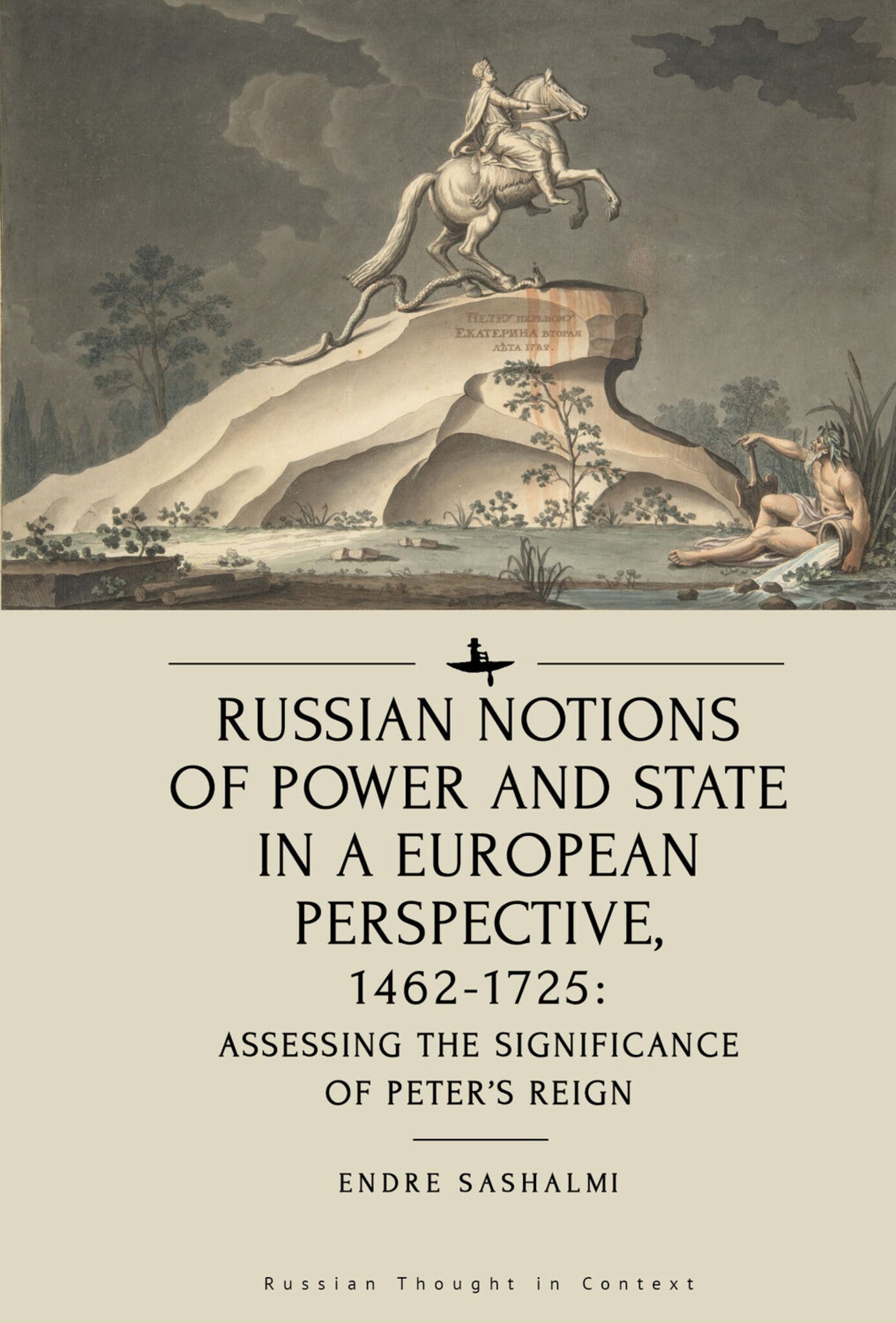


"Sashalmi's intellectually stimulating and deeply researched book analyzes how Muscovite (starting with the accession of Ivan III in 1462) and Petrine political thought—focused on conceptions of power, rulership, and the state—differed from that of Western Christendom, and also how in the reign of Peter I thinkers such as Feofan (Prokopovich) changed Russian ideology. Sashalmi has mastered an enormous historiography, primarily devoted to Muscovite and Petrine political culture but also concerned with the rise of the modern state in Western and Central Europe. The research is impressive, as is the author's ability to come to terms with complicated and nuanced treatments of political concepts and ideas."
—Elise Kimerling Wirtschafter, Kritika: Explorations in Russian and Eurasian History, Slavica Publishers
“This monograph draws on a considerable body of literature and provides valuable guidance for researchers interested in the subject…[A]worthy culmination of the author’s research activities in recent years and will be an essential read for both young and experienced scholars of Russian Studies.”
— Katalin Schrek, RussianStudiesHu
“Endre Sashalmi’s impressive work is supported by an imposing documentary base (primary and secondary). Specialists and students of the long durée of Russian history should read this work.”
— Steven A. Usitalo, Slavonic and East European Review
"This book is a product of remarkable scholarship covering multiple primary and secondary sources (with a thirty page long bibliography). ...I cannot recommend the monograph highly enough to any reader with an interest in European (and Russian) history of ideas."
— Anna Taitslin, New Zealand Slavonic Journal
"With his precise analyses of sources and the careful elaboration and evaluation of research, Endre Sashalmi's Notions of Power is an important contribution to the assessment of the pre-modern Russian understanding of the state. In his book, Sashalmi highlights the Petrine era as a phase of accelerated change from personal to abstract rule, but questions its characterization as an abrupt turning point against the background of the changes in ideas of state and rulership in the 17th century."
— Simon Dreher, Jahrbücher für Geschichte Osteuropas
“The book by Endre Sashalmi… is an erudite and thoughtful exploration of Russian thinking on the nature of power, authority, and self-determination over the period of some two and a half centuries that culminated in the era of Peter the Great. The book is based on a wide array of primary sources and provides an indispensable survey of Western and Russian historiography. Steeped in comparative and contextual methodology, the book offers an impressive synthesis of trajectories of the understanding of state and sovereignty in the West and in early modern Russia. … This book makes an important contribution to the growing body of research on the history of political ideas and political language in early modern Russia, rather than yet another survey of Russian political thought. While eschewing a conventional pre- and post-Petrine divide, Sashalmi offers a much-needed prequel to works on the eighteenth century, especially those by scholars associated with the recently shuttered German Historical Institute in Moscow.”
— Olga Tsapina, Ab Imperio
"E. Sashalmi has chosen a fascinating subject, and he has shown all its richness in a long term perspective, as well as its current relevance."
— Pierre Gonneau, Revue des études slaves (translated from the French)
“Russia Notions of Power and State meticulously reconstructs medieval and early modern sources to provide a coherent account of the Russian state and power that is shown to be different from European concepts and unique to Russian civilization. It helps explain why the rule of law is arbitrarily applied in Russia, why territorial integrity is considered so vital to Russian national interests, and why Russian rulers are not just leaders but embody the state itself in the person and actions. For those interested in what makes the Russian state distinctive and different from its western counterparts, Russian Notions of Power and State provides a clear picture why and helps us better understand Russian action and strategy in our increasingly fractured and contentious world.”
— Lee Trepanier, VoegelinView
“Sashalmi’s book gives a comprehensive analysis of the Russian notions of power and state, and provides critical analyses of the terminologies used by Western scholars. It is a valuable resource for academicians, researchers and students who study the history of the Russian state structure.”
— Ayse Dietrich, International Journal of Russian Studies
“Despite proposing a comparative perspective, Sashalmi skillfully manages to avoid the pitfalls of such an approach, by focusing on the locally developed Russian language of power and the reception of Western political concepts. … The result is a fresh perspective on familiar concepts such as gosudarstvo (state), samoderzhavie (autocracy), or tselnnosti (territorial integrity). … [T]hrough its use of a large variety of sources, the in-depth analysis of how (apparently) similar notions of power developed in Western and Muscovite tradition, and constant engagement with previous scholarship, Sashalmi makes a convincing case for the reappraisal of Early Modern Russian political culture.”
— Iulia Nitescu, Studii şi Materiale de Istorie Medie
“Sashalmi’s work meticulously chronicles the genesis and evolution of Russia’s modern state, and the notions behind its meaning and power—becoming an essential reference point for scholars of the long eighteenth century.”
— ECRSA 2023 Marc Raeff Book Prize Committee
“[T]he book under review by a leading Hungarian specialist on medieval and Petrine Russian history has many insights to offer. … Although written by a civilian rather than a legal historian, this is a volume that belongs in an advanced international law collection.”
— William E. Butler, Jus Gentium (Vol. 8, No. 1)
“The Hungarian scholar Endre Sashalmi has written many articles on Russian history in Hungarian and English. The present book is a significantly expanded and revised version of an earlier book of his published in Hungarian… After an Introduction in which he discusses aims, terminology, and genre, Sashalmi divides the book into three main sections: 1) in which he clarifies terms such as ‘autocracy’ and gosudarstvo and discusses the previous approaches to these and other terms; 2) in which he presents a “western perspective” of the notions of power in Russia; and 3) in which he seeks ‘to pinpoint the shifts in the perception of law and state in Russia introduced by [Feofan] Prokopovich,’ Archbishop of Novgorod. … He sees the reign of Peter I as ‘not beginning but accelerating’ the process of westernization.”
— Donald Ostrowski, Slavic Review
“Endre Sashalmi has produced one of the most challenging books anyone can write: a work of synthesis that is at the same time a major reconceptualization of a set of complex themes. He argues that Muscovite political culture is a vitally important lens for understanding early modern Russia, affecting everything from the Imperial succession, to the nature of monarchical power, to the very meaning of the Petrine reforms. Using a dizzying array of published primary and secondary sources (in several languages), Sashalmi’s book both summarizes where we are and moves us forward in our understanding of Russia and the entire western Eurasian space. It is a learned and lucid reappraisal that must be considered by all those working on the early modern centuries.”
— Russell E. Martin, Professor of History, Westminster College (Penna.)
Endre Sashalmi is a professor of history at the Department of Medieval and Early Modern History at the University of Pécs (Hungary), and is a doctor of the Hungarian Academy of Sciences. His main fields of academic interest and research are comparisons of Western and Russian political thought and political iconography from the 15th to the 18th century, as well as the issue of state formation in Russia and in early modern Europe.
Introduction. Explanation of Aims, Genre, and Terminology
PART ONE. Russia and Europe: Clarification of Terms and the Problem of the State
1. Issues of Methodology, Reception, and the Benefits of a Long-Term Approach
2. Territoriality, the Name, and the Nature of the Polity: From the Principality of Moscow to the Russian Empire
3. The Idea of the State in Western Christendom in the Late Middle Ages and the Early Modern Era
4. The Role of Metaphors and Allegorical Personifications in the Development of the Concept of the State in Western Christendom
5. The Meaning(s) of European Perspective
6. The Birth and Meaning of the “Russian State Narrative”
7. The Consequences of the State Narrative: The Discovery of Gosudarstvo by Russian History-Writing
8. Sixteenth- and Seventeenth-Century Muscovite Perceptions of Ruling Power: Characteristics and Methodological Aspects of a Comparison with Western Christendom
9. The Problem of Samoderzhavie
PART TWO. Notions of Power and State in the Context of “Proprietary Dynasticism”: Russia and the Western Perspective
10. Richard Pipes’s Patrimonial Interpretation of Russia Reconsidered in the Light of “Proprietary Dynasticism”
11. Aspects of Rulership and Their Relation to Each Other in Early Modern Europe and Russia: Proprietary, Office, and Divine Right
12. Divine Right of Kings and Divine Right of Tsars: Aspects and Lessons of a Comparison
PART THREE. The Origins of Theory of Law and State in the Works of Feofan Prokopovich: An Intellectual from the Kievan Nest in the Service of Peter the Great
13. Turning Points in the Life of Feofan Prokopovich, and His Most Important Political Works
14. Preliminary Notes on Prokopovich’s Theory of Law and State
15. Power, State, Law, Sovereignty, and Contractualism in Feofan Prokopovich’s Writings
16. Female Allegorical Personification of Russia during the Reign of Peter the Great and His Successors: Visual and Written Sources, and the Notion of State
Epilogue: The Importance of Gosudarstvennost′ in Contemporary Russia
Bibliography
Index