


Some error occured while loading the Quick View. Please close the Quick View and try reloading the page.
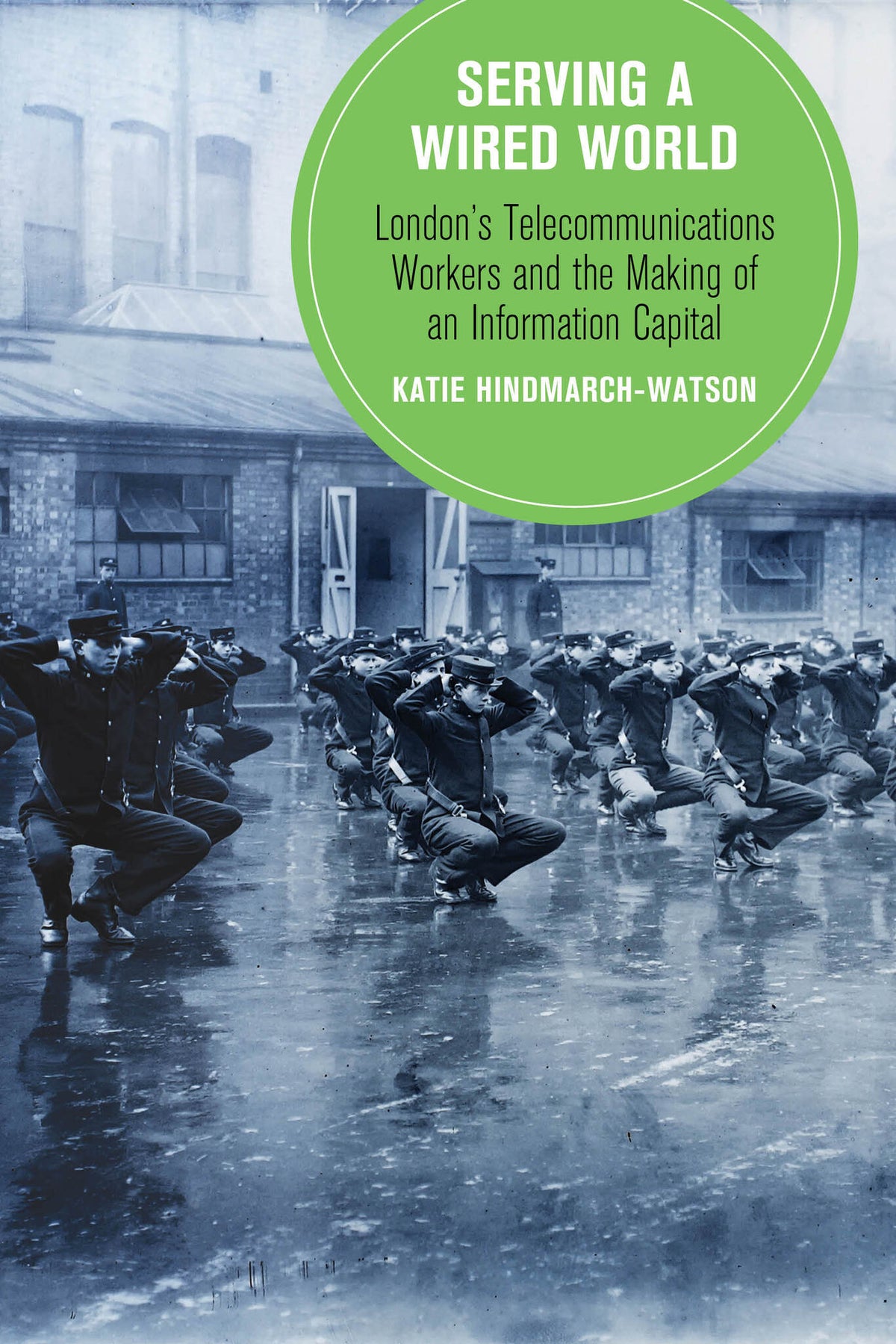
In the public imagination, Silicon Valley embodies the newest of the new—the cutting edge, the forefront of our social networks and our globally interconnected lives. But the pressures exerted on many of today’s communications tech workers mirror those of a much earlier generation of laborers in a very different space: the London workforce that helped launch and shape the massive telecommunications systems operating at the turn of the twentieth century. As the Victorian age ended, affluent Britons came to rely on information exchanged along telegraph and telephone wires for seamless communication: an efficient and impersonal mode of sharing thoughts, demands, and desires. This embrace of seemingly unmediated communication obscured the labor involved in the smooth operation of the network, much as our reliance on social media and app interfaces does today.
Serving a Wired World is a history of information service work embedded in the daily maintenance of liberal Britain and the status quo in the early years of the twentieth century. As Katie Hindmarch-Watson shows, the administrators and engineers who crafted these telecommunications systems created networks according to conventional gender perceptions and social hierarchies, modeling the operation of the networks on the dynamic between master and servant. Despite attempts to render telegraphists and telephone operators invisible, these workers were quite aware of their crucial role in modern life, and they posed creative challenges to their marginalized status—from organizing labor strikes to participating in deviant sexual exchanges. In unexpected ways, these workers turned a flatly neutral telecommunications network into a revolutionary one, challenging the status quo in ways familiar today.
Serving a Wired World is a history of information service work embedded in the daily maintenance of liberal Britain and the status quo in the early years of the twentieth century. As Katie Hindmarch-Watson shows, the administrators and engineers who crafted these telecommunications systems created networks according to conventional gender perceptions and social hierarchies, modeling the operation of the networks on the dynamic between master and servant. Despite attempts to render telegraphists and telephone operators invisible, these workers were quite aware of their crucial role in modern life, and they posed creative challenges to their marginalized status—from organizing labor strikes to participating in deviant sexual exchanges. In unexpected ways, these workers turned a flatly neutral telecommunications network into a revolutionary one, challenging the status quo in ways familiar today.

Price: $29.95
Pages: 288
Publisher: University of California Press
Imprint: University of California Press
Series: Berkeley Series in British Studies
Publication Date:
10 November 2020
Trim Size: 9.00 X 6.00 in
ISBN: 9780520344730
Format: Hardcover

"Serving a Wired World juxtaposes in colorful ways the varied tensions of the period: between administrators and workers, privacy and mediation, female and male employees, good boys and bad ones, order and rebellion. . . . Today’s information workers may recognize some of these tensions, particularly in how library labor is both integral and invisibilized in library operations and how administrative decisions inform public discourse on the labor of information."
"Serving a Wired World… provides a diverse range of sources and insightful analysis to present a rich account of the experiences and activities of telegraphists, telegraph boys, and telephonists."
"Serving a Wired World tells part of the compelling and complicated history of how we got here."
Katie Hindmarch-Watson is Assistant Professor of Modern British History at Johns Hopkins University.
List of Figures
Acknowledgment
Introduction
1 • Dispatches from Underground
2 • The Public Service of Discretion
3 • Gendering the Central Telegraph Office
4 • Bodied Telegraphy
5 • Unintended Networks
6 • Tapped Wires
7 • Martial Mercuries
8 • Voices on the Wires
Epilogue
Notes
Bibliography
Index
Acknowledgment
Introduction
1 • Dispatches from Underground
2 • The Public Service of Discretion
3 • Gendering the Central Telegraph Office
4 • Bodied Telegraphy
5 • Unintended Networks
6 • Tapped Wires
7 • Martial Mercuries
8 • Voices on the Wires
Epilogue
Notes
Bibliography
Index