


Some error occured while loading the Quick View. Please close the Quick View and try reloading the page.
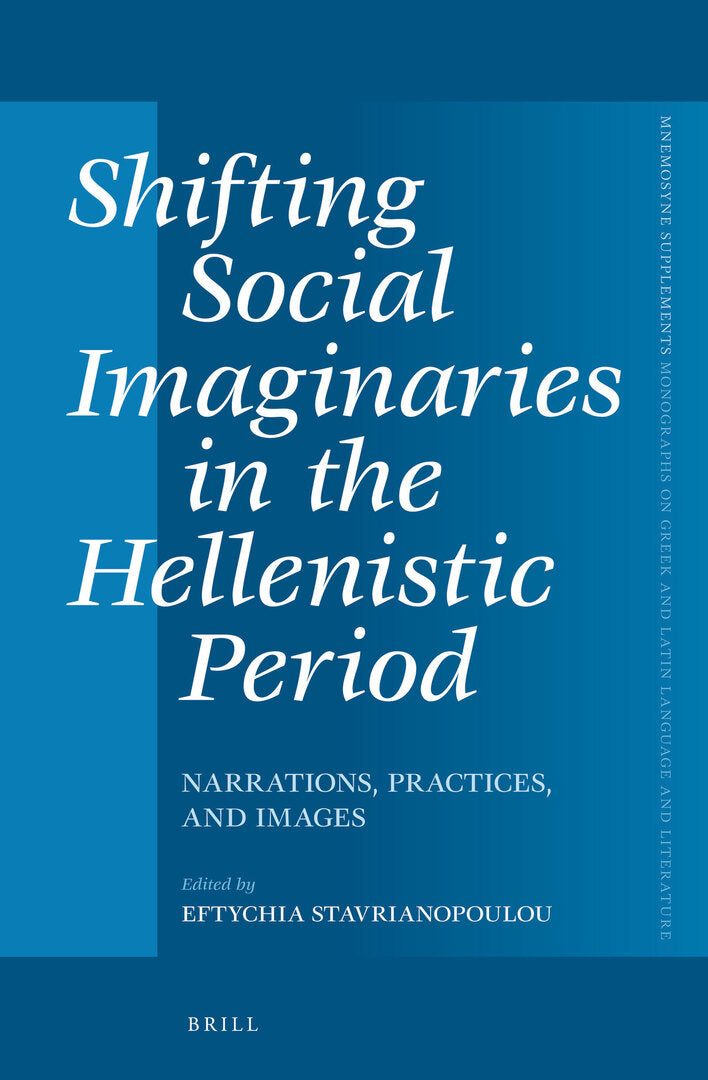
There is a long tradition in classical scholarship of reducing the Hellenistic period to the spreading of Greek language and culture far beyond the borders of the Mediterranean. More than anything else this perception has hindered an appreciation of the manifold consequences triggered by the creation of new spaces of connectivity linking different cultures and societies in parts of Europe, Asia and Africa. In adopting a new approach this volume explores the effects of the continuous adaptations of ideas and practices to new contexts of meaning on the social imaginaries of the parties participating in these intercultural encounters. The essays show that the seemingly static end-products of the interaction between Greek and non-Greek groups, such as texts, images, and objects, were embedded in long-term discourses, and thus subject to continuously shifting processes.

Price: $225.00
Pages: 436
Publisher: Brill
Imprint: Brill
Publication Date:
13 September 2013
ISBN: 9789004257986
Format: Hardcover

"Stavrianopoulou suggests the use of the idea of a “social imaginary” (...) This is an effective theoretical model for discussing intercultural relations in the ancient world, and the application of this line of thinking is utilized admirably and consistently by the authors in this volume, who use the concept of the “social imaginary” to understand the ways in which community identities are changed and reinterpreted based on interactions with each other and with other cultural influences during the Hellenistic period." Jennifer Finn, Bryn Mawr Classical Review 2014.03.63.
Eftychia Stavrianopoulou, D.Phil. (1987, Heidelberg) and Habilitation (2003, Heidelberg), is professor of Ancient History and member of the Cluster of Excellence “Asia and Europe” at the University of Heidelberg. She has published monographs and articles on Greek epigraphy, social history and ritual studies.
Contributors: Heather D. Baker, Omar Coloru, Andrew Erskine, Eleni Fassa, Gilles Gorre, Sylvie Honigman, Andrea Jördens, Deniz Kaptan, Rachel Mairs, Christian Marek, Christoph Michels, Jessica L. Nitschke, Eftychia Stavrianopoulou, Rolf Strootman, and Onno van Nijf.
Contributors: Heather D. Baker, Omar Coloru, Andrew Erskine, Eleni Fassa, Gilles Gorre, Sylvie Honigman, Andrea Jördens, Deniz Kaptan, Rachel Mairs, Christian Marek, Christoph Michels, Jessica L. Nitschke, Eftychia Stavrianopoulou, Rolf Strootman, and Onno van Nijf.