


Some error occured while loading the Quick View. Please close the Quick View and try reloading the page.
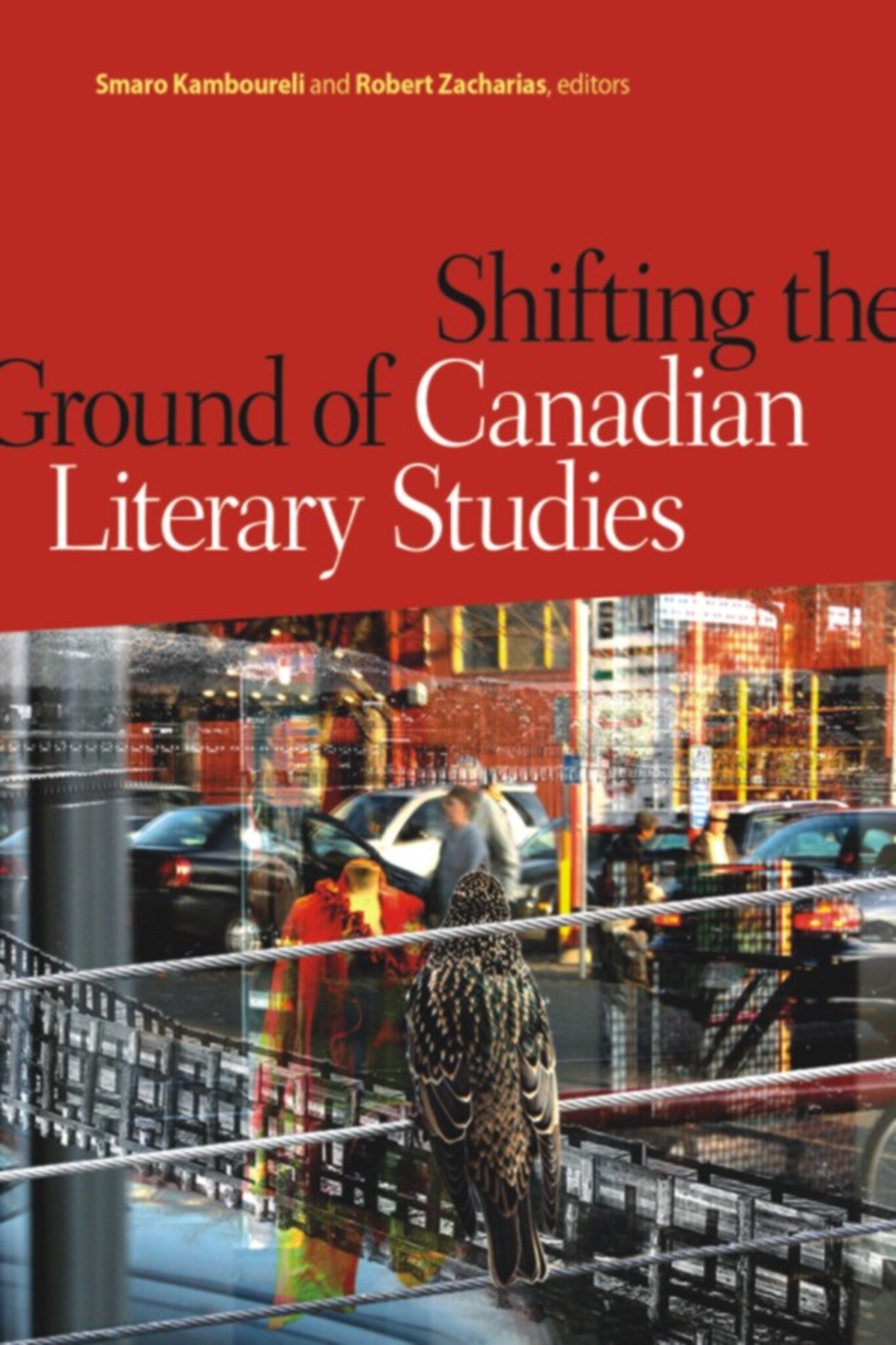
Shifting the Ground of Canadian Literary Studies is a collection of interdisciplinary essays that examine the various contexts—political, social, and cultural—that have shaped the study of Canadian literature and the role it plays in our understanding of the Canadian nation-state. The essays are tied together as instances of critical practices that reveal the relations and exchanges that take place between the categories of the literary and the nation, as well as between the disciplinary sites of critical discourses and the porous boundaries of their methods. They are concerned with the material effects of the imperial and colonial logics that have fashioned Canada, as well as with the paradoxes, ironies, and contortions that abound in the general perception that Canada has progressed beyond its colonial construction.
Smaro Kamboureli’s introduction demonstrates that these essays engage with the larger realm of human and social practices—throne speeches, book clubs, policies of accommodation of cultural and religious differences, Indigenous thought about justice and ethics—to show that literary and critical work is inextricably related to the Canadian polity in light of transnational and global forces.


— Brendan McCormack, Canadian Literature, 220, Spring 2014, 2014 October
This text represents a continuation of a significant groundswell in the realignment of the cultural criteria defining not just Canadian literature, but also Canadian culture and politics. By clear inference the value of such self-reflexive examination extends well beyond the borders of Canada and provides a relationship for a broadened redefinition of literature in general as well as Canadian literature and national indentity.... The historicity of literature as well as its communicative character should presuppose a relation of work, audience, and new work which takes the form of a dialogue as well as a process, and which can be understood in the relationship of message and receiver as well as in the relationship of question and answer, problem and solution. Shifting the Ground is about just that: the relation of old work and old voices to the new work and new voices in building a collective consciousness. While controversial, it is without question a critically important anthology of texts.
— Christopher Ward, Transnational Literature, November 2013, 2013 December
Given the wide range of approaches and disciplines included in this volume, the index is particularly helpful in terms of orientation and contains not only major concepts and historical events related to Canadian studies, but also refers to important representatives of the Canadian literary scene. Moreover, each articles comes with an annotated section which, together with the overall bibliography, provides useful and interesting suggestions for further reading and discussion. The book's strengths certainly lie in the fact that it manages to emphasize the importance of the nation-state which, in spite of all cosmopolitan, global, and transnational developments at work, continues to serve as an important conceptual framework within the area of Canadian literary studies. Thus this volume is especially valuable for Canadian literary scholars and critics interested in the current debates centering on the nation with regard to (trans)national and global challenges.
— Felicitas Schweiker, Anglistik: International Journal of English Studies, 25.2, September 2014, 2014 September
Shifting the Ground of Canadian Literary Studies explores the shift towards a foregrounding of the situational and material conditions influencing the production of Canadian literature.... [It] is a work of considerable scholarly achievement. Copiously annotated and with a comprehensive index, it is an excellent source for all interested in exploring the new direction of Canadian studies in the first decade of this millennium.
— Jane Mattisson Ekstam, Kristianstad University, Sweden, Cantext, March 2013, 2013 April
Smaro Kamboureli is a professor and the Avie Bennett Chair in Canadian Literature in the English Department at the University of Toronto. She is the founder of the TransCanada series of books, published by WLU Press, originating from interdisciplinary conferences that initiated collaborative research on the methodologies and institutional structures and contexts that inform and shape the production, dissemination, teaching, and study of Canadian literature. Her most recent publications include Shifting the Ground of Canadian Literary Studies (WLU Press 2012), co-edited with Robert Zacharias and Producing Canadian Literature: Authors Speak on the Literary Marketplace (WLU Press, 2013), co-edited with Kit Dobson.
Table of Contents for Shifting the Ground of Canadian Literary Studies, edited by Smaro Kamboureli and Robert Zacharias
Preface | Smaro Kamboureli and Robert Zacharias
Introduction: Shifting the Ground of a Discipline: Emergence and Canadian Literary Studies in English | Smaro Kamboureli
National Literatures in the Shadow of Neoliberalism | Jeff Derksen
"Beyond CanLit(e)": Reading. Interdisciplinarity. Transatlantically. | Danielle Fuller
White Settlers and the Biopolitics of State Building in Canada | Janine Brodie
"Some Great Crisis": Vimy as Originary Violence | Robert Zacharias
Amplifying Threat: Reasonable Accommodations and Quebec's Bouchard–Taylor Commission Hearings (2007) | Monika Kin Gagnon and Yasmin Jiwani
The Time Has Come: Self and Community Articulations in Colour. An Issue and Awakening Thunder | Larissa Lai
Archivable Concepts: Talonbooks and Literary Translation | Kathy Mezei
Is CanLit Lost in Japanese Translation? | Yoko Fujimoto
The Cunning of Reconciliation: Reinventing White Civility in the "Age of Apology" | Pauline Wakeham
The Long March to "Recognition": Sákéj Henderson, First Nations Jurisprudence, and Sui Generis Solidarity | Len Findlay
bush/writing: embodied deconstruction, traces of community, and writing against the state in indigenous acts of inscription | peter kulchyski
Notes
Works Cited
Contributors
Index