


Some error occured while loading the Quick View. Please close the Quick View and try reloading the page.
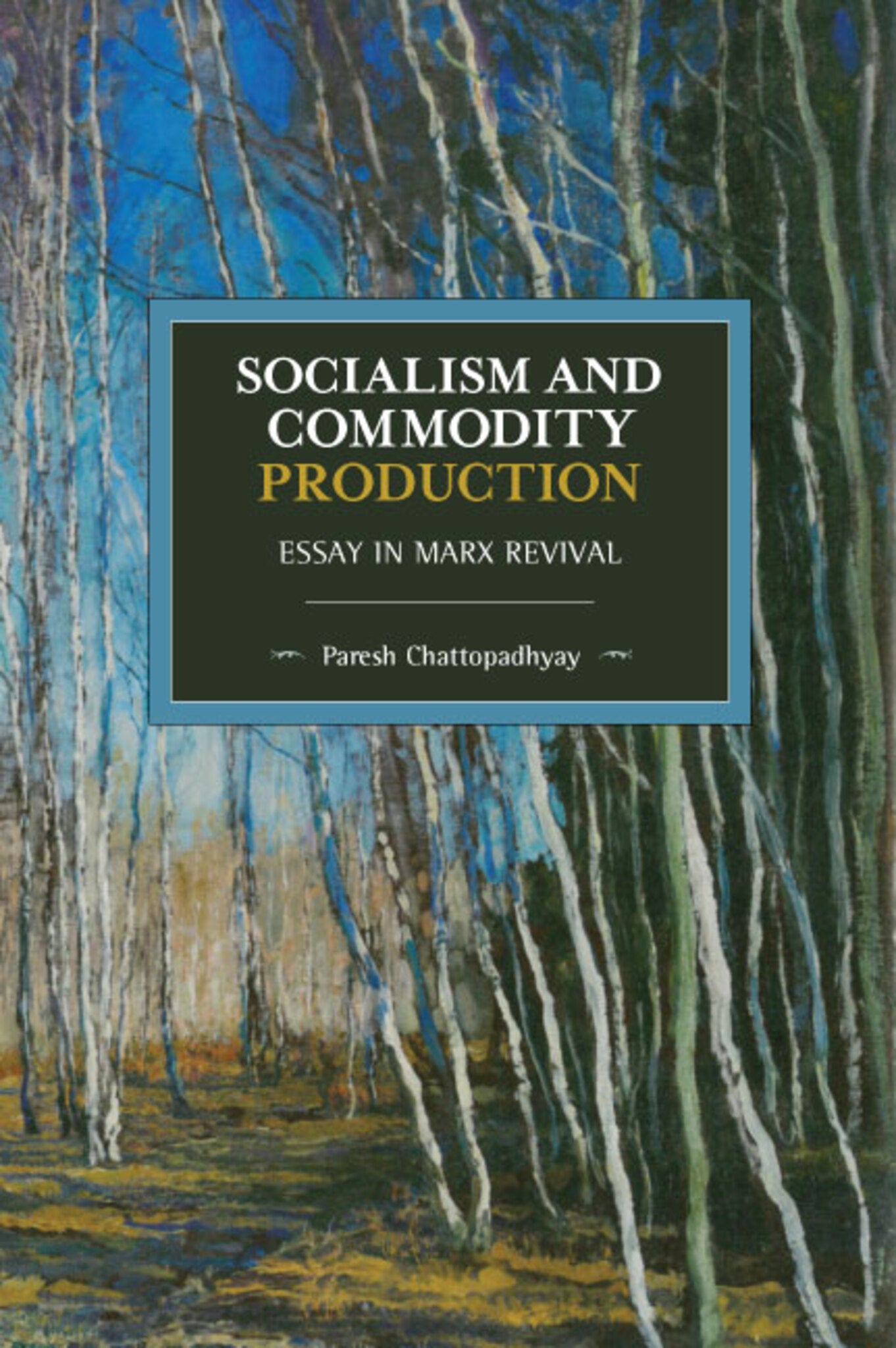
"Socialism" is a word that is now habitually taken to refer to a particular social system that prevailed in different parts of the globe during the twentieth century. This system was defined primarily by single-party rule with public (mainly state) ownership of the means of production along with a centrally planned economy. Its material base was generalised commodity production. The spokespersons of this system claim that this socialism was derived from Marx.
Paresh Chattopadhyay's Socialism and Commodity Production argues the falsity of this claim. On the basis of a comprehensive study of Marx's own texts, as well as a detailed engagement with a wide variety of theorists of socialist economics, it shows that Marx's socialism constituted an "Association" of free individuals in which private ownership, the commodity, wage labor and the state have no place.


“There are few things in the world as complicated as capitalism, and that has made it very easy for friends and foes of Marx alike to downplay or omit completely important parts of his analysis [...] Yet, the potential of capitalism to evolve into communism is scattered all over Marx's writings, early and late, and is an essential part of his thinking [...] Paresh Chattopadhyay is one of the few scholars who does justice to this dimension of Marxism, and he – and his latest work – deserve our closest attention and thanks. Highest marks!”
—Bertell Ollman, NYU
“This valuable book will surely contribute to both a revival of interest in Marx’s emancipatory ideas and the [...] impending process of revolutionary renewal.”
—George Liodakis, Capital & Class
Paresh Chattopadhyay, State Doctorate in Economic Sciences (1964), University of Paris, has published many articles, as well as the book The Marxian Concept of Capital and the Soviet Experience (Praeger, 1994; translated into Japanese in 1999). He is Professor of Political Economy in the Faculty of Human Sciences, University of Quebec in Montreal.
Table of Contents
Preface
Prologue
Twentieth-Century Socialism
Socialism as Minority Rule
Lenin's Role
The Relevance of Marx
A Caricature of Marx's Socialism
1 On Socialism: Association of Free Individuals
(Pre)conditions of Socialism
Associated Mode of Production
Ownership Relation
Exchange Relations
Distribution/Allocation
Labouring Individual under Socialism
2 Commodity Production
From Commodity to Capital
Paradoxes and Contradictions
On the Value Form
Commodity Circulation: Possibility of Crisis
3 Simple Commodity Production
The Problem
Discussion after Engels
The Critics
Criticisms Discussed
Conclusion
4 Commodity Production and Socialism in Marx's Followers
The First Followers: August Bebel and Karl Kautsky
Marxians after Kautsky
5 On Socialist Accounting
The Labour Process
Point of Departure
How to Proceed
Labour Time: Neglected Aspects
Labour Time and Non-labour Time
Socialist Accounting Framework
On Planning and the Unit of Calculation
6 Anarchist Communism
Peter Kropotkin
Carlo Cafiero
Anarchism and Marx: The Relation
7 Concerning Guild Socialism
Introduction
Guild Socialism as Democracy
Distribution and Allocation in Guild Socialism
Consumers and Producers
Transformation of the Existing Society
Ambiguities and Contradictions
8 On Market Socialism
Origin of Market Socialism
The Competitive Solution
Criticisms
Feasible Socialism
Analytical Market Socialism
Market Socialism Proper
Market Socialism - &'Marxian'
Market Socialism is Capitalism
9 The Problematic of a Non-capitalist Road to Socialism
Capital's Positive Contribution
The Controversy
Controversy Continued
Further Considerations
Epilogue
Illusion of the Epoch: Twentieth-Century Socialism
Preliminaries
Nature of Twentieth-Century Socialism
The Party-State
The Fundamental Question
References
Index