


Some error occured while loading the Quick View. Please close the Quick View and try reloading the page.
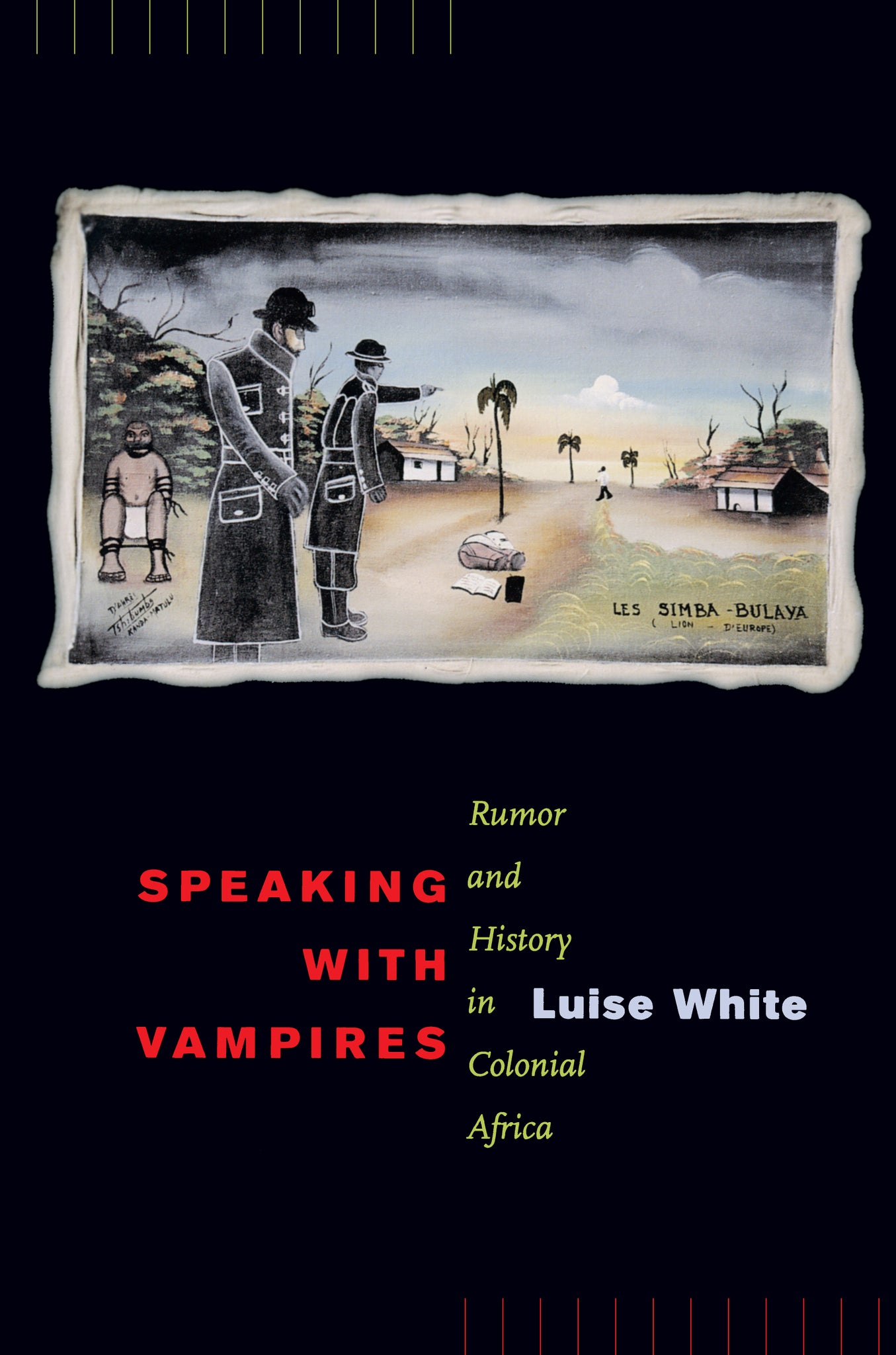
During the colonial period, Africans told each other terrifying rumors that Africans who worked for white colonists captured unwary residents and took their blood. In colonial Tanganyika, for example, Africans were said to be captured by these agents of colonialism and hung upside down, their throats cut so their blood drained into huge buckets. In Kampala, the police were said to abduct Africans and keep them in pits, where their blood was sucked. Luise White presents and interprets vampire stories from East and Central Africa as a way of understanding the world as the storytellers did. Using gossip and rumor as historical sources in their own right, she assesses the place of such evidence, oral and written, in historical reconstruction.
White conducted more than 130 interviews for this book and did research in Kenya, Uganda, and Zambia. In addition to presenting powerful, vivid stories that Africans told to describe colonial power, the book presents an original epistemological inquiry into the nature of historical truth and memory, and into their relationship to the writing of history.
During the colonial period, Africans told each other terrifying rumors that Africans who worked for white colonists captured unwary residents and took their blood. In colonial Tanganyika, for example, Africans were said to be captured by these agents of c
White conducted more than 130 interviews for this book and did research in Kenya, Uganda, and Zambia. In addition to presenting powerful, vivid stories that Africans told to describe colonial power, the book presents an original epistemological inquiry into the nature of historical truth and memory, and into their relationship to the writing of history.
During the colonial period, Africans told each other terrifying rumors that Africans who worked for white colonists captured unwary residents and took their blood. In colonial Tanganyika, for example, Africans were said to be captured by these agents of c

Price: $33.95
Pages: 368
Publisher: University of California Press
Imprint: University of California Press
Series: Studies on the History of Society and Culture
Publication Date:
28 April 2023
ISBN: 9780520922297
Format: eBook

List of Maps
Acknowledgments
A Note on Currencies and Talk
PART ONE
I. Blood and Words: Writing History with (and about)
Vampire Stories
2. Historicizing Rumor and Gossip
PART TWO
3· "Bandages on Your Mouth": The Experience
of Colonial Medicine in East and Central Africa
4· "Why Is Petrol Red?" The Experience of Skilled
and Semi-Skilled Labor in East and Central Africa
PART THREE
5· "A Special Danger": Gender, Property, and Blood
in Nairobi, 1919-1939
6. "Roast Mutton Captivity": Labor, Trade,
and Catholic Missions in Colonial Northern
Rhodesia
7· Blood, Bugs, and Archives: Debates over Sleeping-
Sickness Control in Colonial Northern Rhodesia,
1931-1939
8. Citizenship and Censorship: Politics, Newspapers,
and "a Stupefier of Several Women" in Kampala
in the 1950s
9· Class Struggle and Cannibalism: Storytelling and
History Writing on the Copperbelts of Colonial
Northern Rhodesia and the Belgian Congo
10. Conclusions
Bibliography
Credits
Index
Acknowledgments
A Note on Currencies and Talk
PART ONE
I. Blood and Words: Writing History with (and about)
Vampire Stories
2. Historicizing Rumor and Gossip
PART TWO
3· "Bandages on Your Mouth": The Experience
of Colonial Medicine in East and Central Africa
4· "Why Is Petrol Red?" The Experience of Skilled
and Semi-Skilled Labor in East and Central Africa
PART THREE
5· "A Special Danger": Gender, Property, and Blood
in Nairobi, 1919-1939
6. "Roast Mutton Captivity": Labor, Trade,
and Catholic Missions in Colonial Northern
Rhodesia
7· Blood, Bugs, and Archives: Debates over Sleeping-
Sickness Control in Colonial Northern Rhodesia,
1931-1939
8. Citizenship and Censorship: Politics, Newspapers,
and "a Stupefier of Several Women" in Kampala
in the 1950s
9· Class Struggle and Cannibalism: Storytelling and
History Writing on the Copperbelts of Colonial
Northern Rhodesia and the Belgian Congo
10. Conclusions
Bibliography
Credits
Index