


Some error occured while loading the Quick View. Please close the Quick View and try reloading the page.
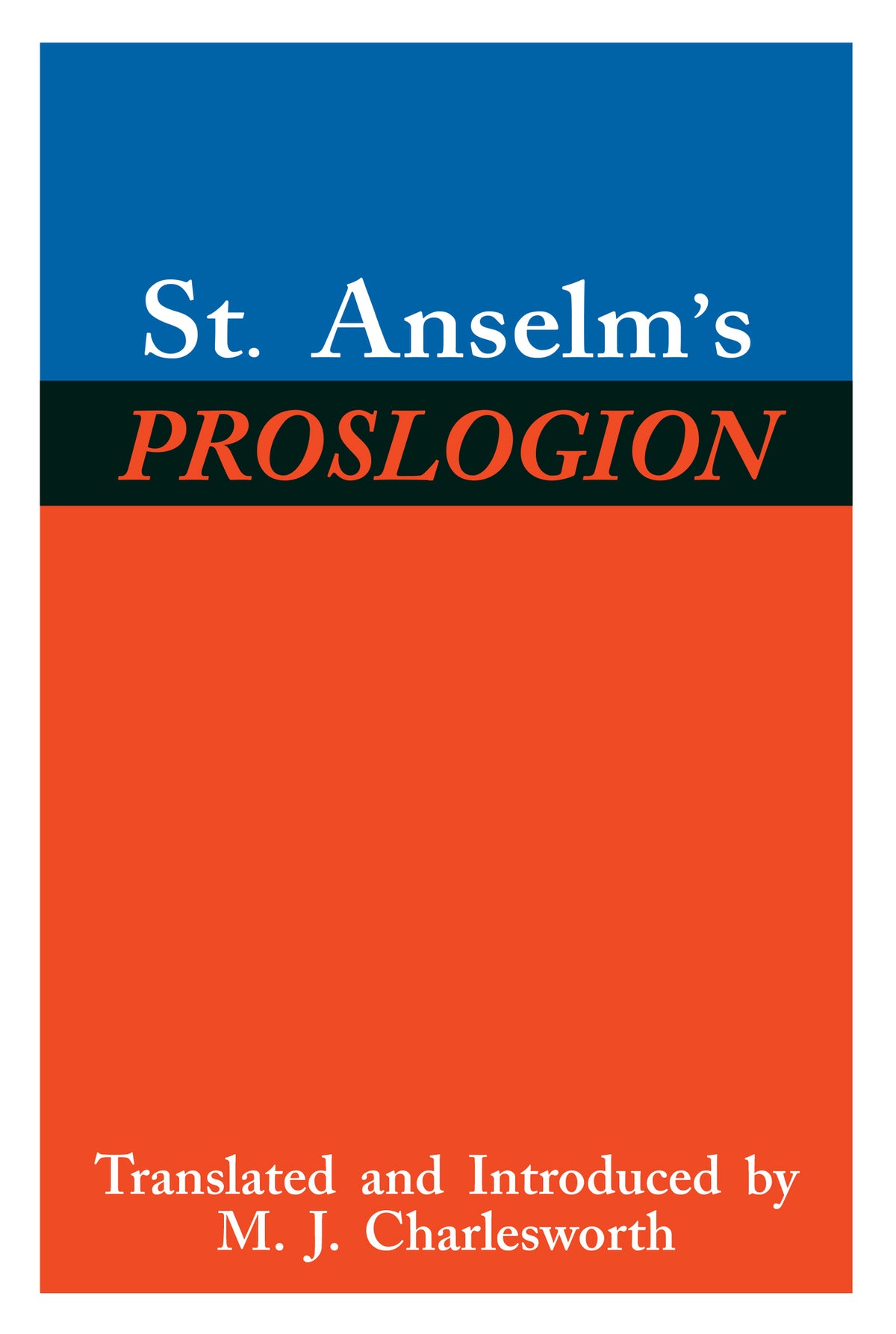
In the Proslogion, St. Anselm presents a philosophical argument for the existence of God. Anselm's proof, known since the time of Kant as the ontological argument for the existence of God, has played an important role in the history of philosophy and has been incorporated in various forms into the systems of Descartes, Leibniz, Hegel, and others.
Included in this edition of the Proslogion are Gaunilo's "A Reply on Behalf of the Fool" and St. Anselm's "The Author's Reply to Gaunilo." All three works are in the original Latin with English translation on facing pages. Professor Charlesworth's introduction provides a helpful discussion of the context of the Proslogion in the theological tradition and in Anselm's own thought and writing.


"A most useful edition, with Latin text and Professor Charlesworth's lucid translation on facing pages. The Introduction consists of a succinct historical sketch of the ontological argument, a biographical chapter on St. Anselm and his times, and an illuminating exposition of his thought, with particular reference to the relationship of his ideas to those of St. Augustine, and a thoroughgoing refutation of Barth's interpretation of Anselm." —Reprint Bulletin Book Reviews
"An excellent translation, introduction, and commentary on this important theological treatise. . . . The author's point of view is that though Anselm sees reason as operating within the realm of faith, he also sees it as operating 'prior to and independently of faith' so that the argument of this treatise is intended to have validity not only for the believer but also for the unbeliever." —Choice
Anselm of Canterbury (1033/4-1109), also called Anselm of Aosta (Italian: Anselmo d'Aosta) after his birthplace and Anselm of Bec (French: Anselme du Bec) after his monastery, was a Benedictine monk, abbot, philosopher and theologian of the Catholic Church, who held the office of archbishop of Canterbury from 1093 to 1109. After his death, he was canonized as a saint.
Maxwell John Charlesworth AO FAHA (1925–2014), was an Australian philosopher and public intellectual. He taught and wrote on a wide range of areas including the philosophy of religion and the role of the Church in a liberal democratic society; Australian Aboriginal culture and religions; European philosophy from medieval to continental; bioethics and modern science’s role in society; and the philosophy of education. In 1990, he was made an Officer of the Order of Australia for his contributions to Australian society in the fields of education and bioethics.