


Some error occured while loading the Quick View. Please close the Quick View and try reloading the page.
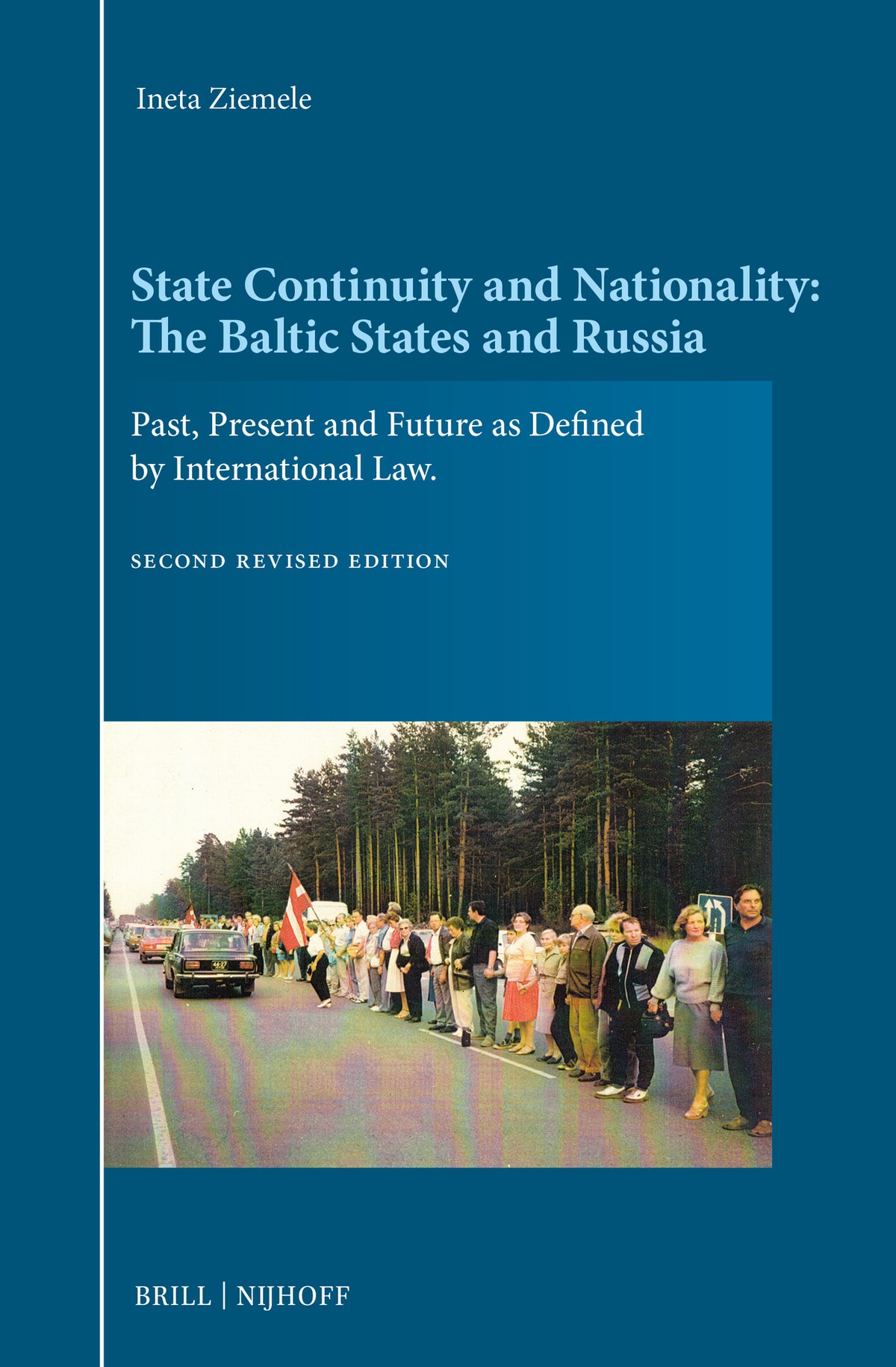
This work was award as one of the Latvian Academy of Sciences’ Most Significant Achievements in Fundamental Research in 2025.
Political changes in Central and Eastern Europe in the 1990s led to important territorial changes and confronted decision-makers and international lawyers with complex questions relevant to State continuity and succession. The case of the Baltic States was particularly difficult since they re-emerged after half-a-century of Soviet occupation. In addition to questions on the status of new States, important issues arose with regard to the fate of nationals of the former federations, generating frantic international efforts in developing and consolidating available rules and principles on nationality in situations of territorial change. In this context, the Baltic case stood apart. It raised questions of non-recognition of consequences of their illegal occupation in international law, but that was not the way the issues were dealt with.
The book documents and examines the story of the Soviet occupation of the Baltic States in 1940 and their claim to State continuity fifty years later. It brings in the issue of the obligations of Russia in this context. The book asks the question what nationality solutions had to be adopted in the region and shows the scrutiny they received from international institutions. This second edition of the book revisits decisions that were taken in the 1990s and asks whether they have withstood the test of time. The case of the Baltic States is an example of the strength of international law rules, when applied with courage, and of the risks, when too many compromises with rules and principles are accepted. Although the book is specific in its coverage, it is of general importance because it draws conclusions concerning developments in law and practice which are relevant for a better understanding and regulation of statehood and nationality in international law.
Political changes in Central and Eastern Europe in the 1990s led to important territorial changes and confronted decision-makers and international lawyers with complex questions relevant to State continuity and succession. The case of the Baltic States was particularly difficult since they re-emerged after half-a-century of Soviet occupation. In addition to questions on the status of new States, important issues arose with regard to the fate of nationals of the former federations, generating frantic international efforts in developing and consolidating available rules and principles on nationality in situations of territorial change. In this context, the Baltic case stood apart. It raised questions of non-recognition of consequences of their illegal occupation in international law, but that was not the way the issues were dealt with.
The book documents and examines the story of the Soviet occupation of the Baltic States in 1940 and their claim to State continuity fifty years later. It brings in the issue of the obligations of Russia in this context. The book asks the question what nationality solutions had to be adopted in the region and shows the scrutiny they received from international institutions. This second edition of the book revisits decisions that were taken in the 1990s and asks whether they have withstood the test of time. The case of the Baltic States is an example of the strength of international law rules, when applied with courage, and of the risks, when too many compromises with rules and principles are accepted. Although the book is specific in its coverage, it is of general importance because it draws conclusions concerning developments in law and practice which are relevant for a better understanding and regulation of statehood and nationality in international law.

Price: $246.00
Pages: 614
Publisher: Brill
Imprint: Brill | Nijhoff
Publication Date:
28 August 2025
ISBN: 9789004679610
Format: Hardcover

“Since the return of the Baltic States to independence, the development of their nationality law, the balancing of their claim to national unity and the rights to be granted to the Soviet-time settlers has been of the greatest concern for these countries as a matter both of secure existence and of human rights. The author of the present work, Judge Ineta Ziemele, has probably been the most influential individual contributor to this process, both in her academic work and in her role as a domestic as well as European Judge. In her book she thus reviews and updates a story to which she herself has been an actor. Putin’s restorative imperialism behind Russia ‘s war of aggression against Ukraine makes this book essential reading."
Munich/The Hague, March 2025
Bruno Simma, Emeritus Professor, Ludwig-Maximilians-Universität München and a former judge of the International Court of Justice (ICJ).
“It is great merit of Dr. Ziemele’s work that she locates the specific questions of interest to the Baltic States and their peoples within the general framework of international law. (..) The result is a valuable account both of the specific and the general."
Cambridge, November 2005
James Crawford†, at the time Whewell Professor of International Law, University of Cambridge
Munich/The Hague, March 2025
Bruno Simma, Emeritus Professor, Ludwig-Maximilians-Universität München and a former judge of the International Court of Justice (ICJ).
“It is great merit of Dr. Ziemele’s work that she locates the specific questions of interest to the Baltic States and their peoples within the general framework of international law. (..) The result is a valuable account both of the specific and the general."
Cambridge, November 2005
James Crawford†, at the time Whewell Professor of International Law, University of Cambridge
Ineta Ziemele is Judge at the Court of Justice of the European Union and Professor of International Law at the Riga Graduate School of Law in Latvia. Since 2017 she is a corresponding Member of the Latvian Academy of Sciences. She has served as President of the Latvian Constitutional Court and Judge on the European Court of Human Rights and President of Section. She received her legal education at the University of Latvia, Lund University (M.I.L.) and University of Cambridge (Ph.D.) and held Chevening, Fulbright, and Max Planck Institute for Comparative Public and International Law research scholarships. She is the founder and co-editor-in-chief of the Baltic Yearbook of International Law and member of advisory or editorial boards of the European Convention on Human Rights Law Review and International Journal on Minority and Groups Rights.