


Some error occured while loading the Quick View. Please close the Quick View and try reloading the page.
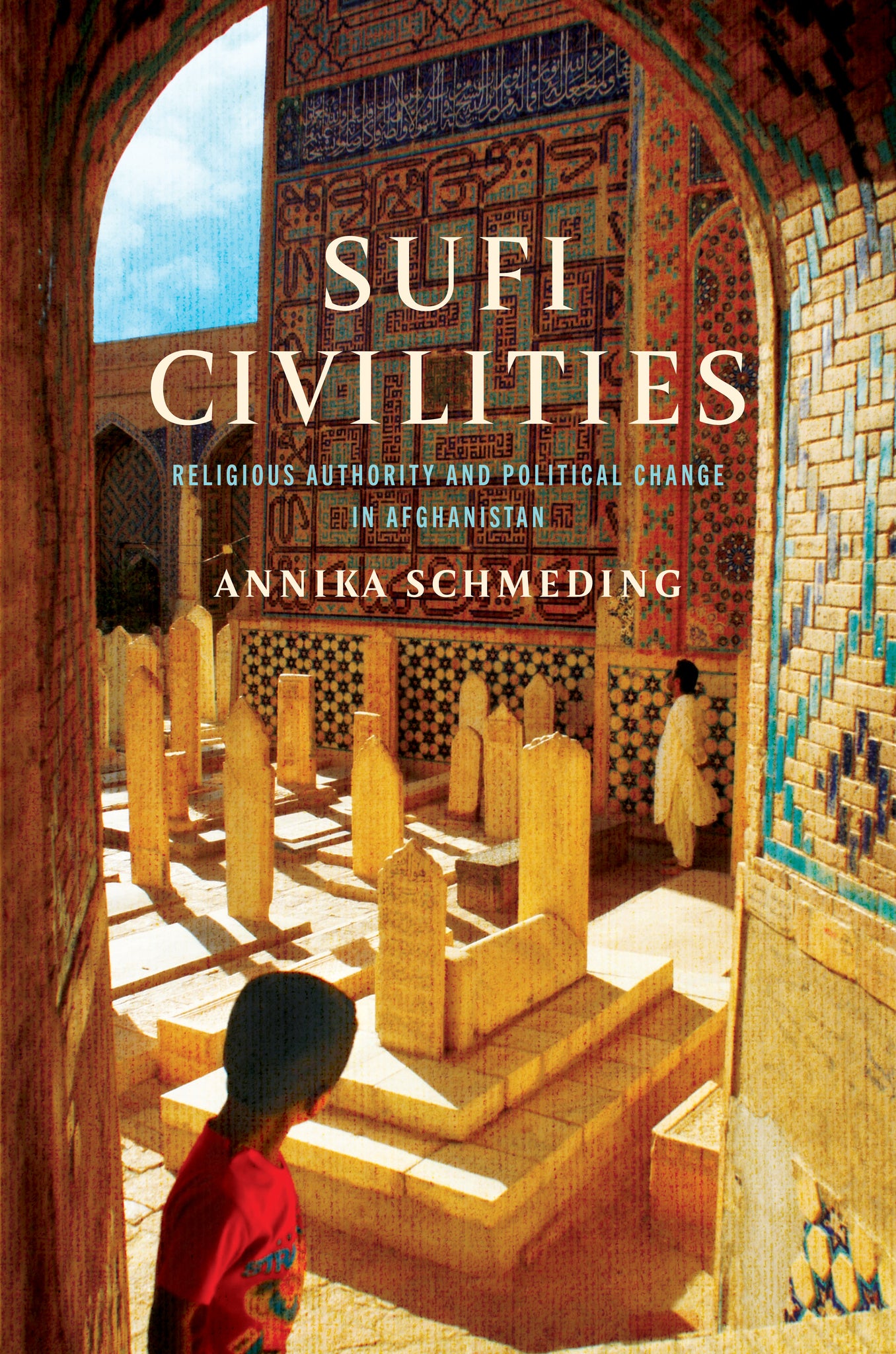
Despite its pervasive reputation as a place of religious extremes and war, Afghanistan has a complex and varied religious landscape where elements from a broad spectrum of religious belief vie for a place in society. It is also one of the birthplaces of a widely practiced variant of Islam: Sufism. Contemporary analysts suggest that Sufism is on the decline due to war and the ideological hardening that results from societies in conflict. However, in Sufi Civilities, Annika Schmeding argues that this is far from a truthful depiction. Members of Sufi communities have worked as resistance fighters, aid workers, business people, actors, professors, and daily workers in creative and ingenious ways to keep and renew their networks of community support.
Based on long-term ethnographic field research among multiple Sufi communities in different urban areas of Afghanistan, the book examines navigational strategies employed by Sufi leaders over the past four decades to weather periods of instability and persecution, showing how they adapted to changing conditions in novel ways that crafted Sufism as a force in the civil sphere. This book offers a rare on-the-ground view into how Sufi leaders react to moments of transition within a highly insecure environment, and how humanity shines through the darkness during times of turmoil.


"Sufi Civilities opens the door to a marvelous world of faith that lies hidden in plain sight. Schmeding's path breaking ethnographic account of diverse Sufi communities in contemporary Afghanistan is both new and exciting. Over the past half century they have outlasted every radical political regime that failed to appreciate just how deeply Sufism is embedded in Afghanistan's Islamic culture." —Thomas Barfield, Boston University
"Afghan Sufis have been hidden from view by attention to mujahidin, Taliban, and al-Qaida. Through astute anthropological observation, Annika Schmeding shows how Sufis became important players in the contests for religious authority that emerged from the cultural whirligig of a NATO-supported Islamic Republic. This is a major contribution to the study of modern Afghanistan." —Nile Green, University of California, Los Angeles
"Sufi Civilities will remain for decades a mandatory (English-language) text for understating the role of Islam in Afghanistan." —Kate Clark, Afghanistan Analysts Network
"Rather than the top-down approach to civil society imposed on Afghanistan, Sufi Civilities offers a blueprint of the strategies Sufi communities use that fit the bottom-up cultural structures of the country, highlighting new pathways for progress." —Soraya Afzali, British Journal of Middle Eastern Studies
"The ethnographic breadth of the work and the willingness to learn to think otherwise about matters of spiritual negotiation and authority are what lend this work its unique perspective... Schmeding's careful attention to their interlocuters' ways of knowing, dreaming, intuiting, valuing, and judging amid the dissolution of traditional orders is crucial to the book's role in revealing a philosophy of the self that takes seriously the occult and the place of gnosis in collective life."—Fatima Mojaddedi, International Journal of Middle East Studies
"Sufi Civilities is an important and beautifully written book. Its contribution to the anthropology of Islam is significant, particularly in its contestation of Western NGO-defined civil society and instead turning attention to more rooted forms of everyday piety." —Anika Kabani, Journal of the Anthropological Society of Oxford
"Sufi Civilities is an elegantly written, analytically nuanced, and ethnographically textured account of Sufis in Afghanistan. Obviously of interest to specialists of the country and wider region as well as scholars of Islam within and beyond Central and South Asia, its accessible style, carefully presented ethnographic material, and clear discussion of concepts will also make it a powerful addition to undergraduate and postgraduate reading lists in fields including but not limited to the anthropology of religion and religious studies." —Magnus Marsden, Journal of the Royal Anthropological Institute
"Sufi Civilities: Religious Authority and Political Change in Afghanistan challenges the simplified account of Afghan Islam by illuminating Sufi communities not as fading relics, but as dynamic political and spiritual actors." —Abishek Kumar Yadav, Economic & Political Weekly
Note on Transliteration Acknowledgmentsix
Introduction
1. Navigating the Past: Sufi Strategies of State Alignment, Contestation and Strategic Distance
2. Navigating Insecurity: Mullahs and Sufi Lodges
3. Navigating the Interior: Sufi Poetry as Islamic Education and Heritage
4. Gendered Navigation: Equality in Difference
5. Navigating the Divine through Dreams
Conclusion and Epilogue on Transitions
Glossary
Notes
References
Index