


Some error occured while loading the Quick View. Please close the Quick View and try reloading the page.
Timber high-rises: a new urban element
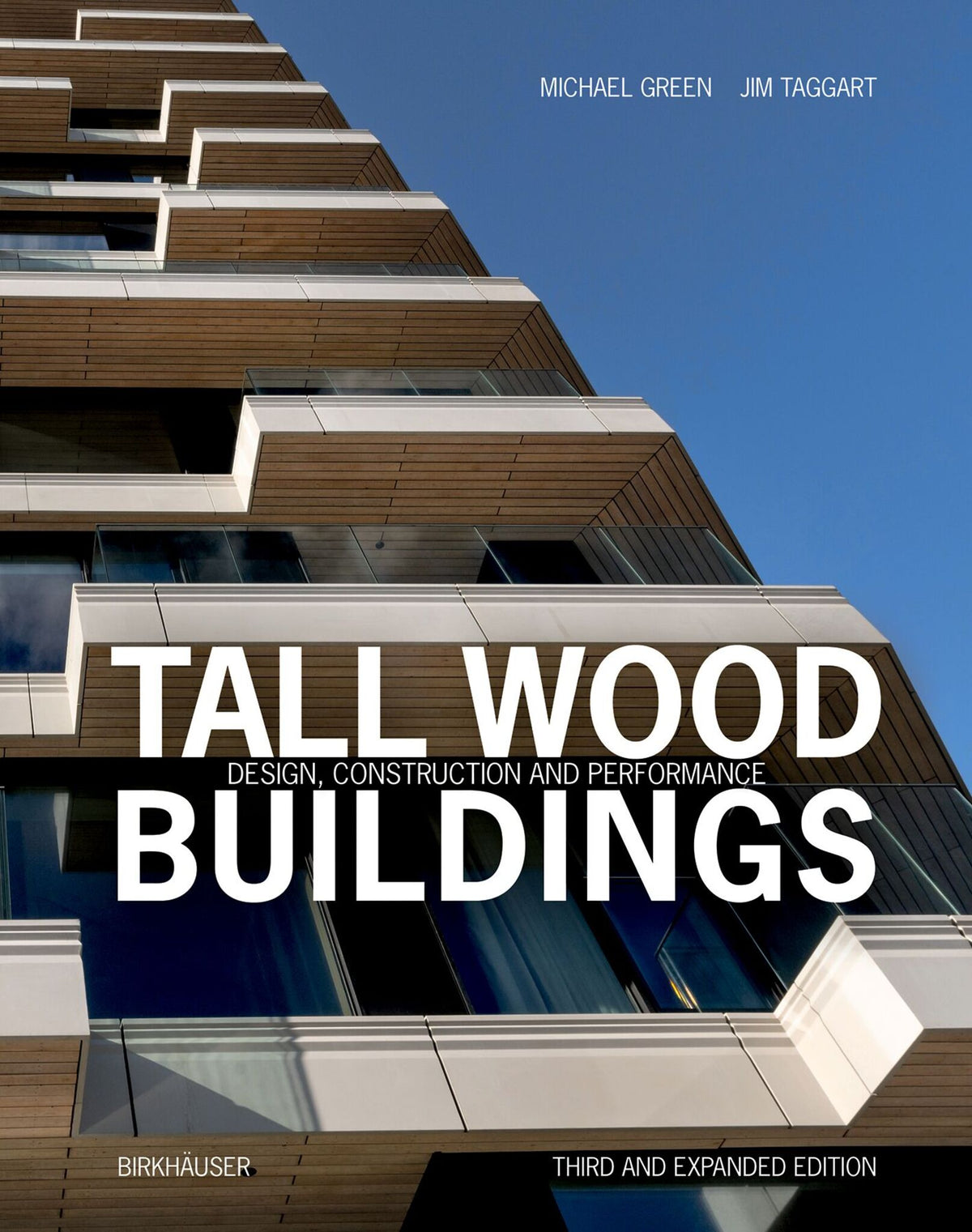
Tall wood buildings have been at the foreground of innovative building practice in urban contexts for a number of years. From London to Stockholm, from Vancouver to Melbourne timber buildings of up to 20 storeys have been built, are under construction or being considered. This dynamic trend was enabled by developments in the material itself, prefabrication and more flexibility in fire regulations. The low CO2 footprint of wood - often regionally sourced - is another strong argument in its favour. This publication explains the typical construction types such as panel systems, frame and hybrid systems. An international selection of 17 case studies is documented in detail with many specially prepared construction drawings, demonstrating the range of the technology. For this expanded edition, a new outlook chapter has been added as well as eight cutting-edge projects, among them Haut Amsterdam, EDGE Südkreuz Berlin and Sara Cultural Centre in Sweden.
- Spectacular international case studies
- Specifically prepared construction drawings explain structural details
- Authors are experienced specialists for timber construction


"Is there anything in architecture that wood cannot do? New engineering methods allow for the erection of timber buildings of unprecedented heights, creating healthier living and working environments in our cities. These new structures reduce the carbon footprint of the construction industry and tackle the global housing shortage in an eco-friendly way. They are practical, economical and at times beautiful. Tall Wood Buildings by Michael Green and Jim Taggart is a passionate plea for the use of advanced timber technologies in high-rise construction. Written by architects for architects, the book — now available in a second, expanded edition — embeds the technical subject matter and its contemporary relevance in a broad cultural context. […]
According to Green and Taggart, engineered-wood technologies will establish new collaborative relations between designers and builders. An integral thinking that considers digital modeling, off-site prefabrication and innovative transportation concepts is required. This gives architects the chance to reassert their role in society, by reconnecting to their ancient Greek ancestor, the architekton, or master carpenter. It remains to be seen if the master carpenter of the 21st century can solely rely on techno-ecological expertise to create masterly wood buildings. Greatness in architecture is not necessarily created by height. And optimized engineering methods carry the risk of erasing the architectural poetics of timber in the strive for sheer tallness. According to Green and Taggart, a cultural shift is necessary to open minds toward envisioning future cities made from wood rather than concrete. That shift must also include a rethinking of urban typologies to unfold not only the physical but also the associative qualities of the material, embedding it into its own history. In the quest towards a new wooden architecture, it is necessary to embrace the material’s special tectonics beyond the competition with steel and concrete. The book is a great contribution to creating the technological excitement and confidence architects need to work on that task."
Georg Windeck, «Vers une Architecture en Bois»;
"With
technical efficiency and editorial quality, this book takes stock of
the most ambitious step that wood architecture has made of in the last
decade: that of building highrises."
ArquitecturaViva 199 (2017), 69
"The
case studies are thoroughly presented in a way that will be useful to
professionals, both with regards to their architectural and structural
design. Tall Wood Buildings is a very important book for the future -
not only of architecture and construction - but also in presenting a
viable option of how we might build a sustainable future for our
planet."
David Valldeby in: www.canadianarchitect.com, 07/2017
Michael Green, Michael Green Architecture, Vancouver
Michael founded his architecture firm MGA | Michael Green Architecture, not for profit school DBR | Design Build Research and research platform TOE | Timber Online Education, to focus on progressive architecture, research, education and innovation. From Vancouver, British Columbia, he and his team work on international projects that are diverse in their scale, building type and location. A Fellow of the Royal Architectural Institute of Canada, Michael is vested in helping build healthier communities through innovative architecture, interiors, landscape and urban design. He is particularly known for his research, leadership and advocacy in promoting the use of wood in the built environment with extensive
international talks on the subject, including his 2013 TED talk which has been translated into 31 different languages and viewed over 1.3 million times
Jim Taggart, Sustainable Architecture and Building Magazine
Since leaving architectural practice in 1992, Jim has written and lectured extensively on the use of wood in contemporary architecture to audiences throughout North America and across the world. He is also the author of the award-winning books Toward a Culture of Wood Architecture (2011) and The Architecture of Engagement (2019). Jim has taught architecture at the British Columbia Institute of Technology in Vancouver since 2004, and has been editor of Sustainable Architecture and Building Magazine (SABMag) since its inception in 2006. He is a Fellow of the Royal Architectural Institute of Canada, Executive Director of the Royal Architectural Institute of Canada Foundation and was the recipient of the
2012 Premier of British Columbia’s ‘Wood Champion’ award.