


Some error occured while loading the Quick View. Please close the Quick View and try reloading the page.
Honorable Mention, Bernard S. Cohn Book Prize
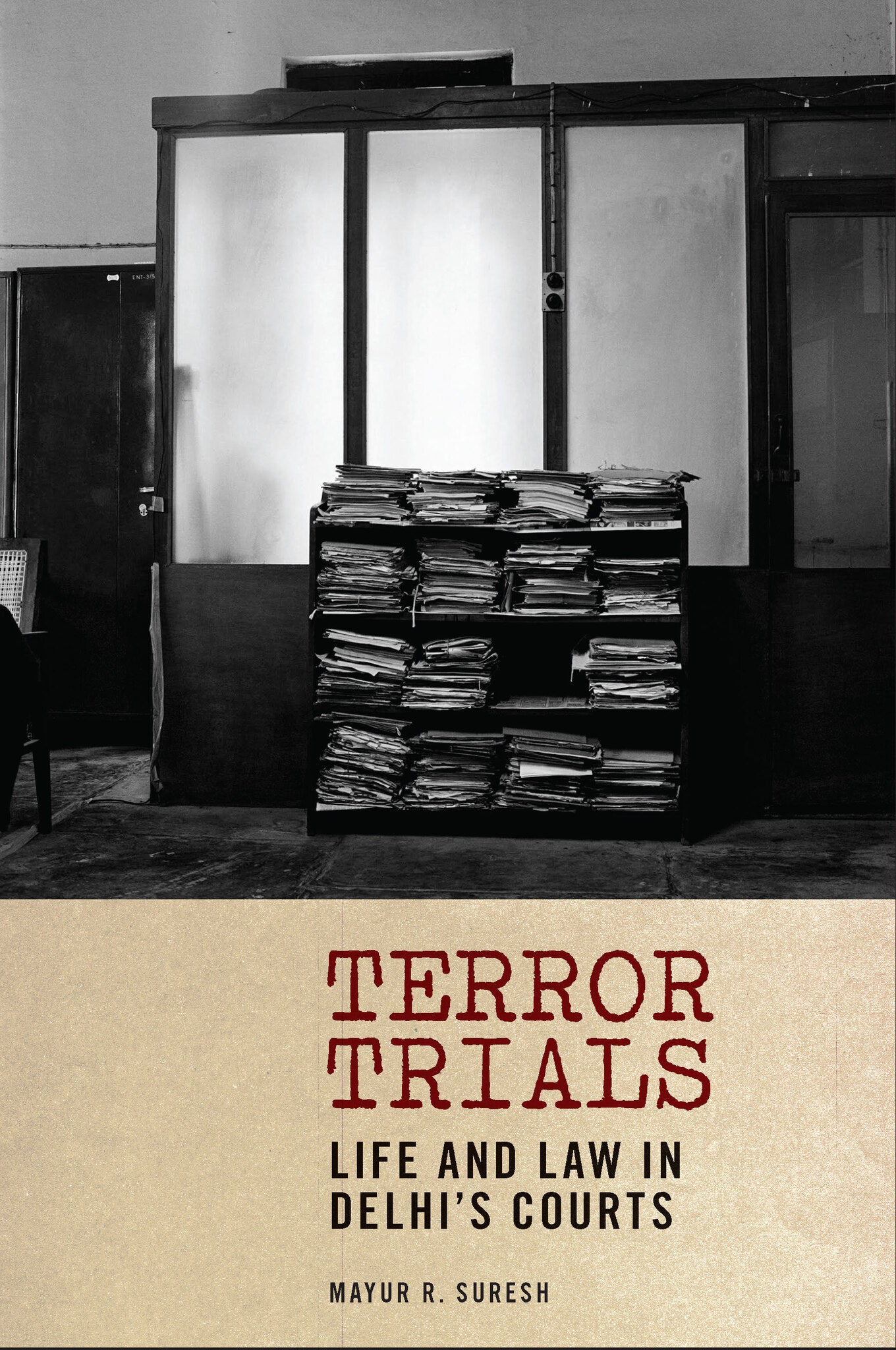
An ethnography of terrorism trials in Delhi, India, this book explores what modes of life are made possible in the everyday experience of the courtroom. Mayur Suresh shows how legal procedures and technicalities become the modes through which courtrooms are made habitable. Where India’s terror trials have come to be understood by way of the expansion of the security state and displays of Hindu nationalism, Suresh elaborates how they are experienced by defendants in a quite different way, through a minute engagement with legal technicalities.
Amidst the grinding terror trials—which are replete with stories of torture, illegal detention and fabricated charges—defendants school themselves in legal procedures, became adept petition writers, build friendships with police officials, cultivate cautious faith in the courts and express a deep sense of betrayal when this trust is belied. Though seemingly mundane, legal technicalities are fraught and highly contested, and acquire urgent ethical qualities in the life of a trial: the file becomes a space in which the world can be made or unmade, the petition a way of imagining a future, and investigative and courtroom procedures enable the unexpected formation of close relationships between police and terror-accused.
In attending to the ways in which legal technicalities are made to work in everyday interactions among lawyers, judges, accused terrorists, and police, Suresh shows how human expressiveness, creativity and vulnerability emerge through the law.


Terror Trials is an illuminating and novel legal ethnography that engages terrorism not as spectacular, but rather as a quotidian bureaucratic legal terrain that Suresh unknots with keenness and patience.---Sameena Mulla, Emory University
. . . [A] novel contribution to studying legal technicalities not merely as administrative obstacles, but as avenues of possibility. At the heart of Terror Trials is the stories of petitioners, who like Prometheus stealing fi re from the gods, draw on the law to carve out spaces of hope and agency.
The descriptions in this volume are vibrant and are used to great effect, challenging many presumptions of social-legal studies. This is a major contribution with relevance beyond India, important to all who study courts. Highly recommended.
. . . [A]n engaging and interesting read for both ordinary readers and academics.
Abbreviations and Glossary | ix
Introduction | 1
1 Custodial Intimacy: Law and the Police in Two Parts | 35
2 Recycled Legality: Doing Things with Legal Language | 71
3 Law and the Vulnerable State | 92
4 Hypertext: Files and the Fabrication of the World | 115
5 Certification and the Fabrication of Truths | 137
6 Petition Writing: Desire, Ethics, Mourning | 169
Conclusion: An Acquittal? | 199
Acknowledgments | 213
Notes | 219
References | 235
Index | 251