


Some error occured while loading the Quick View. Please close the Quick View and try reloading the page.
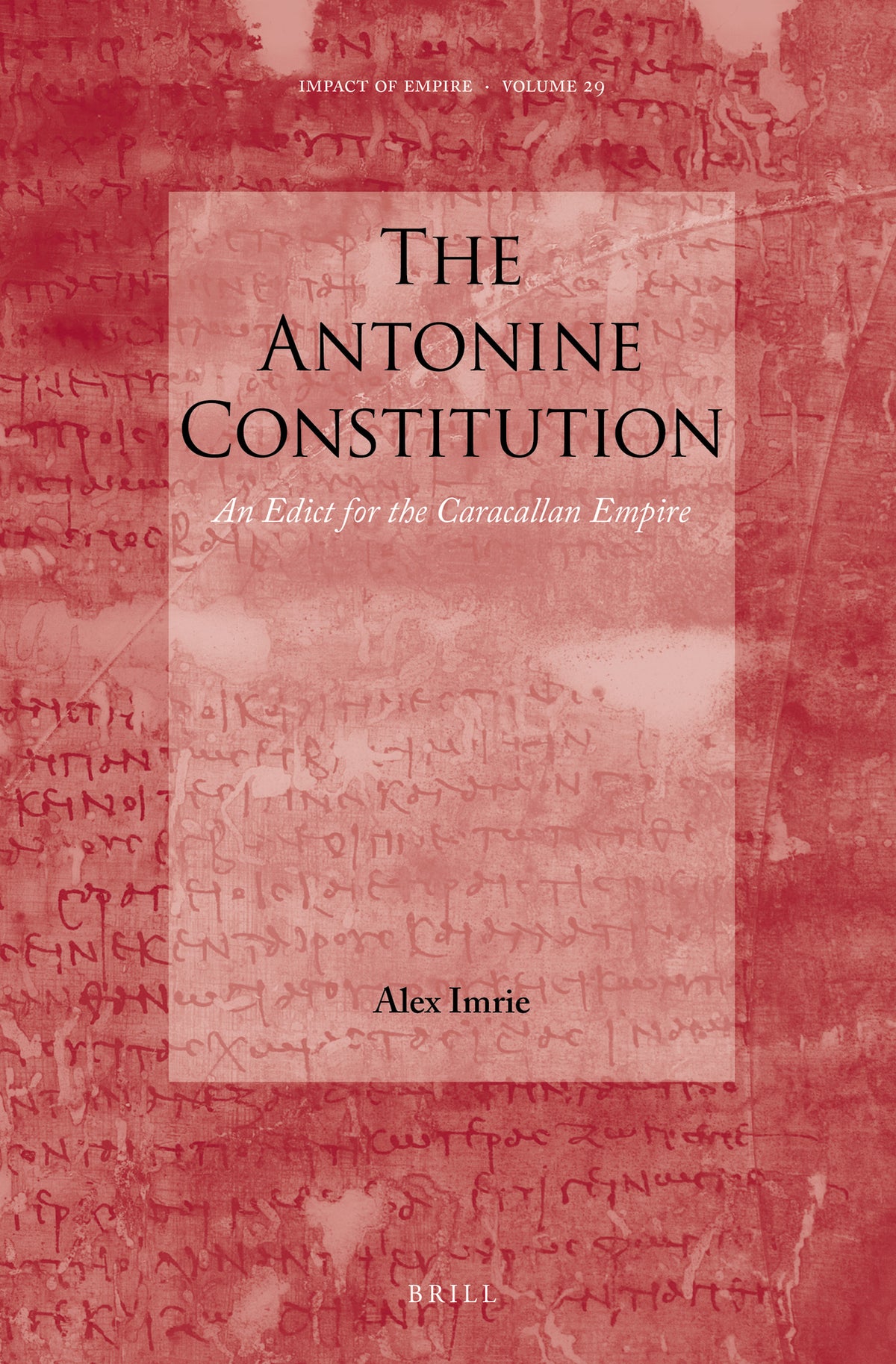
In The Antonine Constitution, Alex Imrie approaches the famous edict of AD 212 from numerous angles, offering an assessment of its rationale that is rooted in the dynamic period of the early third century. Controversial since its discovery, it is depicted here as a keystone in Caracalla’s attempt to revolutionise the public image of the Severan dynasty after murdering his brother.
There is an inherent paradox between the apparently progressive nature of the edict, and the volatile emperor responsible for it. The enigma is only heightened by a dearth of ancient evidence relating to the legislation. By combining literary and material evidence with the surviving papyrological record, Alex Imrie shows that Caracalla’s rationale is best understood in an embedded context.
There is an inherent paradox between the apparently progressive nature of the edict, and the volatile emperor responsible for it. The enigma is only heightened by a dearth of ancient evidence relating to the legislation. By combining literary and material evidence with the surviving papyrological record, Alex Imrie shows that Caracalla’s rationale is best understood in an embedded context.

Price: $135.00
Pages: 176
Publisher: Brill
Imprint: Brill
Publication Date:
June 1, 2018
ISBN: 9789004368224
Format: Hardcover

"In conclusion, this book is a good introduction both to the CA and to related scholarship. Chapter 1, on historical and literary contexts, makes the topic accessible and interesting to a broad audience of specialist and non-specialist readers alike. The discussion of the practical rationales in chapters 2 and 3 is comprehensive and summarizes, with added nuance, the general state of scholarship on the matter..."
Lydia Schriemer in BMCR 2019.03.28
"To close, the year 212 will continue to feature in any history of later Rome. What Imrie's book does very well is force us to ask both new and old questions of this moment, of the actual physical copies of the edict and the emperor and dynasty shaping this shift. This is then certainly a worthwhile read, with elements that show great promise." Anthony Smart, CJ-Online, 2019.11.07.
Lydia Schriemer in BMCR 2019.03.28
"To close, the year 212 will continue to feature in any history of later Rome. What Imrie's book does very well is force us to ask both new and old questions of this moment, of the actual physical copies of the edict and the emperor and dynasty shaping this shift. This is then certainly a worthwhile read, with elements that show great promise." Anthony Smart, CJ-Online, 2019.11.07.
Alex Imrie, Ph.D. (2015), is a Tutor in Classics at the University of Edinburgh. He divides his time between teaching and outreach activities across Scotland. He has published articles on Caracalla and the Severan period. This is his first monograph.