


Some error occured while loading the Quick View. Please close the Quick View and try reloading the page.
-K. C. Cole, author of The Universe and the Teacup
"An eager, ambitious book. A stimulating, accessible introduction to scientific theory."
-Dallas Morning News
An award-winning journalist surveys the horizon of a new revolution in science
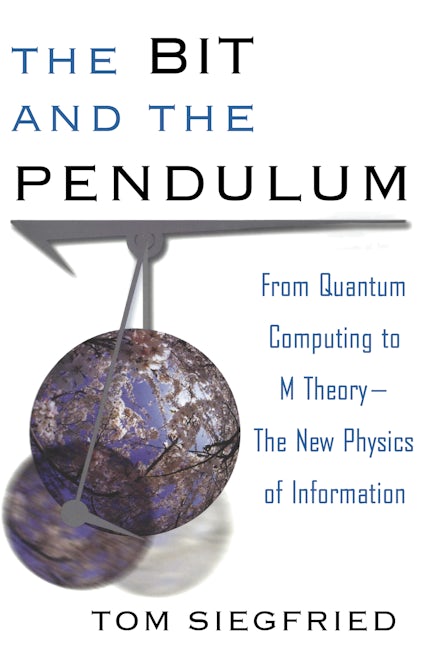
Everything in the universe, from the molecules in our bodies to the heart of a black hole, is made up of bits of information. This is the radical idea at the center of the new physics of information, and it is leading to exciting breakthroughs in a vast range of science, including the invention of a new kind of quantum computer, millions of times faster than any computer today. Acclaimed science writer Tom Siegfried offers a lively introduction to the leading scientists and ideas responsible for this exciting new scientific paradigm.


Information has a precise definition as the state of a system. The simplest bit of information is an either-or state, a zero or one, up or down, yes or no, or a protein either active or inactive (this last connects biology and information). Any system - an atom, a human, the universe - can be completely described by the answers to a few tens of yes-no questions (20 questions, anyone?); that is, a few tens of bits. An information processor, a computer, is a system that transforms its state, according to rules, into a new state. Do not underestimate the import of all this. The thesis developed in the book is that information is not a formal way of analyzing systems and their behavior. "Information is real. Information is physical," Siegfried writes. And later: "Information is more than a metaphor -it is a new reality." And the progression of events through time is computation, so the universe is essentially a huge. If mysterious, computer.
To illustrate, Siegfried begins with the idea of teleportation: "Beam me up, Scotty." If teleportation really exists - and Siegfried shows it does in some sense - it would consist of transporting not matter but the complete information about the structure of an object, every molecule of Captain Kirk, in such a way that the information in the previous location is destroyed. In this view of reality, Siegfried says, "information is the ultimate 'substance' from which all things are made"; witness the light of the recent headlines.
This concept, at most a few decades old in this form, is controversial. Learned opinions vary from complete acceptance to laughing rejection. This book is personal journalism. The author has met with many of the principal movers and shakers. He lets them speak for themselves and recounts his own intellectual journey. He has attended the scientific meetings and read the scientific papers. His primary mentors seem to have been the physicist John Wheeler, a professor of his at the University of Texas, Austin, and the late Rolf Landauer of I.B.M., a primary figure in the physical theory of information (and a deep skeptic about some of the newer directions of exploration).