


Some error occured while loading the Quick View. Please close the Quick View and try reloading the page.
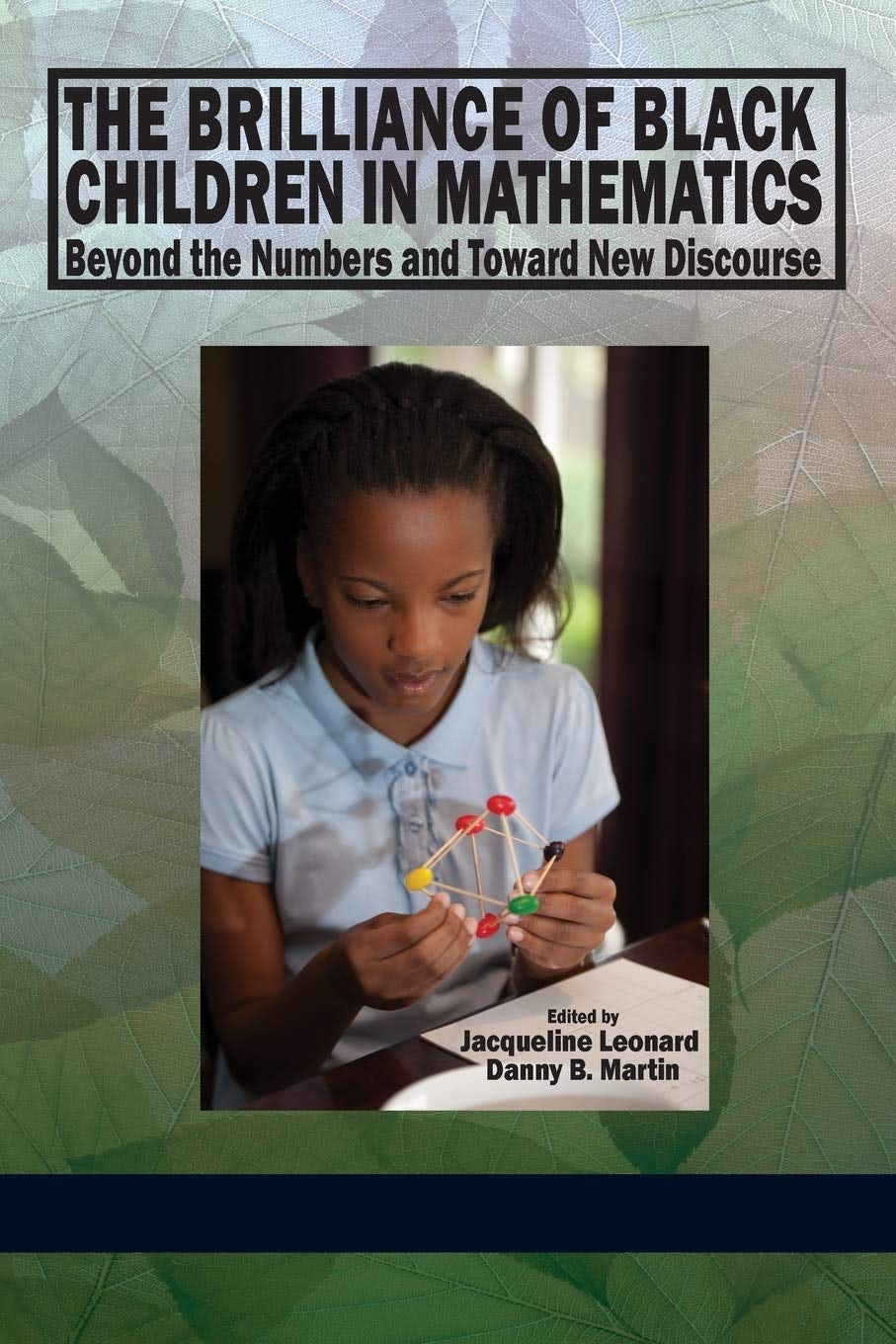
This book is a critically important contribution to the work underway to transform schooling for students who have historically been denied access to a quality education, specifically African American children. The first section of the book provides some historical perspective critical to understanding the current state of education in the U.S., specifically for the education of African American children. The following sections include chapters on policy, learning, ethnomathematics, student identity, and teacher preparation as it relates to the mathematical education of Black children. Through offering “counternarratives” about mathematically successful Black youth, advocating for a curriculum that is grounded in African American culture and ways of thinking, providing shining examples of the brilliance of Blacks students, and promoting high expectations for all rather than situating students as the problem, the authors of this book provide powerful insights related to the teaching and learning of mathematics for African American students. As is made evident in this book, effective teaching involves much more than just engaging students in inquiry-based pedagogy (Kitchen, 2003). The chapters offered in this book demonstrate how mathematics instruction for African American students needs to take into account historical marginalization and present-day policies that do harm to Black students (Kunjufu, 2005). Empowering mathematics instruction for African American students needs to take into consideration and promote students’ cultural, spiritual, and historical identities. Furthermore, mathematics instruction for African American students should create opportunities for students to express themselves and the needs of their communities as a means to promote social justice both within their classrooms and communities.


Foreword, Richard Kitchen.
Preface.
Acknowledgments.
Section I. Cultural-Historical Perspectives.
Chapter 2. The History, Brilliance, and Legacy of Benjamin Banneker Revisited, Jacqueline Leonard and Cheryl Lewis Beverly.
Chapter 3. A Critical Review of American K–12 Mathematics Education, 1900–Present: Implications for the Experiences and Achievement of Black Children, Robert Q. Berry, III, Holly Henderson Pinter, and Oren L. McClain.
Chapter 4. The Mathematical Lives of Black Children: A Sociocultural-Historical Rendering of Black Brilliance, Maisie L. Gholson.
Section II. Policy and Black Children's Mathematics Education.
Chapter 5. Methods of Studying Black Students' Mathematical Achievement: A Critical Analysis, Danté A. Tawfeeq and Paul W. Yu.
Chapter 6. Not Waiting for Superman: Policy Implications for Black Children Attending Public Schools, Jacqueline Leonard, Malaika McKee, and York M. Williams.
Section III. Learning and Learning Environments.
Chapter 7. Advancing a Framework for Culturally Relevant, Cognitively Demanding Mathematics Tasks, Lou Edward Matthews, Shelly M. Jones, and Yolanda A. Parker.
Chapter 8. Adolescents Learn Addition and Subtraction of Integers Using the Algebra Project's Curriculum Process, Mario Eraso.
Chapter 9. The Culture of Learning Environments: Black Student Engagement and Cognition in Math, Jamie M. Bracey.
Chapter 10. Ethnomathematics in the Classroom: Unearthing the Mathematical Practices of African Cultures, Iman Chahine.
Section IV. Student Identity and Student Success.
Chapter 11. Counterstories from Mathematically Successful African American Male Students: Implications for Mathematics Teachers and Teacher Educators, David W. Stinson, Christopher C. Jett, and Brian A. Williams.
Chapter 12. Growing Up Black and Brilliant: Narratives of Two Mathematically High-Achieving College Students, Ebony O. McGee.
Chapter 13. Mathematics Literacy for Liberation and Liberation in Mathematics Literacy: The Chicago Young People's Project as a Community of Practice, Denise Natasha Brewley.
Chapter 14. Unpacking Brilliance: A New Discourse for Black Students and Successful Mathematics Achievement, Nicole M. Russell.
Section V. Preparing Teachers to Embrace the Brilliance of Black Children.
Chapter 15. Tapping into the Intellectual Capital of Black Children in Mathematics: Examining the Practices of Pre-service Elementary Teachers, Shonda Lemons-Smith.
Chapter 16. Developing Teachers of Black Children: (Re)Orienting Thinking in an Elementary Mathematics Methods Course, Tonya Gau Bartell, Mary Q. Foote, Corey Drake, Amy Roth McDuffie, Erin E. Turner, Julia M. Aguirre.
Contributing Authors.
Index.