


Some error occured while loading the Quick View. Please close the Quick View and try reloading the page.
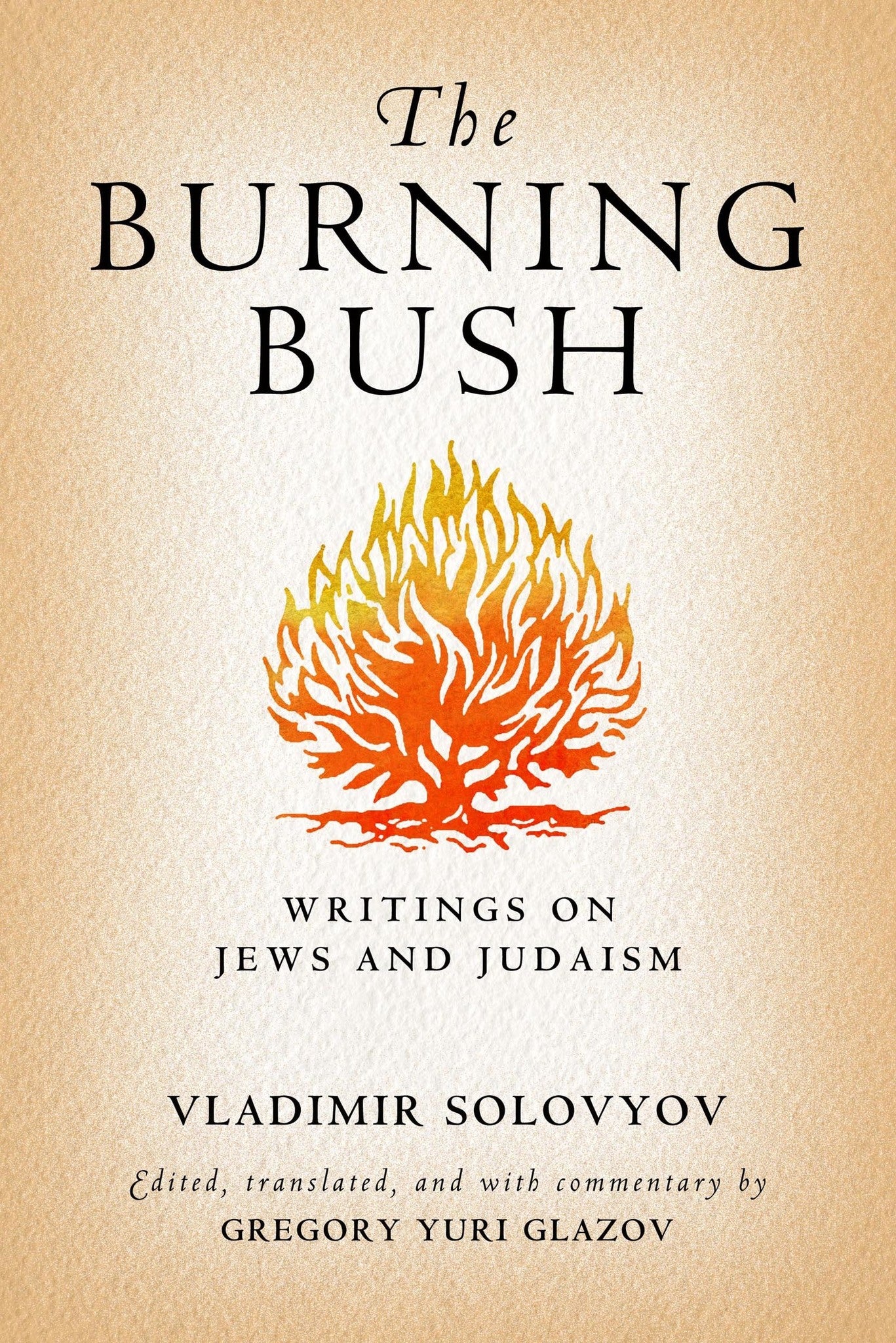
Vladimir Solovyov, one of nineteenth-century Russia's greatest Christian philosophers, was renowned as the leading defender of Jewish civil rights in tsarist Russia in the 1880s. The Burning Bush: Writings on Jews and Judaism presents an annotated translation of Solovyov's complete oeuvre on the Jewish question, elucidating his terminology and identifying his references to persons, places, and texts, especially from biblical and rabbinic writings. Many texts are provided in English translation by Gregory Yuri Glazov for the first time, including Solovyov's obituary for Joseph Rabinovitch, a pioneer of modern Messianic Judaism, and his letter in the London Times of 1890 advocating for greater Jewish civil rights in Russia, printed alongside a similar petition by Cardinal Manning. Glazov's introduction presents a summary of Solovyov's life, explains how the texts in this collection were chosen, and provides a survey of Russian Jewish history to help the reader understand the context and evaluate the significance of Solovyov's work. In his extensive commentary in Part II, which draws on key memoirs from family and friends, Glazov paints a rich portrait of Solovyov's encounters with Jews and Judaism and of the religious-philosophical ideas that he both brought to and derived from those encounters. The Burning Bush explains why Jews posthumously accorded Solovyov the accolade of a "righteous gentile," and why his ecumenical hopes and struggles to reconcile Judaism and Christianity and persuade secular authorities to respect conscience and religious freedom still bear prophetic vitality.


"Gregory Glazov's study . . . is simply without comparison. There is no other publication that so comprehensively gathers and presents Solovyov's lifelong commitment to understanding Judaism and the Jewish people." —The Russian Review
"Glazov offers an extensive history of the question of Jewish relations with Russian Christians as well as a significant commentary of Solovyov’s works on the Christian problem of Jewish relations, each of which receives their own section before Solovyov’s texts, allowing the unfamiliar reader to understand the context of Solovyov’s works. This truly is what makes the work an important contribution to the history of anti-Semitism, but also, to culture studies, showing how people can be easily worked up with hate speech so that they end up willing to commit great atrocities in the name of security." —Patheos
"Poet, theologian, and philosopher Solovyov (1853–1900) was responsible for a renaissance in Russian philosophy and poetry in the early 20th century. . . . Glazov succeeds in bringing another aspect of Solovyov’s intellect into Western scholarship. A definitive work for Russophiles of the 20th century." —Library Journal
"Glazov . . . deserves credit for rescuing Solovyov—whom he dubs 'a Russian analogue to St. Thomas Aquinas and a trailblazer for Russian Orthodox Christians seeking unity with the West and Catholicism'—from obscurity in this comprehensive volume. It is as much biography and commentary as it is a collection of primary sources concerning Solovyov's writings about Jews and Judaism." —Publishers Weekly
"This 'mosaic of sources,' expertly translated and annotated by Gregory Yuri Glazov, forms both a testament to and commentary on Vladimir Solovyov's lifelong interest in the Jews. Together, the poetry, letters, and essays explain why Solovyov turned to Jewish history and texts to help him parse what he called the enduringly problematic 'Christian question.' Glazov's introduction includes an essay by Fr. Alexander Men' and suggests the continuing applicability—and urgency—of Solovyov's focus on the dynamic interface of Christianity and the Jews to our very day." —Judith Deutsch Kornblatt, University of Wisconsin–Madison
"A number of translations of, and commentaries on, Vladimir Solovyov's major philosophical, poetic, and sociopolitical works have recently appeared, but Gregory Glazov's work fills a glaring lacuna by giving us a definitive analysis (with both translations and commentary) of Solovyov's relationship to Russian Jewry. Glazov's study represents a uniquely original contribution to its field. As far as I know, there is no other book like it." —Boris Jakim, translator of books by Vladimir Solovyov, Pavel Florensky, Sergius Bulgakov, Fyodor Dostoevsky, and other Russian thinkers
"Gregory Glazov's The Burning Bush: Writings on Jews and Judaism by Vladimir Solovyov is a beautifully conceived and expertly executed volume. Judith Deutsch Kornblatt did the field of modern religious philosophy a great service by bringing Solovyov's sophiological writings together in a single elegant volume. Glazov has done the same for Solovyov's writings on Judaism." —Paul Valliere, McGregor Professor of the Humanities, Butler University
“The scope of Gregory Glazov’s impressive volume not only extends the principal goal of his book, the translation of Vladimir Solov’ev’s writings on Jews and Judaism, but speaks to the author’s perceptive reading of the entire oeuvre of the great Russian religious philosopher, publicist, and poet.” —Slavic Review
Vladimir Solovyov, one of nineteenth-century Russia's greatest Christian philosophers, was renowned as the leading defender of Jewish civil rights in tsarist Russia in the 1880s.
Gregory Yuri Glazov is professor of biblical studies at Immaculate Conception Seminary School of Theology. He is the author of The Bridling of the Tongue and the Opening of the Mouth in Biblical Prophecy.
Selected Abbreviations
Acknowledgments
PART I
INTRODUCTION
1. Solovyov and the Origins of This Work
2. Texts, Annotations, Key Terms, and Translation
3. “The Life and Thought of Vladimir Sergeevich Solovyov” (1989) by Fr. Alexander Men’
4. Jewish History in Russia up to the End of the Nineteenth Century
Notes to Part I
PART II
COMMENTARY AND PORTRAIT OF SOLOVYOV’S ENCOUNTERS WITH JEWS AND JUDAISM
1. Solovyov’s Writings on Judaism in Light of His Notes, Letters, and Other Testimonies
2. Solovyov’s Unique Respect for Judaism and His Philosophy of History
3. Judaism and Christ: The Testimony of Family and Friends 124
4. Judaism, Christ, and Conscience: The Testimony of Colleagues
5. 1875–1877: Judaism and Sophia in Solovyov’s “Journey with the Magi”
6. 1878–1881: Lectures on Godmanhood and A Critique of Abstract Principles
7. 1878–1881: Dostoevsky, Tolstoy, and Getz 165
8. 1881–1883: The Break with the Slavophiles and Critique of Dostoevsky 9. 1884: “Jewry and the Christian Question”
10. 1885–1886: Joseph Rabinovich and “The Talmud”
11. 1887–1890: Getz’s Journal and the Gestation of the Protest
12. 1890: Tolstoy, Ezekiel 3:18 and 33:8, and the Launch of the Protest
13. 1891: The Foreword to Getz’s The Floor to the Accused
14. 1891: The Central Committee for the Organization of Jewish Emigration, Diminsky, Bakst, and the Encyclopedic Dictionary
15. October 1891: The Lecture “The Fall of the Medieval Worldview”
16. 1892–1894: Final Correspondence with Tolstoy
17. 1894–1896: Gintsburg, Arseniev, Leskov, and the Articles on the Kabbalah
18. 1898–1899: The Protocols of the Elders of Zion and “The Tale of the Antichrist”
19. 1899–1900: The Obituary of Joseph Rabinovich and “The Tale”
20. July 1900: Last Days and Burial
Notes to Part II
PART III
PRIMARY TEXTS
1. “Jewry and the Christian Question” (1884)
2. “The Israel of the New Covenant” (1885)
3. “The Talmud and Recent Polemical Literature about It in Austria and Germany” (1886)
4. “The Jews(,) Their Religious and Moral Teachings(.) The Study of S. Y. Diminsky” (1891)
5. “When Lived the Hebrew Prophets?” Review of Ernest Havet’s La modernité des prophètes (1896)
6. “The Kabbalah,” from the Encyclopedic Dictionary (1896)
7. Foreword to “Kabbalah: The Mystical Philosophy of the Jews,” by David Gintsburg (1896)
8. Obituary of Joseph Davidovich Rabinovich ✝ 5 May 1899
9. Letters to Faivel Meir Bentsilovich Getz
10. “The Sins of Russia” (1887)
11. Correspondence with Tolstoy
12. The Protest Letter, London Times (December 10, 1890)
13. Solovyov’s Protest Letter in the Memoirs of Korolenko (1909)
14. Letter to Konstantin Konstantinovich Arseniev
15. Letters to Baron David Goratsievich Gintsburg
16. Letters to Nikolai Yakovlevich Grot
17. Letters to Moskovskie vedomosti (October 1891)
18. Six Poems
19. Appendix: The Protest Letter of Henry Edward Cardinal Manning, London Times (December 10, 1890)
Notes to Part III
Bibliography
General Index
Biblical, Christian Magisterial, and Rabbinic Index