


Some error occured while loading the Quick View. Please close the Quick View and try reloading the page.
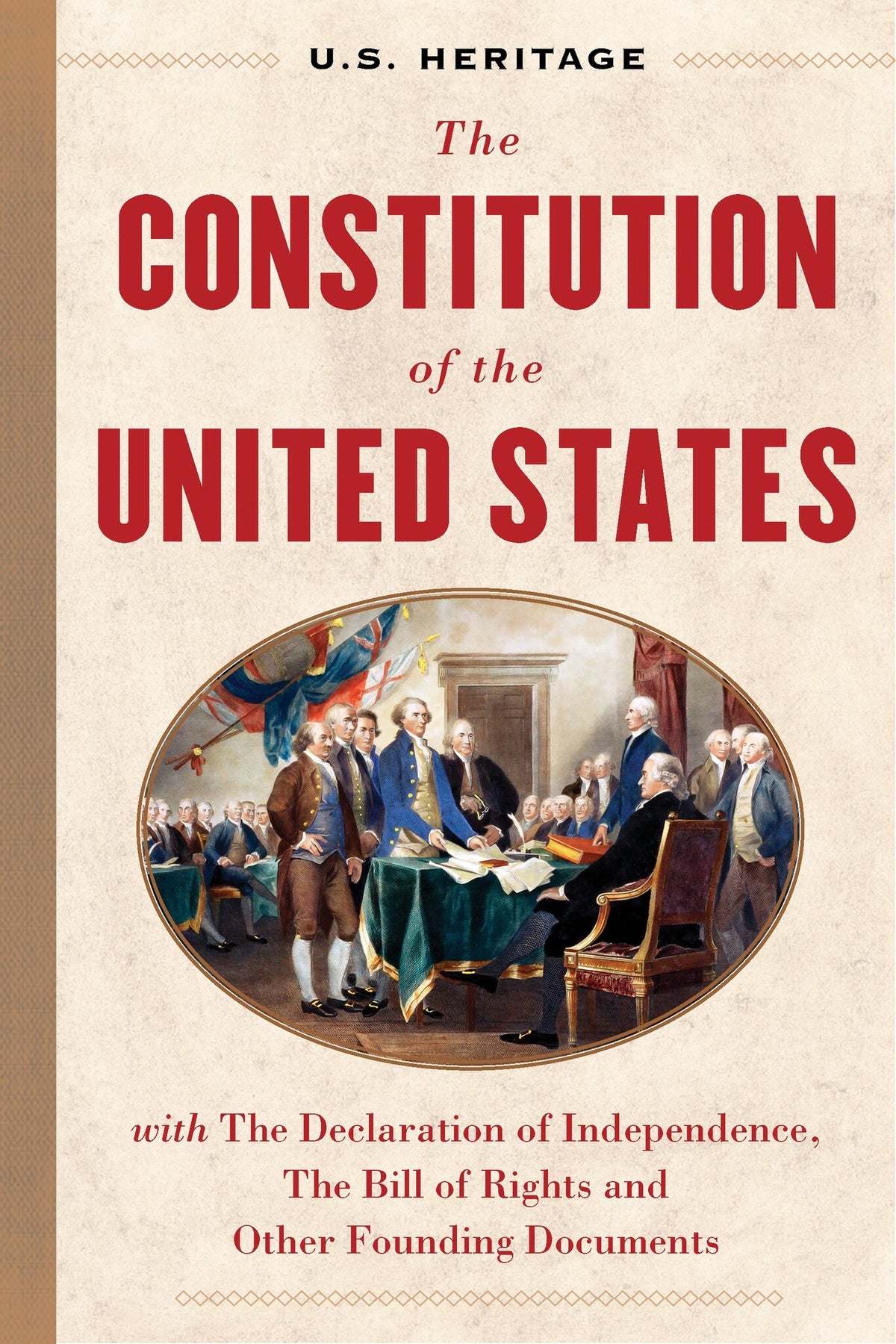
The U.S. Heritage series The Constitution of the United States: with The Declaration of Independence, The Bill of Rights and other Founding Documents includes:
- The Constitution of the United States and Bill of Rights
- The Declaration of Independence
- The Federalist Papers
- The Articles of Confederation
- Common Sense
- President George Washington's Farewell Addresses to the Nation
- The Louisiana Purchase
- The Monroe Doctrine
- And much much more more
The Constitution of the United States: with The Declaration of Independence, The Bill of Rights and other Founding Documents is part of the U.S. Heritage series and is a collection of the key founding documents, speeches, and other writings that helped establish and form the United States of America. The revolutionary ideas and inspirational writings are included in this book for everyone, for students of all ages, to people who are actively involved in politics and their community and anyone interested in the amazing birth and history of America.
LEARN WHAT IT MEANS TO BE AN AMERICAN!
HUMANIX BOOKS U.S. Heritage series is the definitive collection of political writings and history of the Founding Fathers that paved the way for the United States of America to become the indispensable nation and THE example of Democracy, Liberty and Freedom in the world.


HUMANIX BOOKS U.S. Heritage series is the definitive collection of political writings and history of the Founding Fathers that paved the way for the United States of America to become the indispensable nation and THE example of Democracy, Liberty and Freedom in the world.
LEARN WHAT IT MEANS TO BE AN AMERICAN!
George Washington was an American military officer, statesman, and Founding Father who served as the first president of the United States from 1789 to 1797. Washington is often referred to as: Father of His Country.
John Adams was an American statesman, attorney, diplomat, writer, and Founding Father who served as the second president of the United States from 1797 to 1801.
Thomas Jefferson was an American statesman, diplomat, lawyer, architect, philosopher, slaver, and Founding Father who served as the third president of the United States from 1801 to 1809. Jefferson was the principal author of the Declaration of Independence, and a proponent of democracy, republicanism, and individual rights,
BENJAMIN FRANKLIN was an American polymath who was active as a writer, scientist, inventor, statesman, diplomat, printer, publisher, forger and political philosopher. Among the leading intellectuals of his time, Franklin was one of the Founding Fathers of the United States, a drafter and signer of the United States Declaration of Independence, and the first United States Postmaster General. Franklin is known as The First American.
Alexander Hamilton was a Nevisian-born American military officer, statesman, and Founding Father who served as the first United States secretary of the treasury from 1789 to 1795. Scholars generally regard Hamilton as an astute and intellectually brilliant administrator, politician, and financier, if often impetuous. His ideas are credited with laying the foundation for American government and finance. Hamilton is known as The Father of American Banking.
James Monroe was an American statesman, lawyer, and diplomat who served as the fifth president of the United States from 1817 to 1825.
James Madison Jr. was an American statesman, diplomat, and Founding Father. He served as the fourth president of the United States from 1809 to 1817. Madison is hailed as the "Father of the Constitution" for his pivotal role in drafting and promoting The Constitution of the United States and the Bill of Rights.
The Founding Fathers of the United States (known simply as the Founding Fathers, Founders, or Framers) were a group of late-18th-century American revolutionary leaders who united the Thirteen Colonies, oversaw the War of Independence from Great Britain, established the United States, and crafted a framework of government for the new nation.
Historians are in general agreement that six of the most prominent leaders of the Revolutionary Era of 1765–1791 are Founding Fathers: George Washington, Benjamin Franklin, John Adams, Thomas Jefferson, James Madison, James Monroe and Alexander Hamilton.
Foreword > "Big Name" tk
- The Mayflower Compact
- City upon a Hill: A Model of Christian Charity
- The Letters of Silence Dogood
- The Declaration of Rights and Grievances of 1765
- On Civil War
- The Rights of the Colonists As Men
- An Edict by the King of Prussia
- Rules by Which a Great Empire May Be Reduced to a Small One
- A Summary View of the Rights of British America
- The Boston Massacre
- Address of the First Continental Congress to the Inhabitants of the Several Anglo-American Colonies
- Declaration of Colonial Rights
- A Full Vindication of the Measures of the Congress, from the Calumnies of Their Enemies
- Give Me Liberty or Give Me Death: On the Resolution to Put the Commonwealth into a State of Defence
- A Declaration by the Representatives of the United Colonies of North America
- Address to the People of England
- To the King's Most Excellent Majesty
- A Speech to the Six Confederat Nations
- Common Sense
- The Resolution for Independence
- The Declaration of Independence
- American Independence
- Thoughts on Government
- Benjamin Franklin's Articles of Confederation
- The Articles of Confederation and Perpetual Union
- An Address of the Congress to the Inhabitants of the United States of America
- Information to Those Who Would Remove to America
- The Treaty of Paris
- The Virginia Plan
- The Northwest Ordinance
- Make Manifest Our Unanimity
- United States Constitution
- The Federalist Papers
- George Washington’s First Inaugural Address
- The Bill of Rights
- George Wshington Second Inaugural Address
- George Washington’s Farewell Address to the People of the United States
- John Adams’s First Inaugural Address
- Thomas Jefferson’s First Inaugural Address
- Letter to Congress Regarding Lewis and Clark Expedition
- The Louisiana Purchase Treaty
- Thomas Jefferson’s Second Inaugural Address
- James Madison’s First Inaugural Address
- James Madison’s Second Inaugural Address
- The Star-Spangled Banner
- James Monroe’s First Inaugural Address
- James Monroe’s Second Inaugural Address
- The Monroe Doctrine