


Some error occured while loading the Quick View. Please close the Quick View and try reloading the page.
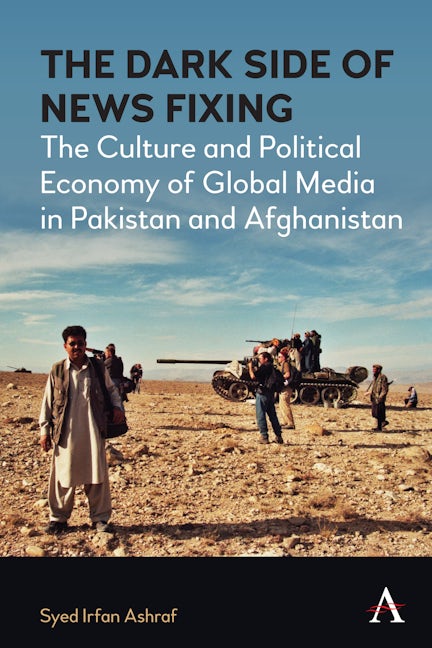
This book provides a local journalist’s perspective on a four-decade long regional contribution to global news production. It shows how the fixers’ risky news pursuits made possible for global media to access distant regions and dangerous caves on Pakistan and Afghanistan borders, causing unprecedented deaths of the local reporters in the context of the U.S-led war on terror. The book analyzes the fixer as a role in its relationship with militarization. It is not a coincidence that fixers become valuable to commercial media only during the height of violence or crises. Emerging under conditions of scarcity or war, the value of this role, in turn, is intrinsically tied to the fear of extinction. It is this vulnerability or perceived expendability— imposed by the need to find work—that binds fixers in a symbiotic relationship with global market and global war. This book, then, serves as a vantage point from which one can clearly see the connection between the regional wars and commercial media, as well as local journalists’ transformation into daily wage earners in a global media shift toward neoliberalism.


“Ashraf penetratingly explores the mesh of global journalistic hierarchies, capitalism and neo-imperialism in one of the world’s most dangerous war zones – the historically fractious Pashtun Belt straddling Pakistan and Afghanistan. Readers concerned with the politics of intellectual labor in war reporting should grasp this book for its fresh analyses and grounded information” — John D.H. Downing, Chief Editor, Sage Handbook of Media Studies.
“Reporting from FATA-Afghanistan-Pakistan, the ground zero of news production today – where imperialism, capitalism, and religious fundamentalism collude to constantly displace people from their homes and lives – Syed Irfan Ashraf reveals how the ubiquitous ‘fixer’ is not just another professional category in journalism, but its nadir. From his own experience as a ‘fixer’, Ashraf shows how the global media capitalist machine literally feeds on the life and work of local journalists, mutilating them into its ‘eyes and ears’, and the terrible costs extracted in return for the fundamental human desire to be seen and heard; to speak back to an international public and not just be its victim or other. Thinking like Marx, Ashraf explains how the ‘fixer’ is a role, imposed by the process of the proletarianization; and its dehumanizing consequences, not only for journalists, but society as a whole — Jyotsna Kapur, Professor, Cinema and Media Studies, Southern Illinois University, US.
The monograph, thanks to its empirical richness, is a valuable and unique contribution to the fast-growing volume of literature on fixers. The author, albeit briefly, looks into the previously unexplored intensity of fixers’ emotional experience. Their affective proximity to the events they cover made the local journalists’ labor more painful and traumatic but also motivated them, including the author himself, “to connect worries of the Pashtun community (...) to wider audiences to highlight the global violence” (p. 31). Ashraf vividly depicts the complexity of the conflict reporting ecosystem: the murky settings, the fabric of which is made by chains and nets of mutual exploitation—Mass Communication and Society
The Dark Side of News Fixing is a timely intervention that calls for a deeper understanding of the global structures that reduce local journalists to disembodied labourers while distorting their knowledge to sustain cycles of militarism in the Pashtun Belt. It contributes to postcolonial studies, borderlands theory, racial capitalism and journalism studies by interrogating the political economy of knowledge production in one of the world’s most militarised regions. —International Quarterly for Asian Studies
Irfan Ashraf has a PhD in mass communication and media arts (MCMA) from the Southern Illinois University, Carbondale and is an assistant professor at the Department of Journalism and Mass Communication, University of Peshawar, Pakistan.
List of Figures; About the Author; Acknowledgments; Introduction; Chapter One Laying Bare the Malala Story: Some Tough and Painful Reflections on the “Fixer” Role; Chapter Two The “Fixer”: Journalism’s Dark Secret; Chapter Three Pashtuns as Potential “Fixers”: News Work in a State of War; Chapter Four The Afghan Beat: Journalism as War; Chapter Five The “Fixer”: Local Labor, Global Media; Chapter Six Buying Low, Selling High: The Hunt for Bin Laden; Chapter Seven Impunity: The New Normal; Chapter Eight Reporting with Marx; Appendix; Notes; Bibliography; Index.