


Some error occured while loading the Quick View. Please close the Quick View and try reloading the page.
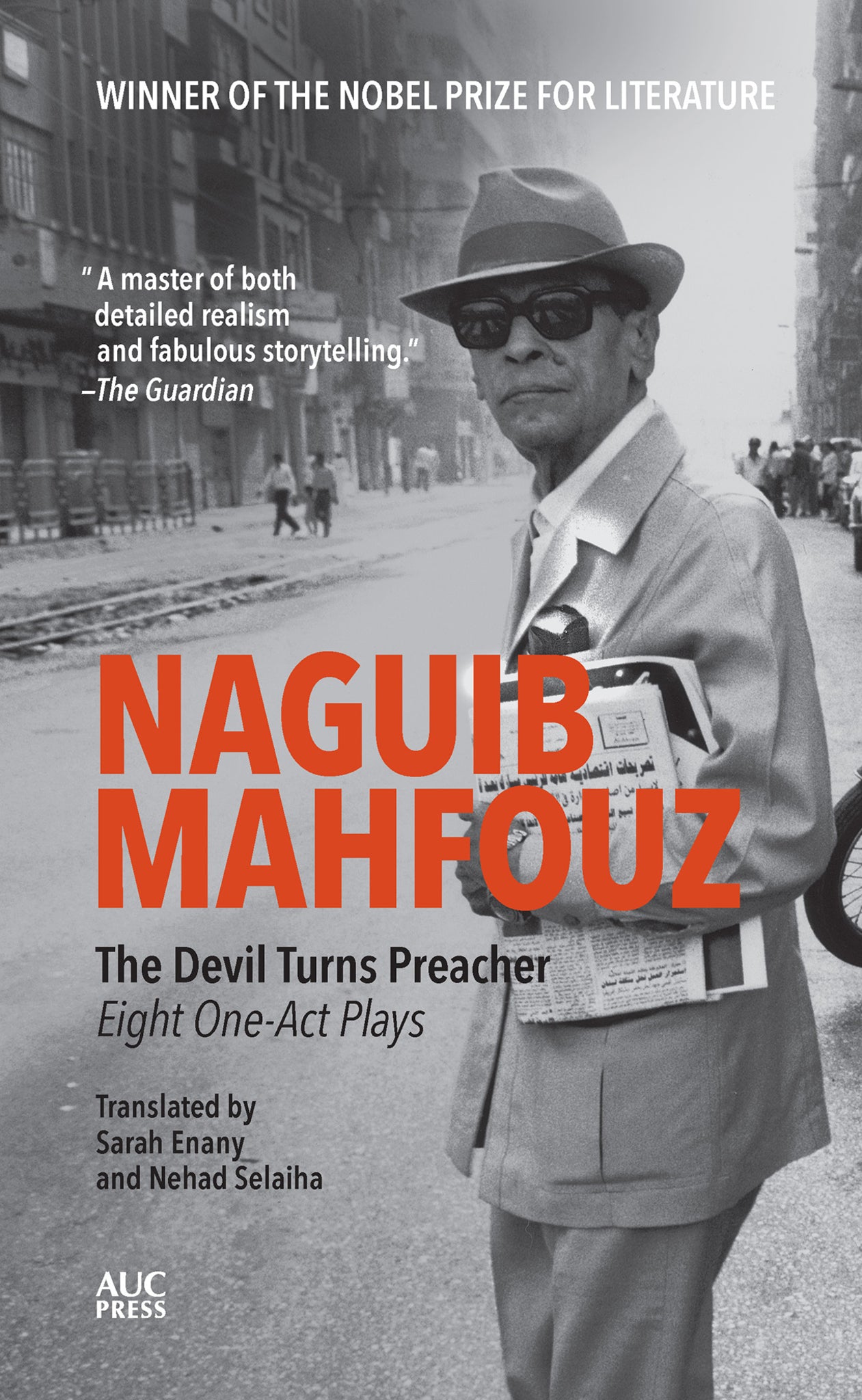
To mark twenty years since the death of Nobel Laureate Naguib Mahfouz, his only collection of plays are to be published worldwide in English for the first time
Naguib Mahfouz is a literary icon, and the only Arab writer to win the Nobel Prize for Literature. He has been celebrated across the globe for his novels and short stories, which have been translated into over forty languages. But what is not known by many is that he made a foray into drama: he wrote eight one-act plays in the 1960s and 1970s. They were performed in Cairo at the time and then largely forgotten – overtaken by his immensely successful fiction writing.
These forgotten gems showcase Mahfouz’s bold storytelling and mastery of suspense and pace. Eclectic in their dramatic style and suggesting far-reaching dramatic influences from Ionesco to Camus to Beckett. They are filled with political subtext and symbolize, in dramatic form, a monumental period in Egyptian history, including war with Israel and the death of Nasserism.
- The Legacy
- The Rescue
- The Mountain
- Death and Resurrection
- A Draft Proposal
- The Task
- The Chase
- The Devil Turns Preacher


PRAISE FOR NAGUIB MAHFOUZ:
"Mahfouz's work is freshly nuanced and hauntingly lyrical."—Los Angeles Times Book Review
"The Arab world's foremost novelist."—The New York Times
“He is not only a Hugo and a Dickens, but also a Galsworthy, a Mann, a Zola and a Jules Romains.”—Edward Said, London Review of Books
"A towering literary figure."—The Economist
"A master of both detailed realism and fabulous storytelling."—The Guardian
"Mahfouz is a storyteller of the first order in any idiom."—Vanity Fair
"The incredible variety of Naguib Mahfouz's writings continues to dazzle our eyes."—The Washington Post
Naguib Mahfouz (Author) was born in Cairo in 1911 and began writing when he was seventeen. His nearly forty novels and hundreds of short stories range from re-imaginings of ancient myths to subtle commentaries on contemporary Egyptian politics and culture. Some of his most famous works include The Cairo Trilogy, made up of Palace Walk, Sugar Street, and Palace of Desire, as well as Miramar, Midaq Alley, and Children of the Alley. In 1988, he was the first writer in Arabic to be awarded the Nobel Prize in Literature. He died in August 2006.
Sarah Enany (Translated by) is a literary translator and a professor in the English Department of Cairo University. She is a recipient of the Banipal Prize for Literary Translation for her translation of The Girl with Braided Hair (Hoopoe Fiction, 2020). She has translated several operas including the acclaimed sung versions of Les Miserables and Mozart's The Magic Flute into Egyptian Arabic, and Sayed Higab's libretto for the opera Miramar into English. She is also the translator of Witness to War and Peace: Egypt, the October War, and Beyond, The Book Smuggler, and the Jewish Muslim trilogy (all AUC Press).
Nehad Selaiha (Translated by) (1945–2017), dubbed "The Lady of Theater Criticism," was an Egyptian academic and critic. She was and remains the foremost critic of Arab theatre, traveling all over Egypt and the Arab world to view hundreds of theater performances and known especially for her wryly humorous comments on the state of theater and her passionate championing of amateur and independent theater-makers. She was the resident theater reviewer of Al-Ahram Weekly for decades and has published many books on Egyptian and Arab theater, as well as contributing to publications at home and abroad. She has been honored with numerous awards including the State Achievement Award.
Introduction
The Legacy
The Rescue
The Mountain
Death and Resurrection
A Draft Proposal
The Task
The Chase
The Devil Turns Preacher