


Some error occured while loading the Quick View. Please close the Quick View and try reloading the page.
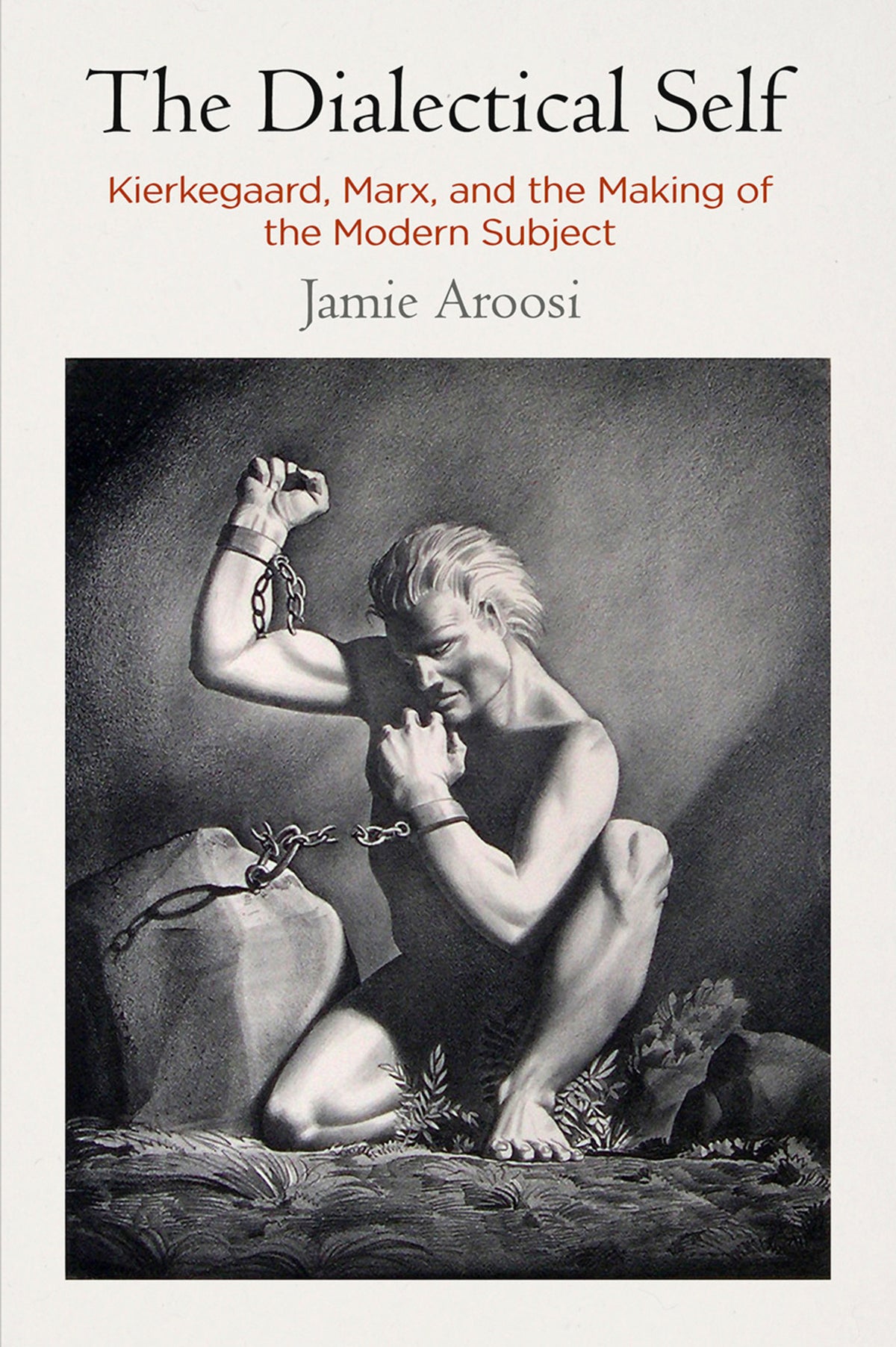
Although Karl Marx and Søren Kierkegaard are both major figures in nineteenth-century Western thought, they are rarely considered in the same conversation. Marx is the great radical economic theorist, the prophet of communist revolution who famously claimed religion was the "opiate of the masses." Kierkegaard is the renowned defender of Christian piety, a forerunner of existentialism, and a critic of mass politics who challenged us to become "the single individual." But by drawing out important themes bequeathed them by their shared predecessor G. W. F. Hegel, Jamie Aroosi shows how they were engaged in parallel projects of making sense of the modern, "dialectical" self, as it realizes itself through a process of social, economic, political, and religious emancipation.
In The Dialectical Self, Aroosi illustrates that what is traditionally viewed as opposition is actually a complementary one-sidedness, born of the fact that Marx and Kierkegaard differently imagined the impediments to the self's appropriation of freedom. Specifically, Kierkegaard's concern with the psychological and spiritual nature of the self reflected his belief that the primary impediments to freedom reside in subjectivity, such as in our willing conformity to social norms. Conversely, Marx's concern with the sociopolitical nature of the self reflected his belief that the primary impediments to freedom reside in the objective world, such as in the exploitation of the economic system. However, according to Aroosi, each thinker represents one half of a larger picture of freedom and selfhood, because the subjective and objective impediments to freedom serve to reinforce one another.
By synthesizing the writing of these two diametrically opposed figures, Aroosi demonstrates the importance of envisioning emancipation as a subjective, psychological, and spiritual process as well as an objective, sociopolitical, and economic one. The Dialectical Self attests to the importance and continued relevance of Marx and Kierkegaard for the modern imagination.


"Jamie Aroosi has a nuanced appreciation for the complexities of the reception of Kierkegaard and Marx in the twentieth century. In a new, refreshing, and useful comparison, The Dialectical Self shows how these two thinkers have much more in common than one might immediately imagine. It deserves our careful attention."
Introduction. The Dialectical Self
PART I. BONDAGE
Chapter 1. Selfhood
Chapter 2. Deception
PART II. EMANCIPATION
Chapter 3. Communication
Chapter 4. Law
Chapter 5. Faith
PART III. FREEDOM
Chapter 6. Subjectivity
Chapter 7. History
Chapter 8. Democracy
PART IV. PRAXIS
Chapter 9. Religion
Chapter 10. Politics
Conclusion. Love and Revolution
Notes
Index
Acknowledgments