


Some error occured while loading the Quick View. Please close the Quick View and try reloading the page.
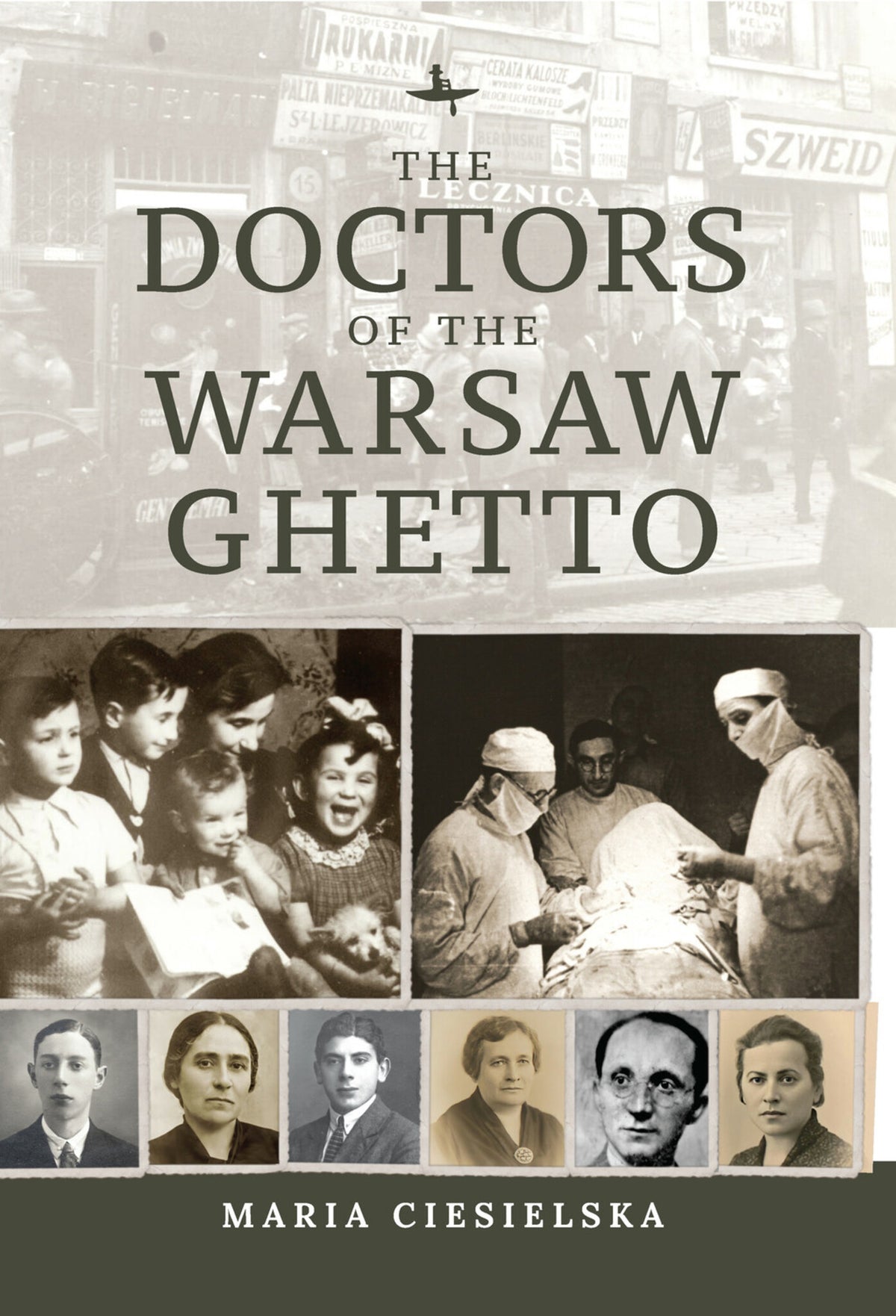


“The strength of this book is in this intertwining of history and memory, in giving personal accounts of events with names and photographs of those doctors and nurses who worked in the Warsaw Ghetto…For readers who belong to the generation of postmemory [it] help[s] to diminish temporal distance and facilitate identification and affiliation. Every library should have a copy of this outstanding book.”
— Henrietta Mondry, University of Canterbury, New Zealand Slavonic Journal
“[The Doctors of the Warsaw Ghetto] sheds light on the influence of doctors, nurses and other health workers on daily coping while attempting to survive and save lives. The book broadens the perspective regarding participants in the Uprising. Ciesielska describes dozens of doctors and nurses who, rather than fleeing for their lives following Aktions in the ghetto, stayed behind to treat their patients in the bunkers, where nearly all of them died; a type of ‘white-coat rebellion’ alongside the armed struggle. These medical services also reflect the doctors’ and nurses’ ethical decisions made under extreme tragic circumstances during the ghetto’s final stages. … This book is a must read for researchers of the Holocaust, the history of medicine, in general, and particularly Jewish medicine. Its appendixes pose an interesting research challenge for further study.”
— Miriam Offer, Social History of Medicine
“It goes without saying that the Nazis had no interest whatsoever in the well-being and health of the captive Jewish inhabitants of the Warsaw ghetto. But because they feared that diseases and epidemics might spread beyond it and endanger German personnel and afflict the general Polish population, they provided a bare modicum of assistance to Jewish hospitals, health services, doctors, nurses and pharmacists.
Innumerable books have been written about the Holocaust in Poland, but precious few have dealt with this important but overlooked issue. Maria Ciesielska’s The Doctors of the Warsaw Ghetto… examines it in voluminous detail from the moment the ghetto was established in November 1940 until it was destroyed during the uprising in April 1943.”
— Sheldon Kirshner, The Times of Israel (blog)
“Ciesielska, however, a specialist in family medicine and an expert in the history of medicine, has delved into the various archives in Poland, producing highly impressive findings. She presents a new, preliminary database, which will serve as a foundation for additional studies and is a significant contribution to commemorating Jewish doctors, both men and women. …Ciesielska’s findings are impressive and an invaluable achievement. Her methodically written book follows a chronological development placed in broad historical contexts and enriched by diverse sources. …Maria Ciesielska’s book sheds light on the ‘other side of the coin’ in its description of Jewish doctors. They left behind a written legacy that is also still relevant today. Their stories provide food for thought on the potential of maintaining ethical and professional strength, even in the most difficult circumstances, and of the ability to resist the forces of evil while continuing to provide patients with devoted medical care in impossible and unexpected conditions. The book also draws attention to the dozens of non-Jewish doctors, who assisted their Jewish colleagues while risking their own lives. Although their numbers were few, their inspirational actions were extraordinary.”
— Miriam Offer, Western Galilee College, Israel, Holocaust and Genocide Studies
“This meticulous account of the Warsaw Ghetto’s medical community, doctors, nurses, and pharmacists, is a long overdue tribute to an era’s unsung heroes. Drawing extensively on archives, with appendices and a photo gallery listing over seven hundred individuals, backgrounds, specialties, hospital affiliations, the author sheds light on a subculture that emerged in 1940, following the ghetto’s establishment, and their dedication under the most hellish of environments to saving or helping Jewish lives. …This poignant but well-researched book is essential for Holocaust collections.”
— Hallie Cantor, Yeshiva University, AJL News & Reviews“…Doctors of the Warsaw Ghetto is a signal contribution to the growing scholarship on Jews in the medical fraternity during the Holocaust, and it has several virtues to commend it: its comprehensive, multifocal treatment of the subject; its attention to every dimension of medicine and healthcare in the Warsaw Ghetto; its recourse to hitherto unused source material; its profiles of specific doctors; and its inventories (in the appendices) of the names of the ghetto’s doctors. But besides being a work of meticulous research, The Doctors of the Warsaw Ghetto is a poignant tribute to the Warsaw Ghetto’s unsung medical ‘fighters.’ It was in this memorial spirit that Ciesielska, discussing her book in an article by the Jewish Book Council, remarked, ‘I don’t know if you can say Kaddish over a book. If it is possible, please do.’”
— Scott Abramson, Northwestern University, Contemporary Jewry
Dr. Maria Ciesielska is a specialist in Family Medicine and a university lecturer with a doctorate in medical history. A keen personal interest in learning more about the fate of her Jewish peers in Warsaw during the Holocaust motivated Maria to publish an award-winning book on this topic in 2017 after years of research.
ACKNOWLEDGEMENTS
FOREWORD BY PROFESSOR MICHAEL
BERENBAUM
FOREWORD BY LUC ALBINSKI
PREFACE
CHAPTER I: INTRODUCTION TO THE JEWISH
COMMUNITY IN POLAND
CHAPTER II: THE MEDICAL SYSTEM IN
PRE-WAR POLAND
Doctors
in pre-war Poland
The
education of doctors in Poland
Career prospects of doctors in Poland
Jewish
doctors in Poland
CHAPTER III: JEWISH DOCTORS AND
ANTI-SEMITISM BETWEEN THE WARS
Anti-Semitism
in Academia
Anti-Semitism
in the Association of Doctors of the Polish State
Activities
of the Association of Doctors of the Polish Republic
Jews
in the Warsaw Medical Society
CHAPTER IV: HEALTHCARE DURING AND IN
THE AFTERMATH OF THE 1939 SIEGE OF WARSAW
The
Czyste (Old Order) Hospital for Orthodox Jews
The Bersohn and Bauman Children’s Hospital
The
Ujazdowski Hospital
The
activities of the Jewish community organizations
CHAPTER V: HEALTHCARE PRIOR TO THE
CREATION OF THE GHETTO
The
Polish medical system under occupation
Creation
of the Judenrat
The
functioning of the medical chambers
The
activities of TOZ
The
Czyste Jewish Hospital
The
Bersohn and Bauman Children’s Hospital
Pharmacies
Emergency
services
The
threat of labor camps
Treatment
of Jewish converts
CHAPTER VI: HEALTHCARE AFTER THE
SEALING OF THE WARSAW GHETTO
The
doctors in the Ghetto
Activities
of the Judenrat’s Health Department
The
fight against epidemics
TOZ
activities after the sealing of the Warsaw Ghetto
Emergency
services
The Czyste
Jewish Hospital
The
Bersohn and Bauman Children’s Hospital
The
hospital at 109 Leszno Street
Pharmacies
The
Chemical and Bacteriological Institute
Medical
care for the Jewish Police
The
prisons
Christian Convert Doctors
Mental
health in the Ghetto
The
threat of labor camps
CHAPTER VII: THE GREAT DEPORTATION
(GROSSAKTION)
Events
leading to the Great Deportation
The
murder of Dr. Franciszek Raszeja
Hostage
taking
The
Great Deportation
Czyste
Jewish Hospital
The
General Hospital on Stawki Street
Doctors
during the Great Deportation
Pharmacists
during the Great Deportation
Doctors
in the Jewish Police during the Deportation
CHAPTER VIII: HEALTHCARE AFTER THE
GREAT DEPORTATION
The
Hospital on 6–8 Gęsia Street
Doctors
after the Great Deportation
Nurses
after the Great Deportation
Pharmacists
after the Great Deportation
Emergency
Services after the Deportation
The
Fate of the Gęsia Street Hospital
CHAPTER IX: THE GHETTO UPRISING AND
ITS AFTERMATH
The
last hospital in the Ghetto
The
fate of Jewish doctors after the Deportation
CHAPTER X: RESISTANCE BY THE MEDICAL
FRATERNITY
The
underground medical school
The
Blum-Bielicka School of Nursing
Studies in Hunger
Disease
Studies in Typhus
CHAPTER XI: CONCLUSION
ANNEXURE I: LIST OF JEWISH DOCTORS
WHO WERE ARRESTED AND HELD HOSTAGE IN 1940 FOLLOWING ANDRZEJ KOTT’S ESCAPE
FROM THE GESTAPO
ANNEXURE II: LIST OF NON-ARYAN
DOCTORS IN WARSAW FROM THE ARCHIVES OF THE JEWISH HISTORICAL INSTITUTE
ANNEXURE III: LIST OF JEWISH DOCTORS
WORKING AND LIVING IN WARSAW IN 1940–1942
ANNEXURE IV: THE DOCTORS MOVED FROM THE WARSAW GHETTO TO THE ŁÓDŹ
GHETTO IN 1941/42
ANNEXURE V: SCHEDULE OF PHARMACIES OVERSEEN BY THE PHARMACY DEPARTMENT
OF THE JUDENRAT
ANNEXURE VI: A LIST OF PHARMACIES OVERSEEN BY THE PHARMACY DEPARTMENT
OF THE JUDENRAT IN THE GHETTO IN SEPTEMBER 1942. ANNEXURE VII: DOCTORS SAVING JEWS IN WARSAW IN 1939–1945
ANNEXURE VIII: PHOTOGRAPHS OF SELECTED DOCTORS AND NURSES
INDEX