


Some error occured while loading the Quick View. Please close the Quick View and try reloading the page.
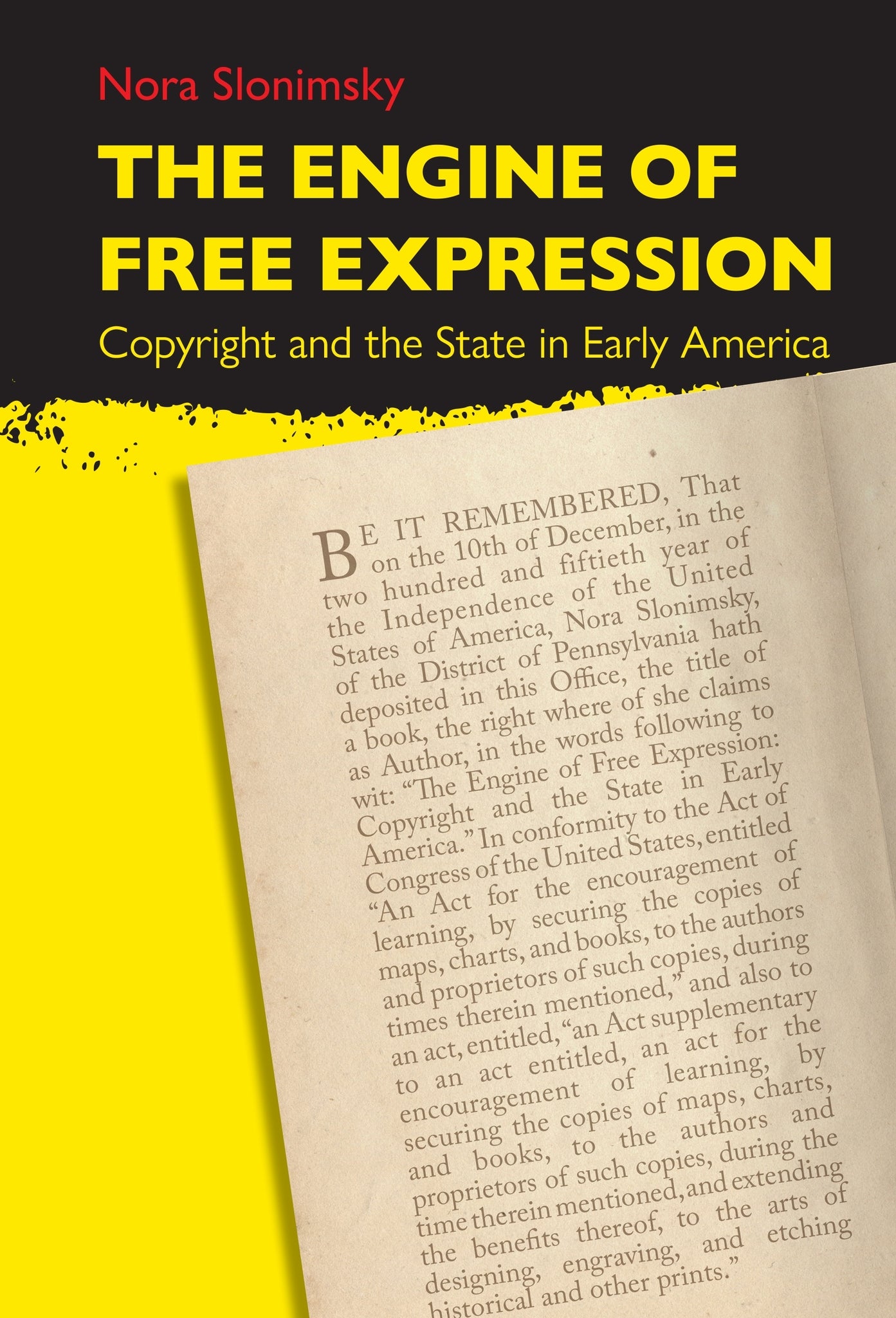
A history of how copyright became a tool and product of both individual and state power in the United States
Intellectual property is both familiar and mysterious, essential to United States politics and economics, and yet opaque in many ways. In The Engine of Free Expression, Nora Slonimsky chronicles the relationship between intellectual property and authority in the origins of the United States and contributes to a deeper understanding of intellectual property, specifically copyright, by doing two things.
First, Slonimsky traces how writers, artists, publishers, lawyers, and others who produced forms of intellectual and creative expression in the eighteenth and early nineteenth centuries—well before there were laws to protect them—thought about the political and commercial recognition of their labor. She calls their thinking “copyright consciousness.” Second, using a wide range of sources and evidence not often associated with intellectual property, Slonimsky argues that copyright was an important tool in the development of governing institutions in the early United States. As those writers and others pressed for protected acknowledgment of their work, they simultaneously relied on and strengthened those institutions, a mutually reinforcing process she calls “copyrighting the state.”
Describing this process over a hundred-year period, The Engine of Free Expression concludes in our present, explaining how this deep history between copyright and government impacts our civic life, from authentic and accurate expression, social media, AI, and digital communication; to the importance of learning, education, and knowledge; and to the health of our democratic institutions.


"The Engine of Free Expression is an extraordinary book. Nora Slonimsky brilliantly shows that even before the codification of copyright laws in the United States, a diverse set of actors engaged in efforts to find means of protecting their published written and artistic expression, a set of ideas and efforts she calls ‘copyright consciousness.’ By weaving together the threads that comprised copyright consciousness, she helps us understand the origins and early life of copyright—origins that intersected with many other concerns including individual rights, commercial protectionism, and the right to claim labor as property. This book will be invaluable for anyone interested in early American history, copyright and intellectual property law, and communication."
"In this pioneering work, Nora Slonimsky weaves the development of copyright consciousness with the birth of the American Republic and the rise of a distinctly American culture. Historians, lawyers, and anyone interested in these topics will find much new to learn here."