


Some error occured while loading the Quick View. Please close the Quick View and try reloading the page.
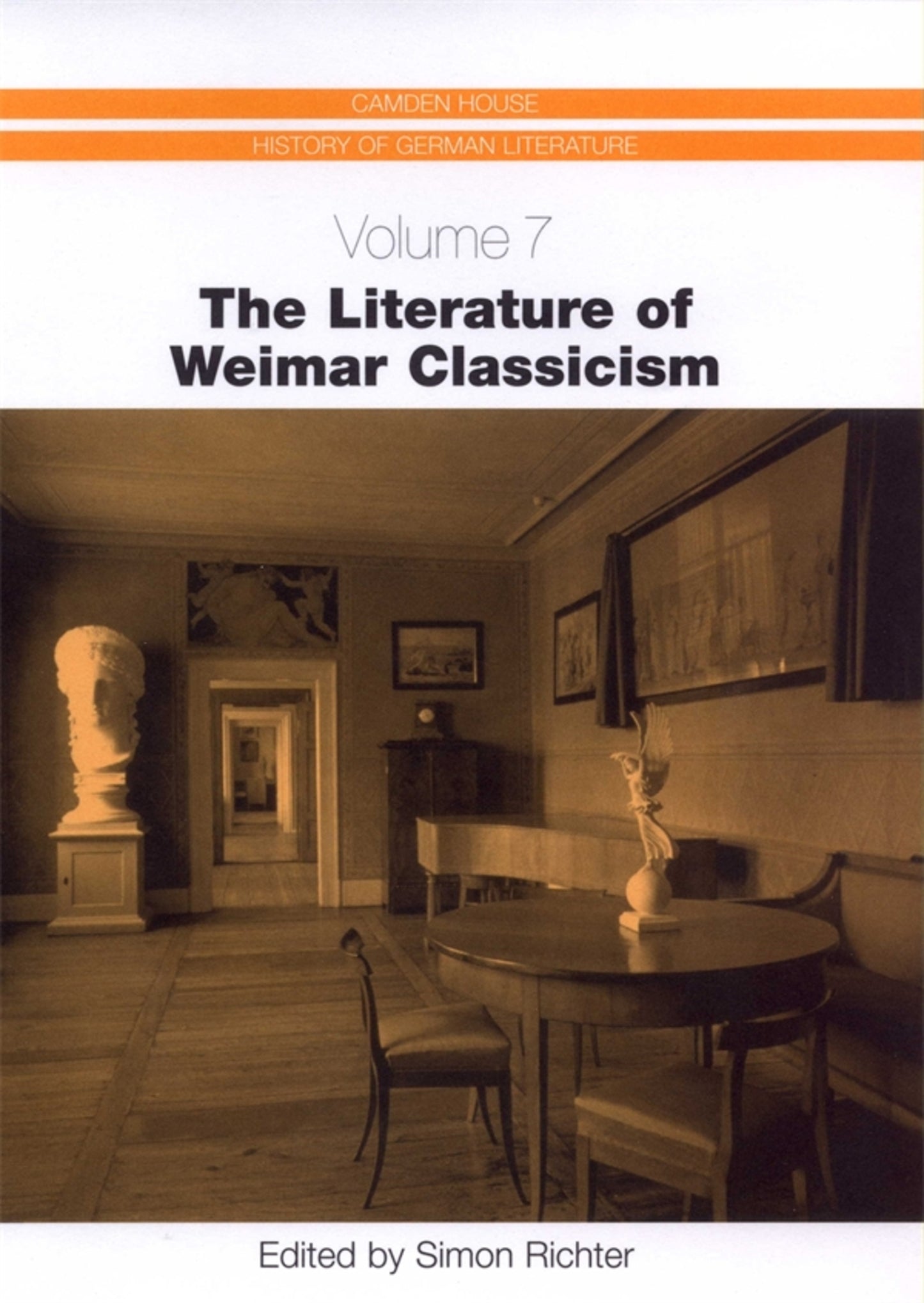
New essays providing an account of the shaping beliefs, preoccupations, motifs, and values of Weimar Classicism.
In Germany, Weimar Classicism (roughly the period from Goethe's return to Germany from Italy in 1788 to the death of his friend and collaborator Schiller in 1805) is widely regarded as an apogee of literary art. But outside of Germany, Goethe is considered a Romantic, and the notion of Weimar Classicism as a distinct period is viewed with skepticism. This volume of new essays regards the question of literary period as a red herring: Weimar Classicism is best understood as a project that involved the ambitious attempt not only to imagine but also to achieve a new quality of wholeness in human life and culture at a time when fragmentation, division, and alienation appeared to be thenorm. By not succumbing to the myth of Weimar and its literary giants, but being willing to explore the phenomenon as a complex cultural system with a unique signature, this book provides an account of its shaping beliefs, preoccupations, motifs, and values. Contributions from leading German, British, and North American scholars open up multiple interdisciplinary perspectives on the period. Essays on the novel, poetry, drama, and theater are joined by accounts of politics, philosophy, visual culture, women writers, and science. The reader is introduced to the full panoply of cultural life in Weimar, its accomplishments as well as its excesses and follies. Emancipatory and doctrinaire by turns, the project of Weimar Classicism is best approached as a complex whole.
Contributors: Dieter Borchmeyer, Charles Grair, Gail Hart, Thomas Saine, Jane Brown, Cyrus Hamlin, Roger Stephenson, Elisabeth Krimmer, Helmut Pfotenhauer, Benjamin Bennett, Astrida Orle Tantillo, W. Daniel Wilson.
Simon J. Richter is Associate Professor of German at the University of Pennsylvania.
In Germany, Weimar Classicism (roughly the period from Goethe's return to Germany from Italy in 1788 to the death of his friend and collaborator Schiller in 1805) is widely regarded as an apogee of literary art. But outside of Germany, Goethe is considered a Romantic, and the notion of Weimar Classicism as a distinct period is viewed with skepticism. This volume of new essays regards the question of literary period as a red herring: Weimar Classicism is best understood as a project that involved the ambitious attempt not only to imagine but also to achieve a new quality of wholeness in human life and culture at a time when fragmentation, division, and alienation appeared to be thenorm. By not succumbing to the myth of Weimar and its literary giants, but being willing to explore the phenomenon as a complex cultural system with a unique signature, this book provides an account of its shaping beliefs, preoccupations, motifs, and values. Contributions from leading German, British, and North American scholars open up multiple interdisciplinary perspectives on the period. Essays on the novel, poetry, drama, and theater are joined by accounts of politics, philosophy, visual culture, women writers, and science. The reader is introduced to the full panoply of cultural life in Weimar, its accomplishments as well as its excesses and follies. Emancipatory and doctrinaire by turns, the project of Weimar Classicism is best approached as a complex whole.
Contributors: Dieter Borchmeyer, Charles Grair, Gail Hart, Thomas Saine, Jane Brown, Cyrus Hamlin, Roger Stephenson, Elisabeth Krimmer, Helmut Pfotenhauer, Benjamin Bennett, Astrida Orle Tantillo, W. Daniel Wilson.
Simon J. Richter is Associate Professor of German at the University of Pennsylvania.

Price: $170.00
Pages: 420
Publisher: Boydell & Brewer Inc.
Imprint: Camden House
Series: Camden House History of German Literature
Publication Date:
30 September 2005
Trim Size: 9.00 X 6.00 in
ISBN: 9781571132499
Format: Hardcover
BISACs:
LITERARY CRITICISM / European / German, Literature: history and criticism, LITERARY CRITICISM / Reference, Literary reference works

The contributions are informative, insightful, and jargon free, presenting a variety of theoretical approaches that reflect current scholarly practices and interests.
Richter's approach successfully emphasizes, as does this collection in general, the multiplicity and variety of 'Classicist' literature.
Weimar Classicism has for long been associated almost exclusively with Goethe and Schiller's writing around 1800. The essays in this volume strive to represent the imposing scholarly tradition on these two writers while also suggesting that 'Classicism' extends also to other writers.... [T]hese essays provide a comprehensive overview useful to any student of German literature.
Richter has succeeded in putting together a stimulating collection of essays that outlines this theoretical project [Cultural Studies] while also fulfilling the more conventional requirements of literary history.
Richter's approach successfully emphasizes, as does this collection in general, the multiplicity and variety of 'Classicist' literature.
Weimar Classicism has for long been associated almost exclusively with Goethe and Schiller's writing around 1800. The essays in this volume strive to represent the imposing scholarly tradition on these two writers while also suggesting that 'Classicism' extends also to other writers.... [T]hese essays provide a comprehensive overview useful to any student of German literature.
Richter has succeeded in putting together a stimulating collection of essays that outlines this theoretical project [Cultural Studies] while also fulfilling the more conventional requirements of literary history.
Introduction - Simon Richter
What is Classicism? - Dieter Borchmeyer
Antiquity and Weimar Classicism - Charles A. Grair
The Correspondence of Goethe and Schiller - Gail K. Hart
Johann Gottfried Herder: The Weimar Classic behind the (City)Church - Thomas P. Saine
Classical Drama and Theatrical Practice in Weimar - Jane K. Brown
German Classical Poetry - Cyrus Hamlin
The Novel in Weimar Classicism: Symbolic Form and Symbolic Pregnance - Roger Stephenson
German Women Writers and Classicism - Elisabeth Krimmer
Weimar Classicism as Visual Culture - Helmut Pfotenhauer
The Irrelevance of Aesthetics and the De-Theorizing of the Self in "Classical" - Benjamin K. Bennett
Goethe's "Classical" Science - Astrida Orle Tantillo
Weimar Classicism and the French Revolution - W. Daniel Wilson
What is Classicism? - Dieter Borchmeyer
Antiquity and Weimar Classicism - Charles A. Grair
The Correspondence of Goethe and Schiller - Gail K. Hart
Johann Gottfried Herder: The Weimar Classic behind the (City)Church - Thomas P. Saine
Classical Drama and Theatrical Practice in Weimar - Jane K. Brown
German Classical Poetry - Cyrus Hamlin
The Novel in Weimar Classicism: Symbolic Form and Symbolic Pregnance - Roger Stephenson
German Women Writers and Classicism - Elisabeth Krimmer
Weimar Classicism as Visual Culture - Helmut Pfotenhauer
The Irrelevance of Aesthetics and the De-Theorizing of the Self in "Classical" - Benjamin K. Bennett
Goethe's "Classical" Science - Astrida Orle Tantillo
Weimar Classicism and the French Revolution - W. Daniel Wilson