


Some error occured while loading the Quick View. Please close the Quick View and try reloading the page.
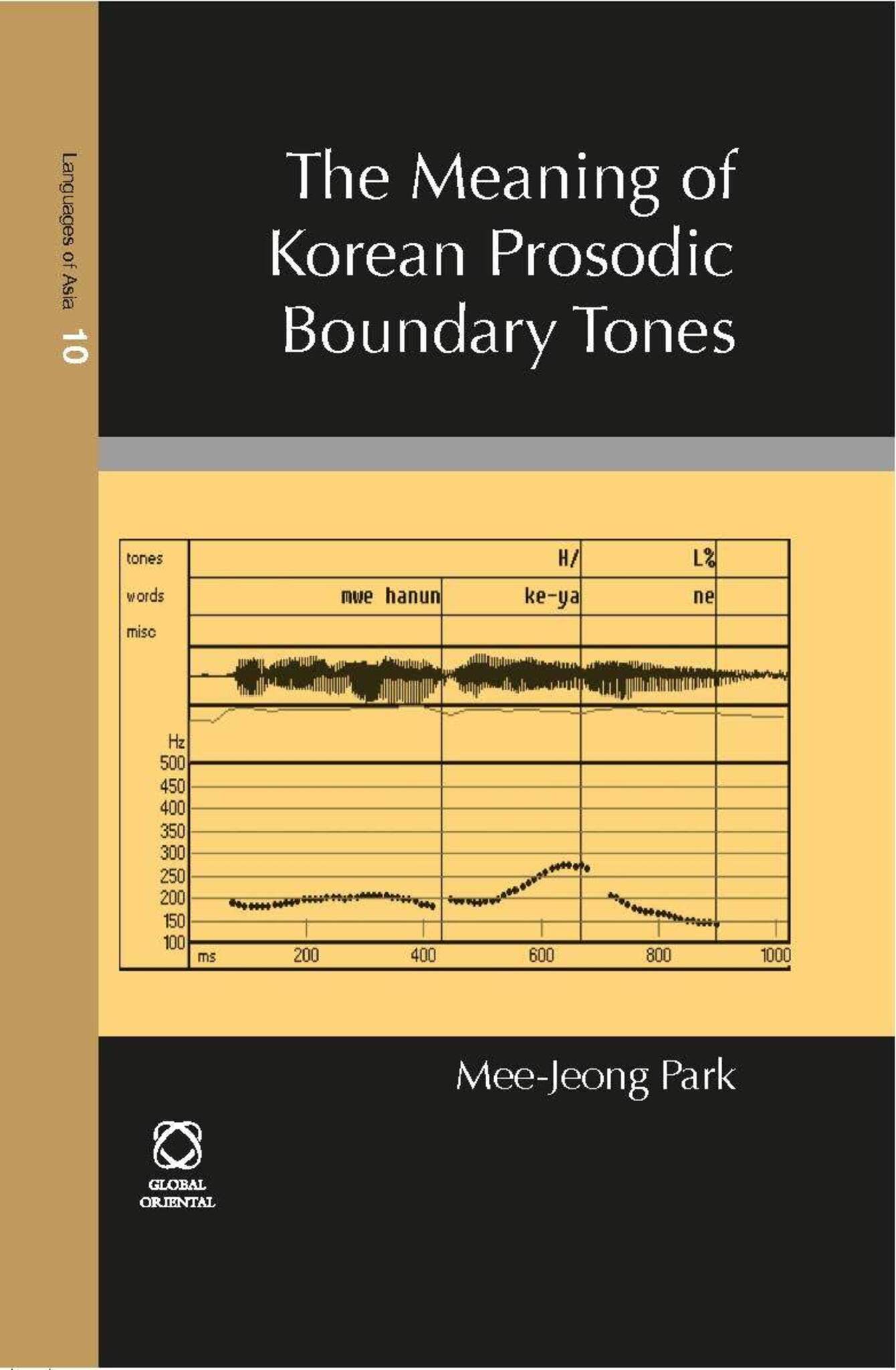
This book marks the first attempt to rationalise the meaning of Korean intonation, especially its boundary tones. Unlike other languages where various pragmatic and discourse meanings are delivered through the types of pitch accent (prominent pitch movement on stressed syllable) and the types of phrase-final boundary tones, Korean delivers the pragmatic/discourse meaning mainly by the types of phrase-final boundary tones. This is possible because Korean has at least nine boundary tones while other languages have two (or, even four or five if the boundary tone of a smaller phrase are included). Various examples are given that illustrate this three-way relationship, i.e., a specific meaning delivered by a certain type of boundary tone and a certain type of morphological marker in natural conversation.

Price: $227.00
Pages: 14
Publisher: Brill
Imprint: Brill
Series: Languages of Asia
Publication Date:
28 November 2012
ISBN: 9789004243576
Format: Hardcover

Mee-Jeong Park, Ph.D. (2003), UCLA, is Associate Professor of Korean at the department of East Asian Languages and Literatures at the University of Hawaii at Manoa. She has published several textbooks and pedagogical researches on Korean language and linguistics.