


Some error occured while loading the Quick View. Please close the Quick View and try reloading the page.
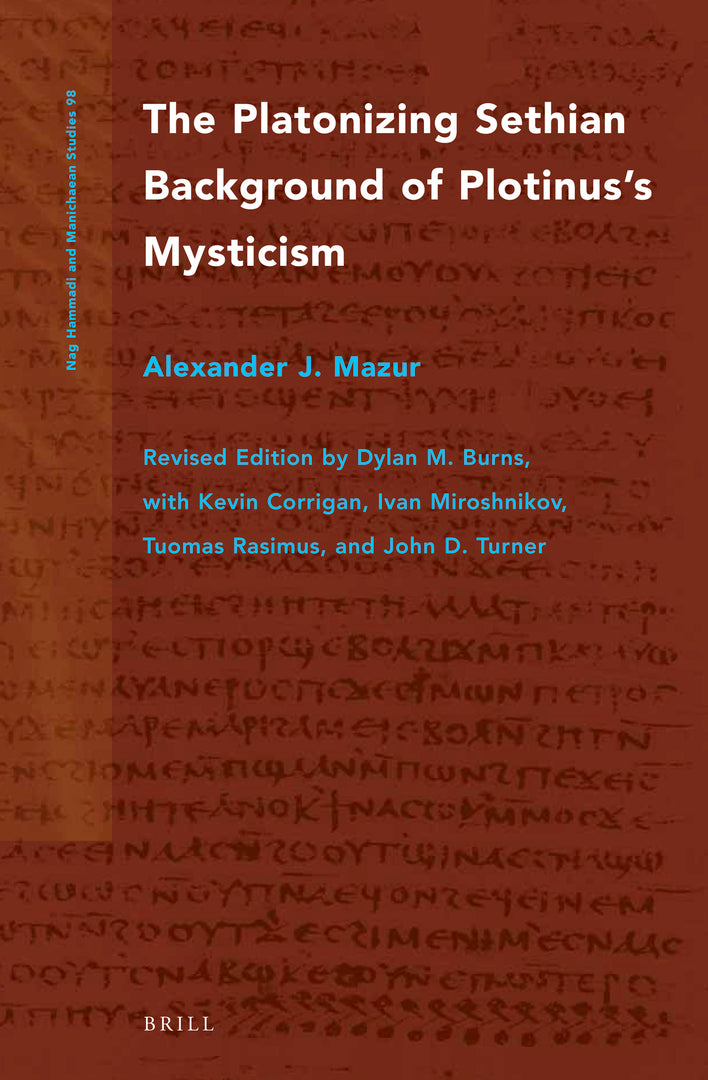
In The Platonizing Sethian Background of Plotinus’s Mysticism, Zeke Mazur offers a radical reconceptualization of Plotinus with reference to Gnostic thought and praxis.
A crucial element in the thought of the third-century CE philosopher Plotinus—his conception of mystical union with the One—cannot be understood solely within the conventional history of philosophy, or as the product of a unique, sui generis psychological propensity. This monograph demonstrates that Plotinus tacitly patterned his mystical ascent to the One on a type of visionary ascent ritual that is first attested in Gnostic sources. These sources include the Platonizing Sethian tractates Zostrianos (NHC VIII,1) and Allogenes (NHC XI,3) of which we have Coptic translations from Nag Hammadi and whose Greek Vorlagen were known to have been read in Plotinus’s school.
A crucial element in the thought of the third-century CE philosopher Plotinus—his conception of mystical union with the One—cannot be understood solely within the conventional history of philosophy, or as the product of a unique, sui generis psychological propensity. This monograph demonstrates that Plotinus tacitly patterned his mystical ascent to the One on a type of visionary ascent ritual that is first attested in Gnostic sources. These sources include the Platonizing Sethian tractates Zostrianos (NHC VIII,1) and Allogenes (NHC XI,3) of which we have Coptic translations from Nag Hammadi and whose Greek Vorlagen were known to have been read in Plotinus’s school.

Price: $188.00
Pages: 338
Publisher: Brill
Imprint: Brill
Publication Date:
15 October 2020
ISBN: 9789004441675
Format: Hardcover

'Speculations, hypotheses, and unanswered questions haunt this fascinating volume. [...] [we can] accept his general claim that Platonizing Sethian spirituality influenced and inspired Plotinus’ own view of the ascent of the soul to the One.'
Mateusz Strozynski, University Adam Mickiewicza, BMCR 2021, https://bmcr.brynmawr.edu/2021/2021.10.36/
Alexander J. ‘Zeke’ Mazur, Ph.D. (2010), University of Chicago, was a postdoctoral fellow at the Department of Philosophy of Université Laval, Québec, Canada. His research and publications focused on Plotinus and the Gnostics as well as other aspects of the relationship between religious praxis and academic philosophy in late antiquity.