


Some error occured while loading the Quick View. Please close the Quick View and try reloading the page.
AJL 2024 Judaica Reference & Bibliography Awards Honorable Mention
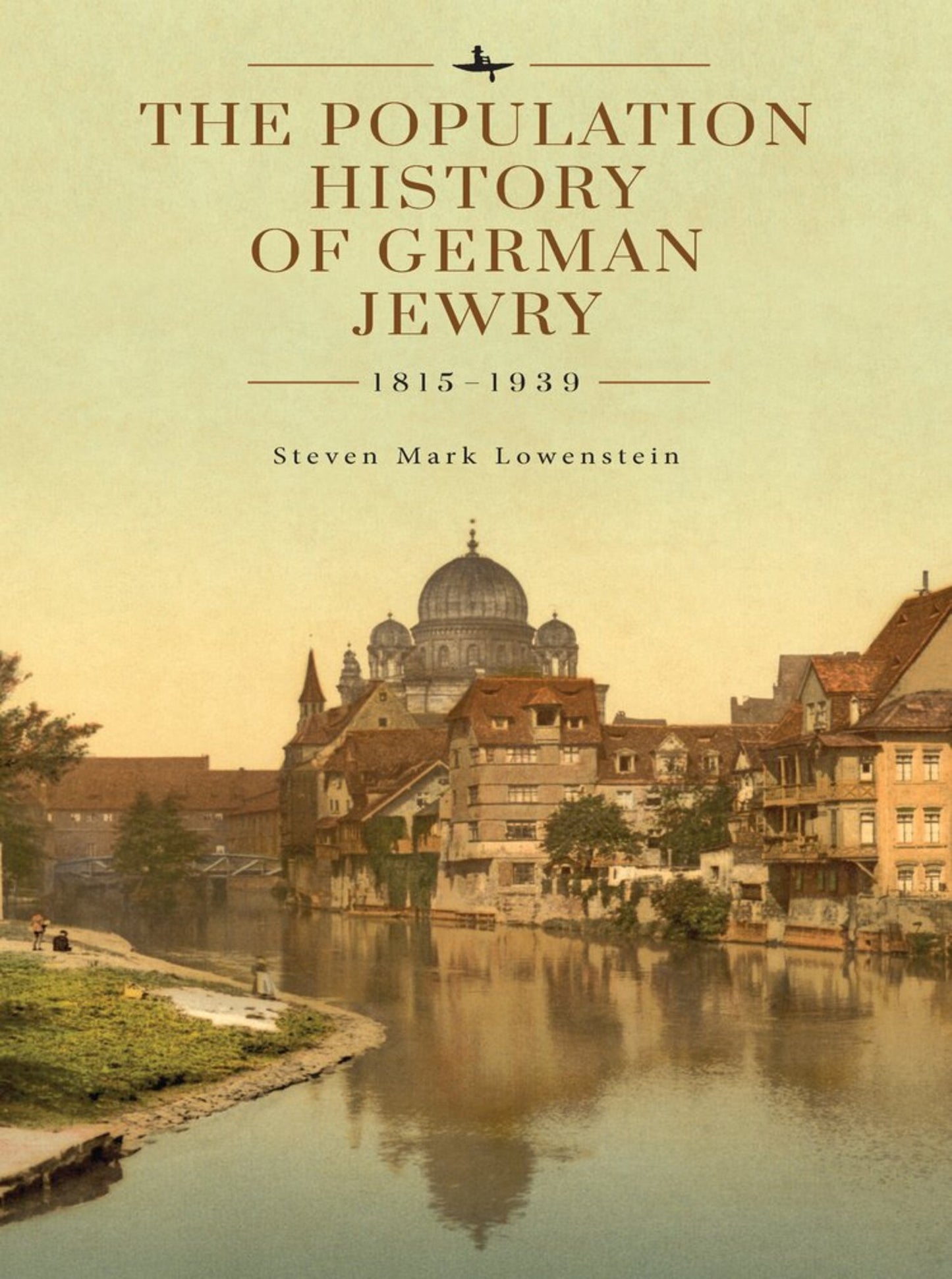
The late Steven Lowenstein was a brilliant social historian who, after retiring from his academic position at the University of Judaism, toiled for years—and up to his final days—to complete this monumental book, which is the definitive demographic history of German Jewry. Lowenstein took the research of Hebrew University demographer Professor Osiel Oscar Schmelz and brought it to life in the daily lived experiences of German Jews.
The book is organized chronologically from Napoleon to German Unification (1815-1871), Imperial Germany and then the post- World War I era through the Nazi period. Later chapters are regional and topical studies.
Lowenstein’s calling as a social historian required him to examines “every leaf on every tree in the forest;” but he never lost sight of the trees and the forest – larger context.
We know the ending of the story of German Jewry. Lowenstein’s great achievement is to document the extraordinary demographic resources that bespoke a vibrant German Jewish culture—and made that ending especially tragic.


“Steven Lowenstein’s monumental study The Population History of German Jewry: 1815–1939 has finally brought demography to center stage…Its encyclopedic detail, comprehensive narrative, nationwide coverage and at the same time attention to regional detail make it a reliable and handy source of information on the basic social processes which shaped Jewish population in German before the Holocaust.”
— Tomasz M. Jankowski, European Journal of Jewish Studies
“This immaculate work of scholarship and statistical gathering is also an act of scholarly devotion. Not only is this work a posthumous tribute to Steven Mark Lowenstein, it is also based on the work of the late Hebrew University demographer Osiel Oscar Schmelz. The resulting book is a tribute to two extraordinary scholars and to scholarly cooperation itself.”
— AJL 2024 Judaica Reference & Bibliography Awards Committee
“This monumental work by the eminent social historian, Steven Lowenstein (1945–2020), appears posthumously; with his early loss, Jewish Studies has lost a prodigious and pathbreaking researcher. The book is based on the huge documentary collections and research of Usiel Oscar Schmelz, a pioneering demographer of Jewry, left unfinished at his death. These Lowenstein supplemented by massive further research and reorganization….The old adage, ‘anecdotes do not data make,’ well sums up Lowenstein’s book, which is about data: precise, specific, and substantiated.”
— Shulamit S. Magnus, Jewish History
“Steven Lowenstein’s landmark volume presents the history of German Jewry from the early 19th century into the Nazi era through the prism of shifting population patterns. Replete with an incomparable array of data, the book’s meticulous narrative also serves as a memorial to a diverse Jewish community whose history reflected the triumphs and tragedies of the modern Jewish experience.”
— Jack Wertheimer, Professor of American Jewish History, The Jewish Theological Seminary
“The pioneering research of Usiel Oscar Schmelz and Steven Lowenstein provides a new dimension for German-Jewish History. Instead of relying on a few personal accounts and anecdotal evidence, this book constitutes a tool to decipher the complete picture of the German-Jewish community. It is an indispensable source for everyone interested in the modern Jewish experience.”
— Michael Brenner, President of the International Leo Baeck Institute for the Research of German-Jewish History and Culture
Professor Steven Lowenstein was Isadore Levine Professor of Jewish History at the University of Judaism (now American Jewish University). He was recognized as one of the most innovative practitioners of German-Jewish social and authored important works in the field including Frankfurt on the Hudson: The German-Jewish Community of Washington Heights, 1933-1983, The Berlin Jewish Community: Enlightenment, Family and Crisis, 1770-1830, and the award-winning Jewish Cultural Tapestry. Following retirement, he became a social worker, working on Skid Row in Los Angeles, and completing this book.
Foreword (Prof. Sergio DellaPergola, the Hebrew University of Jerusalem)
Preface 1. The Life and Work of Steven M. Lowenstein z”l (1945–2020): “From Washington Heights to Skid Row—a Life of Learning and Doing” (David N. Myers, UCLA)
Preface 2. Steven Lowenstein’s Demographic History (Michael Berenbaum, American Jewish University)
Acknowledgments
Editors’ Note
Introduction
CHRONOLOGICAL SECTION
1. From the Fall of Napoleon to the Unification of Germany (1815–1871)
2. German Jewish Population Changes in Imperial Germany (1871–1918)
3. From the “Demographic Crisis” of the 1920s to the Flight to Escape after 1933
TOPICAL SECTION
4. Natural Growth and Changes in the German Jewish Family
5. Changing Age Structure
6. Conversion and Intermarriage
7. Migration—Overall Trends and Internal Migration
8. Immigration and Emigration
9. From Countryside to City: Urbanization and the Survival of Small-Town Jewish Communities
10. Jewish Residential Concentration in German Cities
REGIONAL SECTION
11. The Eastern Provinces
12. Central and Northwestern Germany—from Sparse Jewish Density to an Urban and Immigrant Center
13. Western Germany
14. Southern Germany
Conclusions
Bibliography
Geographic names in German and English (Alphabetized in German)
A Note on Discrepancies