


Some error occured while loading the Quick View. Please close the Quick View and try reloading the page.
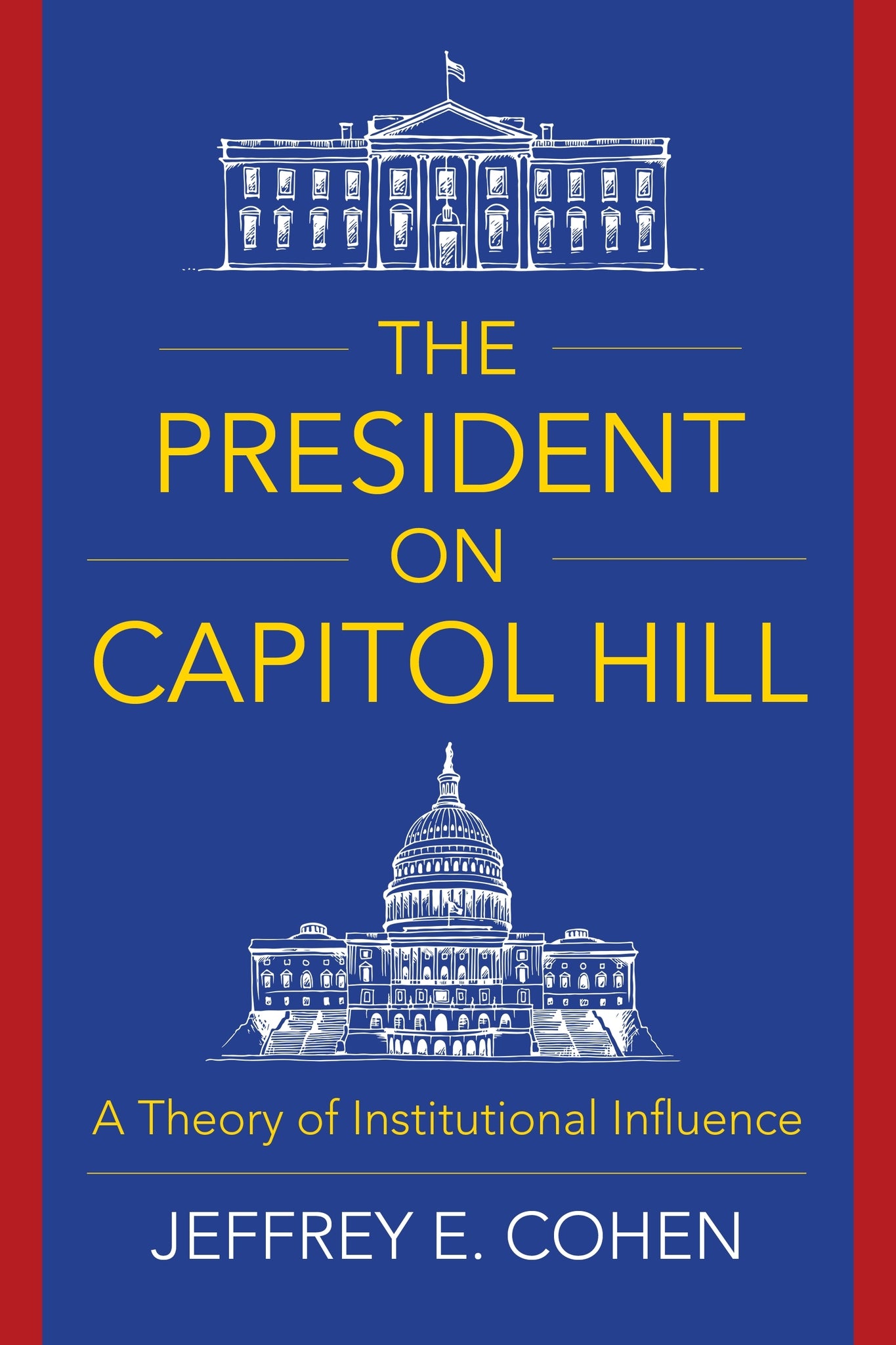
Can presidents influence whether Congress enacts their agenda? Most research on presidential-congressional relations suggests that presidents have little if any influence on Congress. Instead, structural factors like party control largely determine the fate of the president’s legislative agenda. In The President on Capitol Hill, Jeffrey E. Cohen challenges this conventional view, arguing that existing research has underestimated the president’s power to sway Congress and developing a new theory of presidential influence.
Cohen demonstrates that by taking a position, the president converts an issue from a nonpresidential into a presidential one, which leads members of Congress to consider the president’s views when deciding how to vote. Presidential position taking also converts the factors that normally affect roll call voting—such as party, public opinion, and policy type—into resources that presidents can leverage to influence the vote. By testing all House roll calls from 1877 to 2012, Cohen finds that not only do presidents have more influence than previously thought, but through their influence, they can affect the substance of public policy. The President on Capitol Hill offers a new perspective on presidential-congressional relations, showing that presidents are not simply captives of larger political forces but rather major players in the legislative process.


Cohen offers one of the most clearly articulated theories of presidential influence that is distinct from presidential success. His book is the first attempt at conceptually relating many presidential lobbying strategies into one unified framework. This is the most thorough treatment of these issues and will surely be a contribution to the literature in its own right.
— Sharece Thrower, Vanderbilt University
Few scholars of the American presidency have written as widely or as prodigiously as Jeffrey Cohen. In this, his latest, Cohen turns his attention to the effects of presidential lobbying and position taking on Congress and the public. Whereas many scholars see a presidency consigned to, and even subjugated by, a larger political environment, Cohen finds evidence of influence. Success doesn’t just depend upon the hands that presidents are dealt. It depends on how presidents play them.
— William Howell, University of Chicago
Instead of obsessing over presidential winners and losers, Jeffrey E. Cohen focuses our attention on the president’s role in the production of public policy and in the larger political system. He deftly theorizes the bargaining strategies presidents use and presents new evidence about how and to what effect presidents employ the levers of presidential influence. Well-written and clear-eyed, The President on Capitol Hill brings fresh and well-deserved attention to the president’s institutional advantages in a system of separated powers.
— Jon C. Rogowski, Harvard University
Cohen has written another important book that will change how scholars think of the relationship between Congress and the president. Theoretically innovative and empirically rich, this book brings us new insights into the eternal black box of presidential influence.
— Andrew Reeves, Washington University in St. Louis
Rigorous and persuasive.
A must-read for students of the American presidency.
Required reading for scholars studying presidential-congressional relations. The book will prove useful in graduate seminars on the presidency and/or Congress. It may also be useful in an advanced undergraduate presidency course.
Acknowledgments
1. On Presidential Influence in Congress
2. A Theory of Presidential Influence in Congress
3. Estimating Presidential Influence in Congress
4. Presidential Influence in the House in the Modern Era
5. Political Parties as a Source of Presidential Influence
6. The Two Presidencies and Presidential Influence
7. Public Opinion as a Source of Presidential Influence
8. Presidential Lobbying Effort and Influence
9. Modernity and Presidential Influence in Congress
10. Comparing the Influence of Premodern and Modern Presidents
11. Conclusions: Presidential Influence in Congress
Notes
References
Index