


Some error occured while loading the Quick View. Please close the Quick View and try reloading the page.
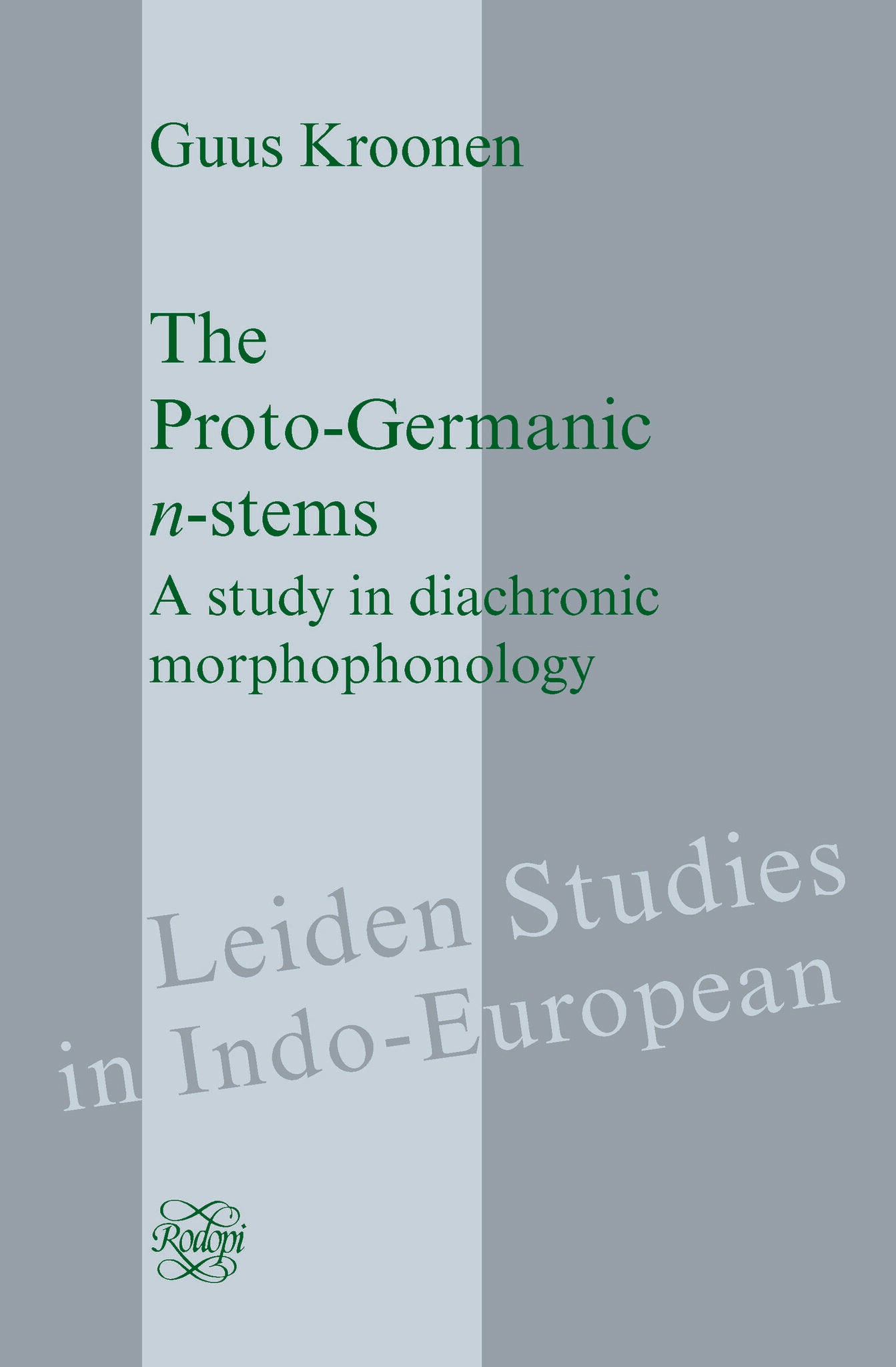
The n-stems are an intriguing part of Proto-Germanic morphology. Unlike any other noun class, the n-stems have roots that are characterized by systematic consonant and vowel alternations across the different Germanic dialects. This monograph represents a diachronic investigation of this root variation. It traces back the Germanic n-stems to their Indo-European origin, and clarifies their formal characteristics by an interaction of sound law and analogy. This book therefore is not just an attempt to account for the typology of the Germanic n-stems, but also a case study of the impact that sound change may have on the evolution of morphology and derivation.

Price: $175.00
Pages: 424
Publisher: Brill
Imprint: Brill
Publication Date:
01 January 2011
ISBN: 9789042032927
Format: Hardcover

”Alles in allem handelt es sich um eine Studie von hohem Wert” in: Germanistik, 2012, Band 53, Heft 1-2
“Kroonen’s study is well researched and carefully presented. He offers a wealth of data… The author has made important connections between the various items ha has collected from the different Germanic languages, including modern dialects, and used reasoned judgment in their evaluation. The book will prove useful not only to scholars of Germanic and Indo-European phonology and morphology, but also those interested in Germanic etymology.”
NOWELE 67:2 (2014)
“Kroonen’s study is well researched and carefully presented. He offers a wealth of data… The author has made important connections between the various items ha has collected from the different Germanic languages, including modern dialects, and used reasoned judgment in their evaluation. The book will prove useful not only to scholars of Germanic and Indo-European phonology and morphology, but also those interested in Germanic etymology.”
NOWELE 67:2 (2014)
Guus Kroonen’s research focuses on the historical linguistics of the Germanic languages, both from the modern dialectal and the Indo-European perspective. He studied Scandinavian languages in Amsterdam and Comparative Indo-European linguistics in Leiden, where he also obtained his doctoral degree. He is a contributor to the Leiden Indo-European Etymological Dictionary, for which he has prepared the Etymological Dictionary of Proto-Germanic (Brill, forthcoming).