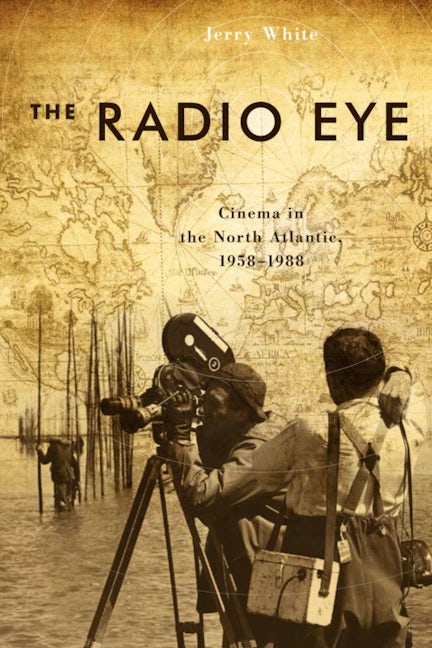
The Radio Eye: Cinema in the North Atlantic, 1958–1988, examines the way in which media experiments in Quebec, Newfoundland, the Faroe Islands, and the Irish-Gaelic-speaking communities of Ireland use film, video, and television to advocate for marginalized communities and often for “smaller languages.”
The Radio Eye is not, however, a set of isolated case studies. Author Jerry White illustrates the degree to which these experiments are interconnected, sometimes implicitly but more often quite explicitly. Media makers in the North Atlantic during the period 1958–1988 were very aware of each other’s cultures and aspirations, and, by structuring the book in two interlocking parts, White illustrates the degree to which a common project emerged during those three decades.
The book is bound together by White’s belief that these experiments are following in the idealism of Soviet silent filmmaker Dziga Vertov, who wrote about his notion of “the Radio Eye.” White also puts these experiments in the context of work by the Cuban filmmaker and theorist Julio García Espinosa and his notion of “imperfect cinema,” Jürgen Habermas and his notions of the “public sphere,” and Édourard Glissant’s ideas about “créolité” as the defining aspect of modern culture. This is a genuinely internationalist moment, and these experiments are in conversation with a wide array of thought across a number of languages.
Price: $89.99
Pages: 285
Publisher: Wilfrid Laurier University Press
Imprint: Wilfrid Laurier University Press
Series: Film and Media Studies
Publication Date:
17 November 2009
Trim Size: 9.00 X 6.00 in
ISBN: 9781554581788
Format: Hardcover
BISACs:
Film history, theory or criticism, PERFORMING ARTS / Television / History & Criticism, SOCIAL SCIENCE / Media Studies

White's book...is as rich in its source documentation...as it is innovative in its judgement of geographic, aesthetic, and political interactivity, marking this text as one that will no doubt engage scholars, producers, and activists alike.... Finding ways to investigate federally funded cultural institutions without reifying the national as a site of inquiry remains difficult; this is particularly true when it comes to decentralizing the very cultural institutions one means to critique. How to move beyond this circular line of critique? I admit my own reliance on these frameworks, which is promoted by the availability of the rich, well-kept, and expertly staffed archives of major cultural institutions in Canada. Yet equally important to exposing the dominant and demonstrating its occlusion of the marginal and interaction with the resistant is engaging with the edges of cultural production on their own terms. A study such as White's should be commended in this respect, since it depends on a complicated research process that included digging up decaying videotapes in basements and garages in order to chart the history of pirate television in the Gaeltacht.... As historians know well, finding ways to tell the stories of people and plaves that have been historically under-represented in dominant discourses (or archival collections) is deeply connected to present-day battles for social justice. So is recognizing spaces in which marginalized and resistant communities speak on their own terms. These studies and spaces are possible through such strategies as oral history and in mining the personal archives of cultural producers active in social movements, although this is not to suggest that such approaches are always easy, achievable, or even desirable. Often the best strategy is accepting that the players involved in such movements disseminate their own knowledge beyond the academy, in ways that might transform academic conceptions of who holds the reins of knowledge itself. And so there remain underexplored possibilities in writing the history of screen media, among other forms of cultural production, which can help film and media historians ask more complex questions about what culture is and what we do in its name.
Jerry White teaches and writes about cinema, literature, and culture in Quebec, Canada, and Europe. He is the author of numerous books on film, including WLU Press-published The Radio Eye: Cinema in the North Atlantic, 1958-1988, Two Bicycles: The Work of Jean-Luc Godard and Anne-Marie Miéville, and Stan Brakhage in Rolling Stock, 1980-1990.
Table of Contents for The Radio Eye: Cinema in the North Atlantic, 1958–1988 by Jerry White
Acknowledgements
Notes on Sources and Language
Introduction
Part 1. The Islands
1 | Pierre Perrault
2 | The NFB’s Newfoundland Project
3 | Sjónvarpsfelagið í Havn
Part 2. The Gaeltacht
An Introduction to the Gaeltacht
4 | Desmond Fennell and Pierre Perrault
5 | Cinegael and the Newfoundland Project
6 | Teilifís na Gaeltachta and the Faroes
Conclusion
Bibliography
Index