


Some error occured while loading the Quick View. Please close the Quick View and try reloading the page.
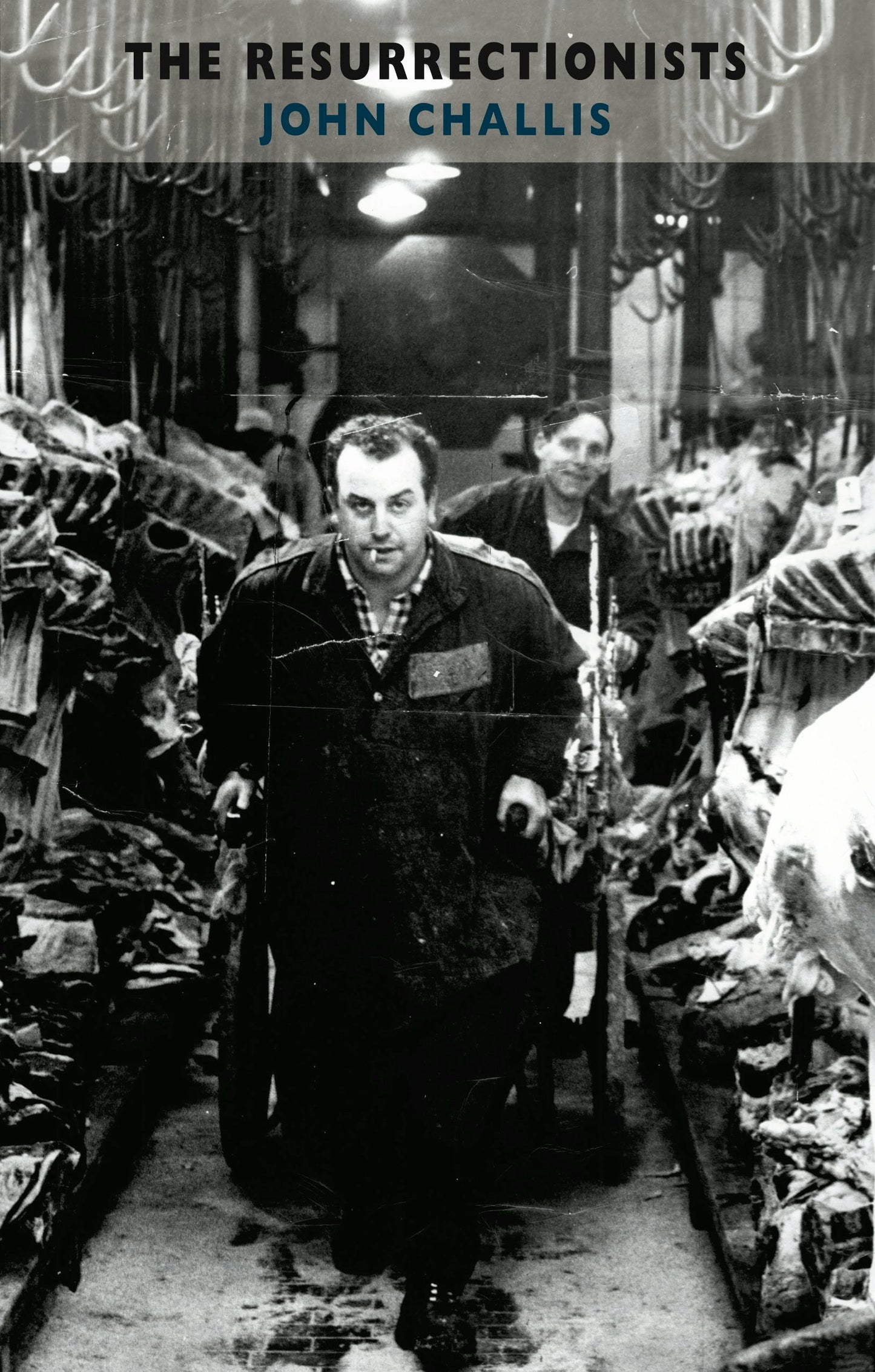


‘Many of the poems in The Resurrectionists by John Challis are situated in the City of London, the West End and East London/Essex borderlands – my own home turf, until recently. These poems are rooted in relationships with family often departed, with old trades and night trading. The cover is brilliant, a photo of men at work in Smithfield’s market. Many poems offer us what this image does: a direct gaze, wit, labour, ghosts and dead meat. The real narrative of a city is not in its architecture, transport, incarcerations or commerce (although all those are here too) but in the flesh and blood – the workers. These are incredibly well-tailored poems, with humanity that acknowledges men’s fears and their cousin vulnerabilities. – Jane Wilkinson, Poetry News (Best poetry books of the year 2021)
'In his debut collection, The Resurrectionists, John Challis reminds us how both personal and collective histories remain a part of our present.... this is poetry as archaeology, though with a lyric alchemy that can conjure “a heap / of gangrenous bodies” at a plague-pit excavation in modern London. Challis commemorates the lives of working London people – butchers in Smithfield market, a cabbie father, “barrow boys and cockle pickers” – in poems that reflect on class politics while generally avoiding nostalgia.... The Resurrectionists is alive to both the individual moment and the long perspective.' - Ben Wilkinson, The Guardian, best recent poetry
‘Challis often writes about his family – much of his acclaimed first collection, The Resurrectionists (2021), involved his father, a London cabbie – and writing about close relatives can involve some tactful manoeuvring.' - Tristram Fane Saunders, The Telegraph (Poem of the Week)
'John Challis’ first full length collection The Resurrectionists occupies the liminal space between the living and the dead. The industrial past and its violent landscapes are not finished with us, but instead spring forth into the present moment where “time alone can be itself, bait and cast a line”. The Resurrectionists explores how the past comes closest when the future is at hand: “the dead leaned in... as though to kiss our baby’s head.” - Poetry Book Society Bulletin, Summer 2021
‘The Resurrectionists is the outstanding first full collection by the North East-based poet John Challis. These are engrossing and vivid poems that capture often disquieting little-told stories of London, full of narrative drive and a variety of voices that feel real and lived.’ - Will Mackie, New Writing North (New Poetry from the North, Summer 2021)
'The title of John Challis’s The Resurrectionists alludes to the ancient profession of body-snatching, and the collection is concerned with all kinds of disinterment and revitalisation. In the title poem, the speaker shows us a corpse, filched for experimental resurrection, “jerking on the table / at the dawn of electricity” and asserts: “I too feel the urge to make something / out of nothing and profit from this work: / the page my barrow and my charge the word.” The double meaning of “barrow” is salient: it’s not merely a burial place but a mobile market stall, one of the many images that bring a lost or fading working-class London memorably to life.' - Carol Rumens, Poem of the Week, The Guardian
‘A resurrectionist was a body snatcher, with a particular market for his swag, namely anatomical education and research. Likewise, Challis’s poetic purpose is to unearth past lives, and study their components....There is nothing glib here, and the absence of irony, even when being critical of contemporary environments, generates a sincerity that is in keeping with the poet’s misgivings about modernity, and with his warmth towards the city and its workers.’ – Stephen Payne, The Friday Poem
‘...the second half of The Resurrectionists allows new life to creep in... and there is a glimpse of something spiritual: the astonishingly beautiful unrhymed sonnet, ‘Naming the Light’, the delicate tracery of ‘Night Change’... there is enough here to make clear that John Challis is one of Britain’s most promising young poets.’ – John Greening, Poetry Salzburg Review
‘In John Challis’s superb first collection, the past has not finished with us. It pursues and provokes and questions what we’re about. Entire vanished or vanishing worlds of work – on the East End docks, at Smithfield, in the pre-Murdoch print, at the wheel of a black cab – reveal vivid traffic between the living and the dead. In rich, urgent combinations of the dramatic and the lyric, Challis adds new energy to the poetry of history, in the tradition of Harrison, Smith, Dunn and Wainwright. In its embrace of both the political and the metaphysical, and in its tender regard for ordinary life the book is both timely and necessary.’ – Sean O’Brien
‘These poems throw a great arc of light out of the city’s storeyed past into the present, place, trades, family, vulnerable fatherhood. Here, balanced at the very edge, where “light will fall out of our language”, John Challis shines his words into the workings of the heart and of nature, with all their unpredictable transformations.’ – Imtiaz Dharker
'John Challis writes with beauty and passion of the so-called every day… he gives us all majesty and a kind of shimmering quality…’ – Ian McMillan
Born in London in 1984, John Challis has held several residencies. In 2015 he was a poet-in-residence with the Northern Poetry Library and chosen as one of the Poetry Trust’s Aldeburgh Eight. His other residences have include ones at Keats Shelley House in Rome, and at Seaton Delaval Hall, a National Trust property in Northumberland, which produced Hallsong, a collaboration with filmmaker Christo Wallers. His pamphlet, The Black Cab (Poetry Salzburg, 2017), was a 2019 New Writing North Read Regional title. His first book-length collection, The Resurrectionists, was published by Bloodaxe in 2021, and will be followed by his second, The Green Parcel, in 2026.
His poems have been broadcast on BBC Radio 4, and published in journals including Magma, The North, Poetry London, The Rialto, Stand, and elsewhere. John also writes reviews and essays, most recently for Wild Court, PN Review, Poetry Salzburg Review and The Poetry School. He has received a Pushcart Prize and a Northern Writers’ Award for his work. He holds a PhD in Creative Writing from Newcastle University, where worked as a Research Associate, and he now teaches at York St John University. He lives in York.